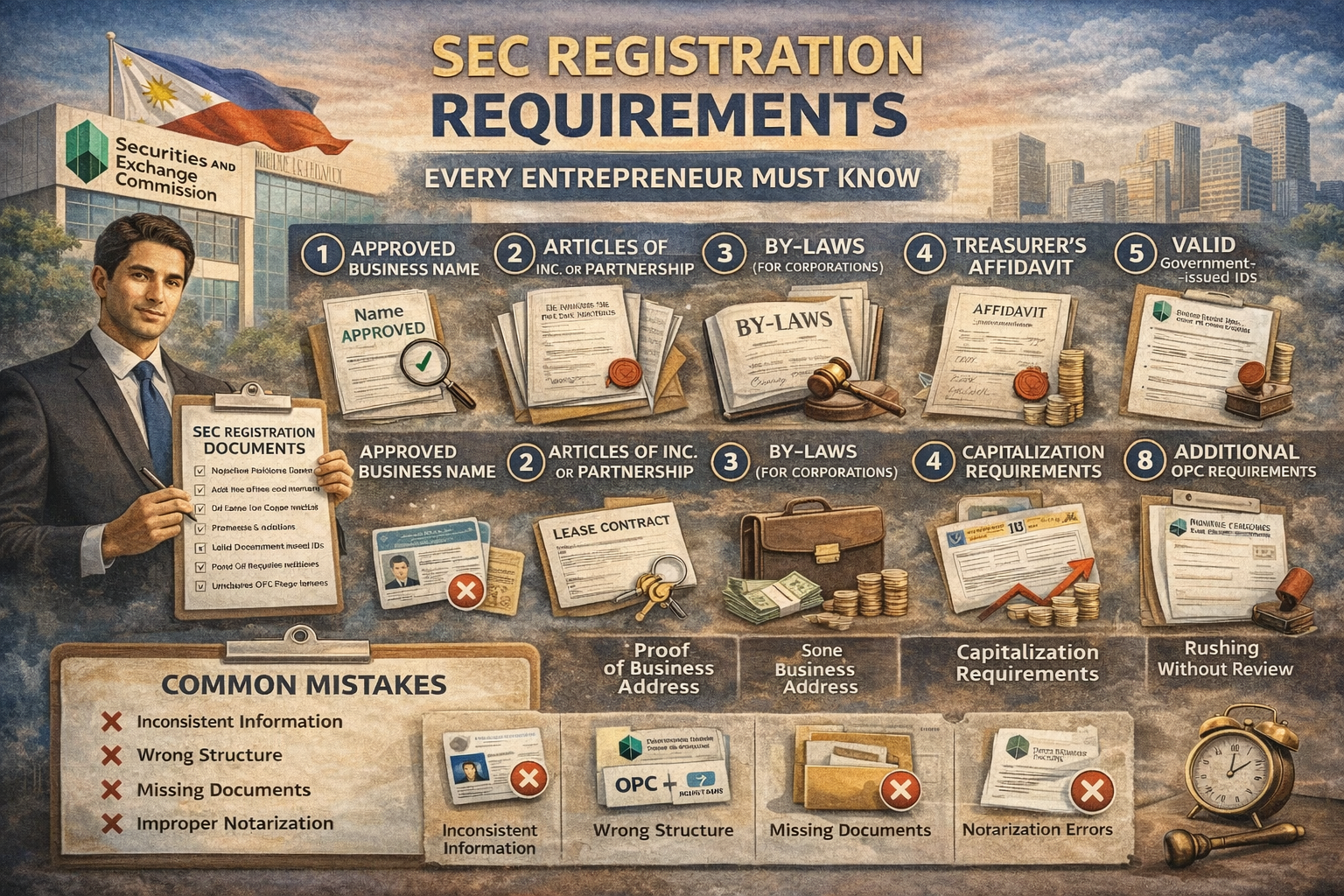
Starting a business without understanding SEC registration requirements is one of the fastest ways to delay—or legally compromise—your venture. As a lawyer assisting entrepreneurs in the Philippines, I can confidently say this:
Most SEC registration problems arise not from complexity, but from lack of preparation.
This guide outlines everything every entrepreneur must know before registering with the Securities and Exchange Commission (SEC)—clearly, accurately, and in plain language.
Who Is Required to Register with the SEC?
SEC registration is mandatory if your business will operate as:
Corporation
One Person Corporation (OPC)
Partnership
📌 Sole proprietors register with DTI, not SEC.
If your business falls under any of the above, SEC registration is not optional—it is required by law.
Core SEC Registration Requirements
While requirements vary slightly depending on structure, the following are the essential documents every entrepreneur must prepare.
1. Approved Business Name
Your proposed business name must be:
Unique
Not confusingly similar to existing entities
Not misleading or restricted
📌 Legal tip: Always prepare at least three (3) name options to avoid rejection.
2. Articles of Incorporation or Partnership
This is the most important legal document of your business. It defines:
Business purpose
Capital structure
Ownership
Governance rules
❗ Poorly drafted Articles are the top cause of SEC delays and rejections.
3. By-Laws (for Corporations)
By-Laws outline how your corporation is governed, including:
Duties of directors and officers
Meeting rules
Voting procedures
📌 OPCs are generally exempt from By-Laws requirements.
4. Treasurer’s Affidavit
This sworn statement confirms that:
The stated capital exists
Initial subscriptions have been paid
📌 False declarations expose incorporators to legal liability.
5. Valid Government-Issued IDs
SEC requires clear copies of valid IDs from:
Incorporators
Directors
Officers
Nominee and alternate nominee (for OPC)
Inconsistent names or signatures are common causes of delay.
6. Proof of Business Address
Acceptable documents include:
Lease contract
Proof of property ownership
Authorization to use address
📌 Addresses must be consistent across all submitted documents.
7. Capitalization Requirements
While many businesses have no minimum capital, certain industries (e.g., lending, recruitment, foreign-owned companies) have specific capital requirements.
❌ Declaring capital without verification can result in rejection.
8. Additional Requirements for OPCs
If registering as an OPC, you must also submit:
Nominee and alternate nominee details
Consent forms
Undertakings required by law
📌 These ensure business continuity in case of incapacity or death.
Common SEC Registration Mistakes Entrepreneurs Make
🚫 Inconsistent information across documents
🚫 Choosing the wrong business structure
🚫 Improper notarization
🚫 Missing supporting documents
🚫 Rushing submission without review
📌 In law, accuracy matters more than speed.
What Happens After SEC Registration?
SEC approval is only the first legal step. Entrepreneurs must still complete:
BIR registration (TIN, receipts, books of accounts)
Local business permits
SSS, PhilHealth, Pag-IBIG registration
Ongoing compliance and reporting
Skipping any of these exposes your business to penalties—even if SEC-registered.
Why Legal Guidance Matters
SEC registration creates your business’s legal identity. Errors made at this stage can:
Delay operations
Affect banking and permits
Complicate future expansion
Increase compliance costs
📌 A legally sound registration today prevents expensive corrections tomorrow.
Final Thoughts
Understanding SEC registration requirements is not just about compliance—it is about building a business on solid legal ground.
📌 Every successful enterprise starts with proper registration.
If you are an entrepreneur planning to grow, hire, or attract investors, take SEC registration seriously—and do it right the first time.
Navigating the business landscape in the Philippines can be both rewarding and intricate. Whether you’re embarking on a new venture or scaling up, ensuring that your corporate endeavors are in line with local regulations is paramount.
At CBOS Business Solutions Inc., we pride ourselves on simplifying these processes for our clients. As a seasoned professional services company, we offer comprehensive assistance with SEC Registration, Visa processing, and a myriad of other essential business requirements. Our team of experts is dedicated to ensuring that your business is compliant, well-established, and ready to thrive in the Philippine market.
Why venture into the complexities of business registration and compliance alone? Allow our team to guide you every step of the way. After all, your success is our commitment.
Get in touch today and let us be your partner in achieving your business goals in the Philippines.
Email Address: gerald.bernardo@cbos.com.ph
Mobile No.: +639270032851
You can also click this link to schedule a meeting.
Leave a Reply