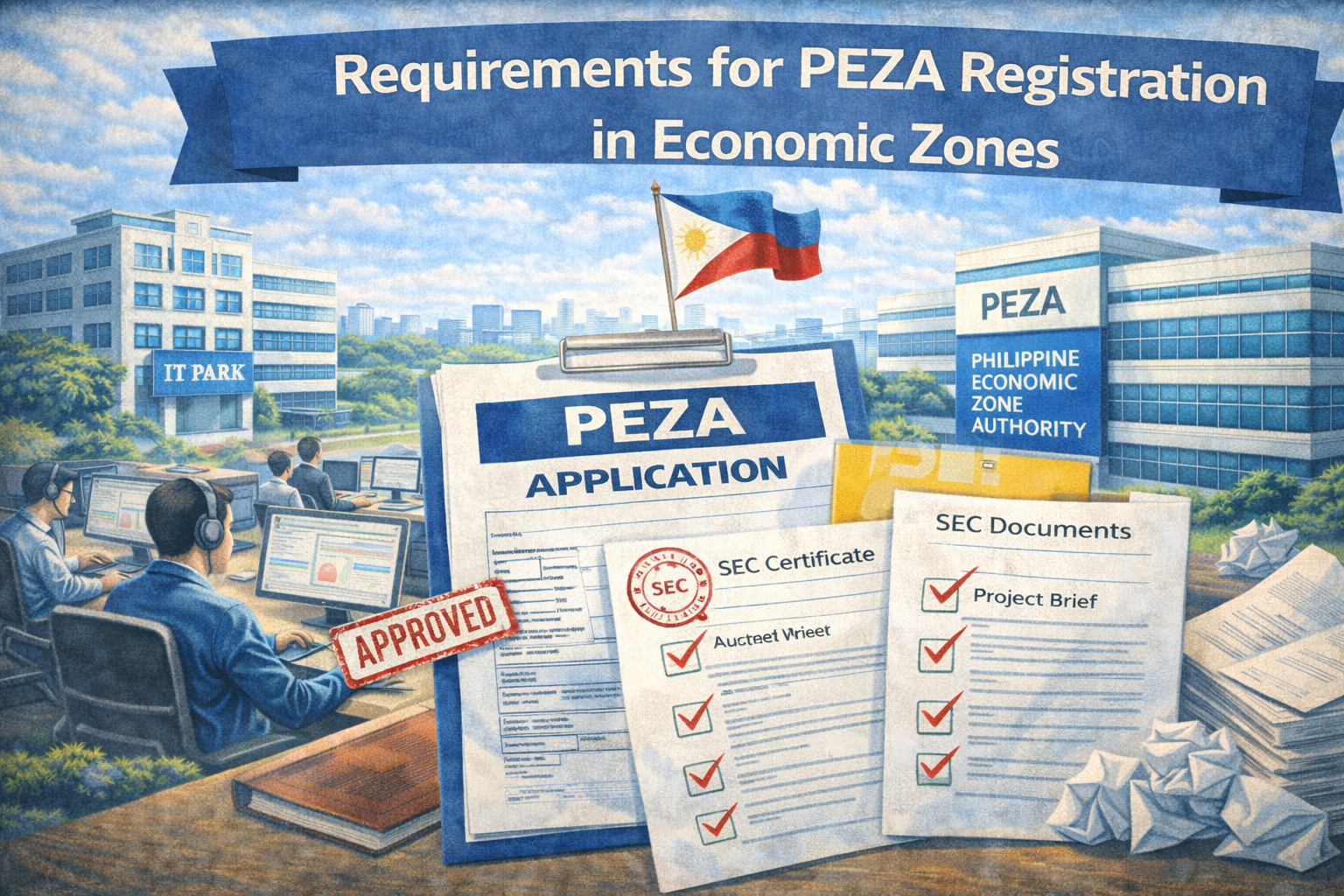
PEZA registration is often advertised as a gateway to tax incentives and smoother operations—and that is true. But legally speaking, PEZA approval is earned, not automatic.
As a lawyer assisting companies entering Philippine economic zones, I always remind clients of this rule:
PEZA incentives are granted only after strict compliance with specific legal and operational requirements.
If you are planning to locate your business inside a PEZA-accredited economic zone, here is a clear and practical guide to the requirements for PEZA registration—explained without unnecessary jargon.
What Is PEZA Registration?
PEZA registration means registering your business with the Philippine Economic Zone Authority (PEZA) so you can legally operate inside an accredited economic zone or IT park and enjoy special fiscal and non-fiscal incentives.
Only businesses that meet PEZA’s qualification and documentation standards are approved.
Core Eligibility Requirement: Business Must Qualify
Before documents are even reviewed, PEZA checks eligibility.
Your business must generally be:
Export-oriented (goods or services), or
IT-BPM, software, shared services, or technology-driven, or
A support enterprise serving PEZA-registered companies
📌 Purely domestic, retail, or consumer-facing businesses usually do not qualify.
Requirement 1: SEC Registration (Mandatory)
All PEZA applicants must first be registered with the Securities and Exchange Commission (SEC) as:
Corporation, or
One Person Corporation (OPC)
Your Articles of Incorporation must clearly state:
Export, IT, or PEZA-aligned activities
Authority to operate inside economic zones
📌 If your SEC purpose does not align with PEZA activity, your application will be delayed or denied.
Requirement 2: Location Inside a PEZA-Accredited Economic Zone
PEZA registration requires a physical location within:
A PEZA-accredited economic zone, or
A PEZA-registered IT park or building
You must submit:
A signed lease contract, or
A location endorsement from the zone developer
📌 Home-based, virtual, or non-accredited locations are not acceptable.
Requirement 3: PEZA Application Form and Project Brief
The Project Brief is the most important PEZA document.
It must clearly explain:
Nature of business operations
Export or service activities
Target markets
Capital investment
Employment projections
📌 Inconsistencies or unrealistic projections are a common cause of PEZA delays.
Requirement 4: Capitalization and Financial Projections
PEZA evaluates whether your business is financially viable.
You will need:
Declared paid-up capital
Projected income and expenses
Employment cost estimates
📌 Figures must be realistic and consistent with your business size and activity.
Requirement 5: Ownership and Nationality Information
Applicants must disclose:
Ownership structure
Nationality of shareholders
Compliance with foreign ownership rules (if applicable)
📌 PEZA allows 100% foreign ownership for most qualified activities, subject to compliance.
Requirement 6: Supporting Corporate Documents
Typical supporting documents include:
SEC Certificate of Registration
Articles of Incorporation
Treasurer’s Affidavit
Board Resolution authorizing PEZA application
Valid IDs of officers and signatories
📌 Missing or improperly notarized documents can halt processing.
Requirement 7: Commitment to PEZA Compliance
PEZA approval comes with continuing obligations, such as:
Regular operational reports
Audit and inspection compliance
Employment and export performance targets
📌 PEZA evaluates not just eligibility, but your capacity to comply long-term.
Common Reasons Applications Fail Despite “Complete” Documents
🚫 SEC purpose not PEZA-aligned
🚫 Non-accredited location
🚫 Weak or vague project brief
🚫 Inconsistent financial data
🚫 Underestimating compliance duties
📌 Most denials are preparation issues—not PEZA policy problems.
How Long Does PEZA Registration Take?
For qualified and well-prepared applicants:
🕒 1–3 months, depending on complexity and board schedules
📌 Incomplete or inconsistent submissions extend timelines significantly.
Final Thoughts
PEZA registration inside economic zones is highly rewarding—but highly regulated.
📌 Meeting the requirements is not just about paperwork—it is about proving that your business deserves PEZA incentives.
When eligibility, documents, location, and compliance capacity are properly aligned, PEZA registration becomes a powerful advantage for growth, tax efficiency, and global competitiveness.
Navigating the business landscape in the Philippines can be both rewarding and intricate. Whether you’re embarking on a new venture or scaling up, ensuring that your corporate endeavors are in line with local regulations is paramount.
At CBOS Business Solutions Inc., we pride ourselves on simplifying these processes for our clients. As a seasoned professional services company, we offer comprehensive assistance with SEC Registration, Visa processing, and a myriad of other essential business requirements. Our team of experts is dedicated to ensuring that your business is compliant, well-established, and ready to thrive in the Philippine market.
Why venture into the complexities of business registration and compliance alone? Allow our team to guide you every step of the way. After all, your success is our commitment.
Get in touch today and let us be your partner in achieving your business goals in the Philippines.
Email Address: gerald.bernardo@cbos.com.ph
Mobile No.: +639270032851
You can also click this link to schedule a meeting.
Leave a Reply