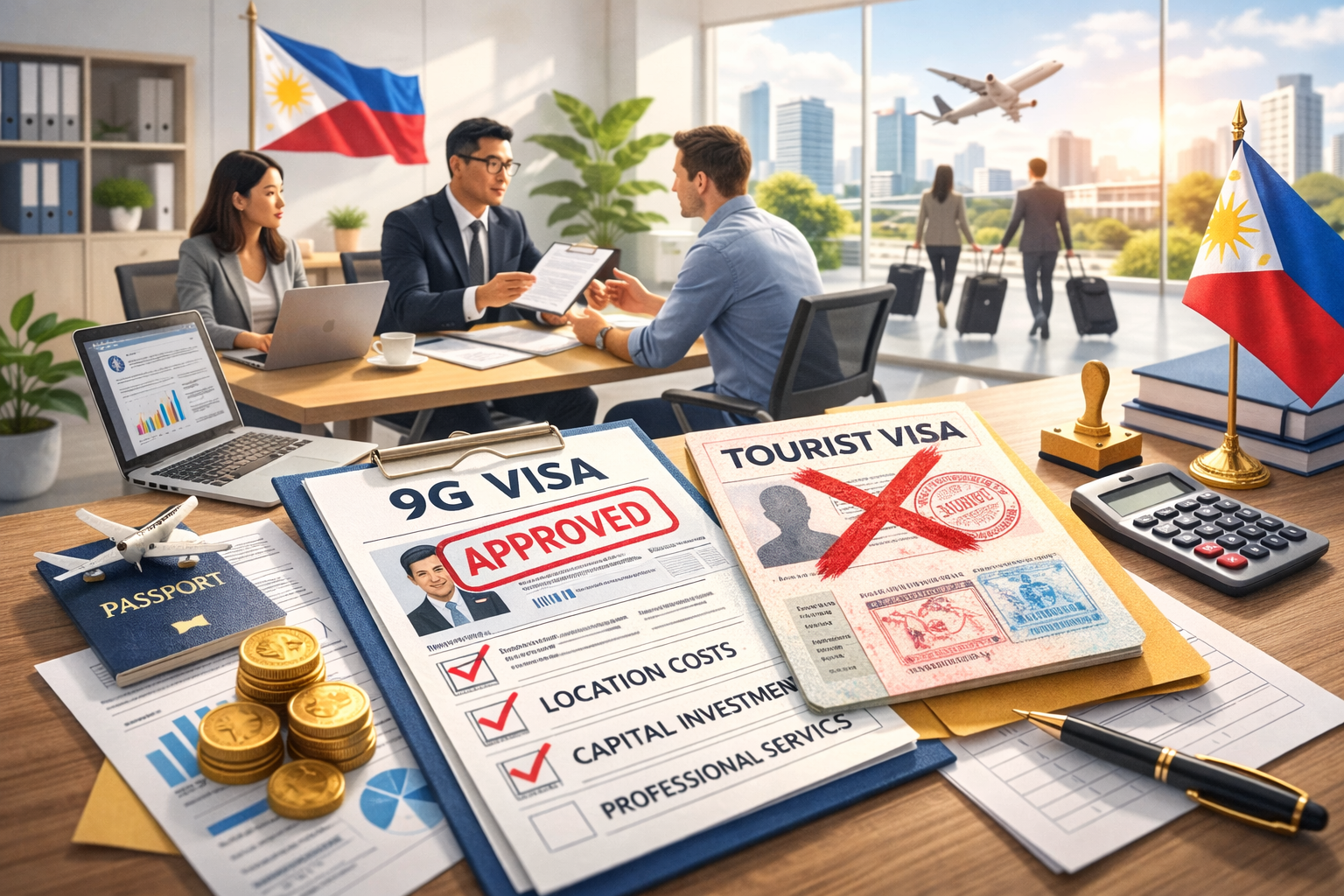
Hiring a foreign national in the Philippines can strengthen your company’s expertise and global reach. However, from a legal standpoint, one mistake can expose your business to penalties:
Allowing a foreign employee to work under a tourist visa.
As a lawyer advising companies on immigration compliance, I must emphasize this clearly:
A tourist visa is not a work permit.
Understanding the difference between a 9G Working Visa and a Tourist Visa is critical for employers who want to remain compliant with Philippine immigration laws.
What Is a 9G Visa?
The 9G Visa—formally known as the Pre-Arranged Employment Visa—is issued to foreign nationals who have secured employment with a Philippine-based company.
It is granted by the Bureau of Immigration (BI) after proper documentation and approval.
Key Features of a 9G Visa:
✔ Allows lawful employment in the Philippines
✔ Valid for the duration of the approved employment contract
✔ Requires employer sponsorship
✔ Linked to a specific company and position
📌 Without a 9G visa, a foreign national cannot legally work in the Philippines.
What Is a Tourist Visa?
A Tourist Visa (commonly under 9A classification) allows a foreign national to:
✔ Enter the Philippines for leisure
✔ Visit family or friends
✔ Conduct limited business meetings
✔ Attend conferences or seminars
However:
❌ It does not allow employment
❌ It does not authorize compensation from a Philippine entity
📌 Working under a tourist visa is considered unauthorized employment.
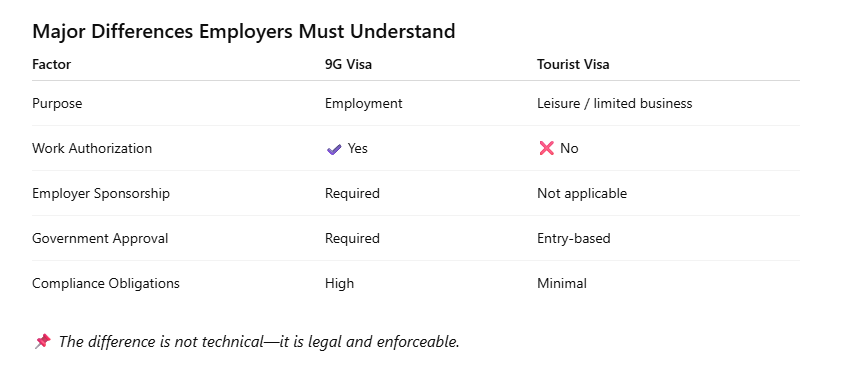
Additional Requirement: Alien Employment Permit (AEP)
Before a 9G visa is approved, the foreign national must usually secure an Alien Employment Permit (AEP) from the Department of Labor and Employment (DOLE).
The AEP confirms that:
The foreign national’s position cannot be filled by a qualified Filipino
The employment complies with labor regulations
📌 The AEP is a prerequisite to the 9G visa process in most cases.
Risks of Allowing Work Under a Tourist Visa
Employers who allow foreign nationals to work under a tourist visa may face:
🚫 Fines and penalties
🚫 Immigration investigations
🚫 Blacklisting of the foreign national
🚫 Deportation orders
🚫 Suspension of company permits
📌 Good faith is not a defense—compliance is mandatory.
Common Employer Misconceptions
❌ “He’s just on probation, so tourist visa is fine.”
❌ “We’re processing the 9G later.”
❌ “He’s only working remotely.”
📌 If the foreign national performs work for your Philippine company, proper work authorization is required.
When Is a Tourist Visa Acceptable?
A tourist visa may be used for:
✔ Short-term visits
✔ Exploratory meetings
✔ Training observation (without compensation)
✔ Contract negotiations
But once actual employment begins, the correct visa must be secured.
Employer Compliance Checklist
✔ Secure an AEP from DOLE
✔ File 9G visa application with BI
✔ Issue a proper employment contract
✔ Monitor visa validity
✔ Avoid allowing work before approval
📌 Immigration compliance protects both employer and employee.
Final Thoughts
The difference between a 9G Visa and a Tourist Visa is simple:
📌 One allows legal employment. The other does not.
For employers hiring foreign nationals in the Philippines, proper visa processing is not optional—it is a legal obligation. Ensuring compliance from the beginning prevents costly penalties and protects your company’s reputation.
Navigating the business landscape in the Philippines can be both rewarding and intricate. Whether you’re embarking on a new venture or scaling up, ensuring that your corporate endeavors are in line with local regulations is paramount.
At CBOS Business Solutions Inc., we pride ourselves on simplifying these processes for our clients. As a seasoned professional services company, we offer comprehensive assistance with SEC Registration, Visa processing, and a myriad of other essential business requirements. Our team of experts is dedicated to ensuring that your business is compliant, well-established, and ready to thrive in the Philippine market.
Why venture into the complexities of business registration and compliance alone? Allow our team to guide you every step of the way. After all, your success is our commitment.
Get in touch today and let us be your partner in achieving your business goals in the Philippines.
Email Address: gerald.bernardo@cbos.com.ph
Mobile No.: +639270032851
You can also click this link to schedule a meeting.
Leave a Reply