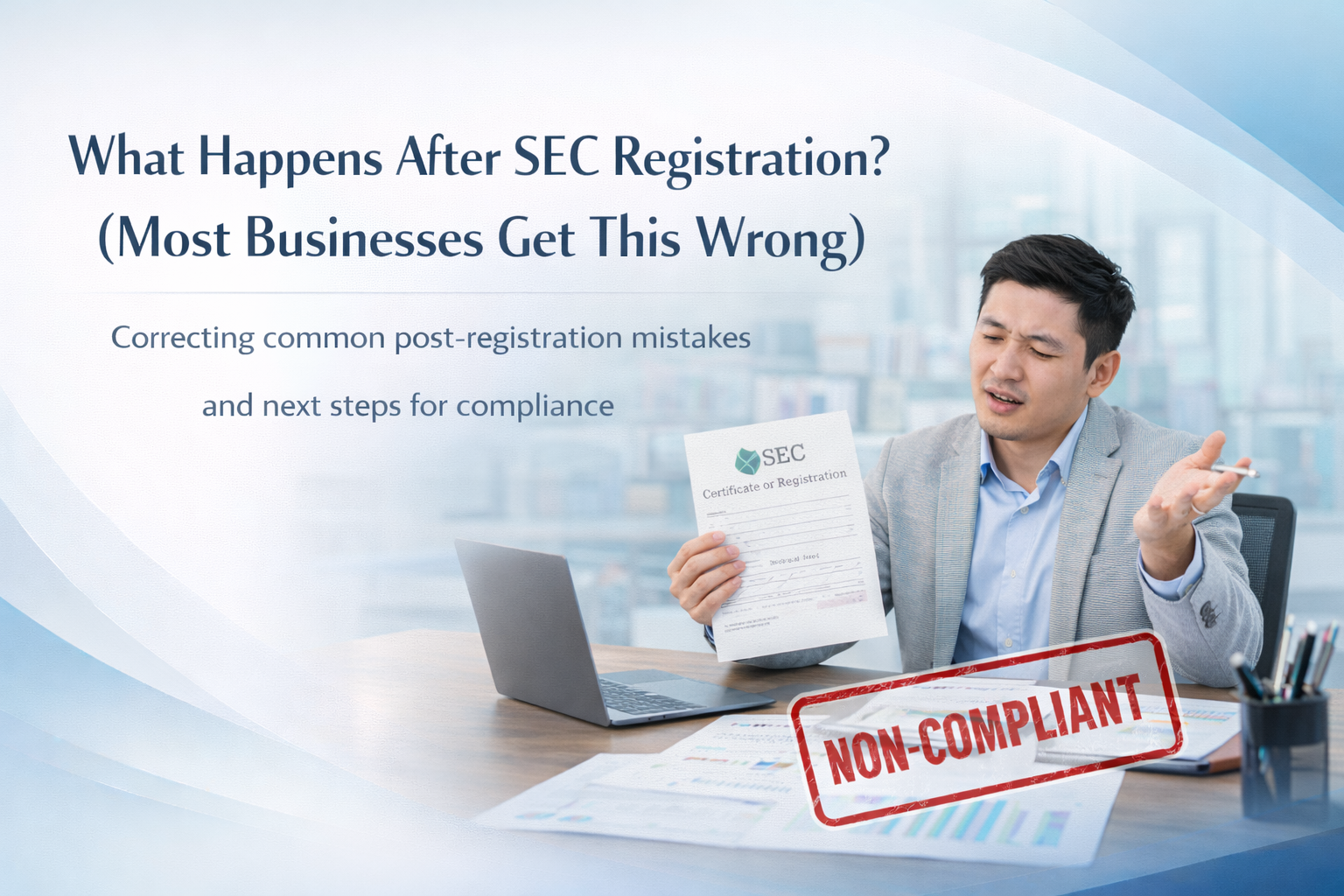
Completing your company registration with the Securities and Exchange Commission (SEC) is a major milestone. For many entrepreneurs, it feels like the final step in starting a business.
But here is the legal reality:
SEC registration is not the end—it is only the beginning.
Many businesses make the critical mistake of assuming that once they receive their SEC Certificate, they are fully compliant and ready to operate. This misunderstanding often leads to penalties, delays, and compliance issues within the first few months.
This article explains what actually happens after SEC registration—and what most businesses get wrong.
The Biggest Misconception: “We’re Already Fully Legal”
After SEC registration, your company gains legal personality. However, it does not yet have full authority to operate.
To become fully compliant, your business must complete several additional requirements.
Failing to do so can result in:
- Inability to issue official receipts
- Delays in operations
- Regulatory penalties
1. BIR Registration Is Mandatory
After SEC registration, the next critical step is registering with the Bureau of Internal Revenue (BIR).
This process includes:
- Securing a Tax Identification Number (TIN)
- Obtaining your Certificate of Registration (COR)
- Registering books of accounts
- Applying for Authority to Print (ATP) receipts
Without BIR registration, your business cannot legally issue receipts or comply with tax obligations.
2. Secure Your Mayor’s Permit
Your business must also obtain a Mayor’s Permit from your local government unit.
This permit:
- Authorizes you to operate within your city or municipality
- Confirms compliance with local regulations
Operating without a Mayor’s Permit may result in fines or business closure.
3. Register with Other Government Agencies (If Applicable)
Depending on your business, additional registrations may be required, such as:
- Employer registrations for government contributions
- Industry-specific licenses or permits
These requirements ensure full compliance with Philippine laws.
4. Start Issuing Official Receipts Properly
Many businesses begin operations without properly issuing receipts.
After BIR registration, you must:
- Use approved receipts or invoices
- Ensure all transactions are documented
- Maintain accurate records
Failure to issue proper receipts is a common compliance violation.
5. Maintain Ongoing Compliance
This is where most businesses fail.
After registration, your company must comply with ongoing obligations, including:
SEC Requirements
- General Information Sheet (GIS)
- Audited Financial Statements (AFS)
BIR Requirements
- Monthly, quarterly, and annual tax filings
- Proper bookkeeping
Local Requirements
- Annual renewal of Mayor’s Permit
Compliance is continuous—not a one-time process.
6. Align Your Operations with Your Registered Business Purpose
Your company must operate within the scope of its declared business purpose in the Articles of Incorporation.
Engaging in activities outside your registered purpose may require amendments with the SEC.
Many businesses overlook this, leading to compliance issues later.
7. Build Internal Systems Early
Successful businesses establish systems early for:
- Accounting and bookkeeping
- Compliance tracking
- Record management
Without these systems, compliance becomes difficult as the business grows.
Common Mistakes Businesses Make
After SEC registration, many businesses:
- Delay BIR registration
- Operate without a Mayor’s Permit
- Fail to issue official receipts
- Miss compliance deadlines
- Ignore reportorial requirements
These mistakes can result in penalties and operational disruptions.
Final Thoughts
SEC registration is a crucial step—but it is only the first step in a series of legal obligations.
To operate fully and legally in the Philippines, businesses must complete tax registration, secure local permits, and maintain ongoing compliance.
Understanding what comes next—and acting on it—can save your business from costly mistakes.
For entrepreneurs, the key takeaway is simple:
Registration starts your business—but compliance sustains it.
Navigating the business landscape in the Philippines can be both rewarding and intricate. Whether you’re embarking on a new venture or scaling up, ensuring that your corporate endeavors are in line with local regulations is paramount.
At CBOS Business Solutions Inc., we pride ourselves on simplifying these processes for our clients. As a seasoned professional services company, we offer comprehensive assistance with SEC Registration, Visa processing, and a myriad of other essential business requirements. Our team of experts is dedicated to ensuring that your business is compliant, well-established, and ready to thrive in the Philippine market.
Why venture into the complexities of business registration and compliance alone? Allow our team to guide you every step of the way. After all, your success is our commitment.
Get in touch today and let us be your partner in achieving your business goals in the Philippines.
Email Address: gerald.bernardo@cbos.com.ph
Mobile No.: +639270032851
You can also click this link to schedule a meeting.
Leave a Reply