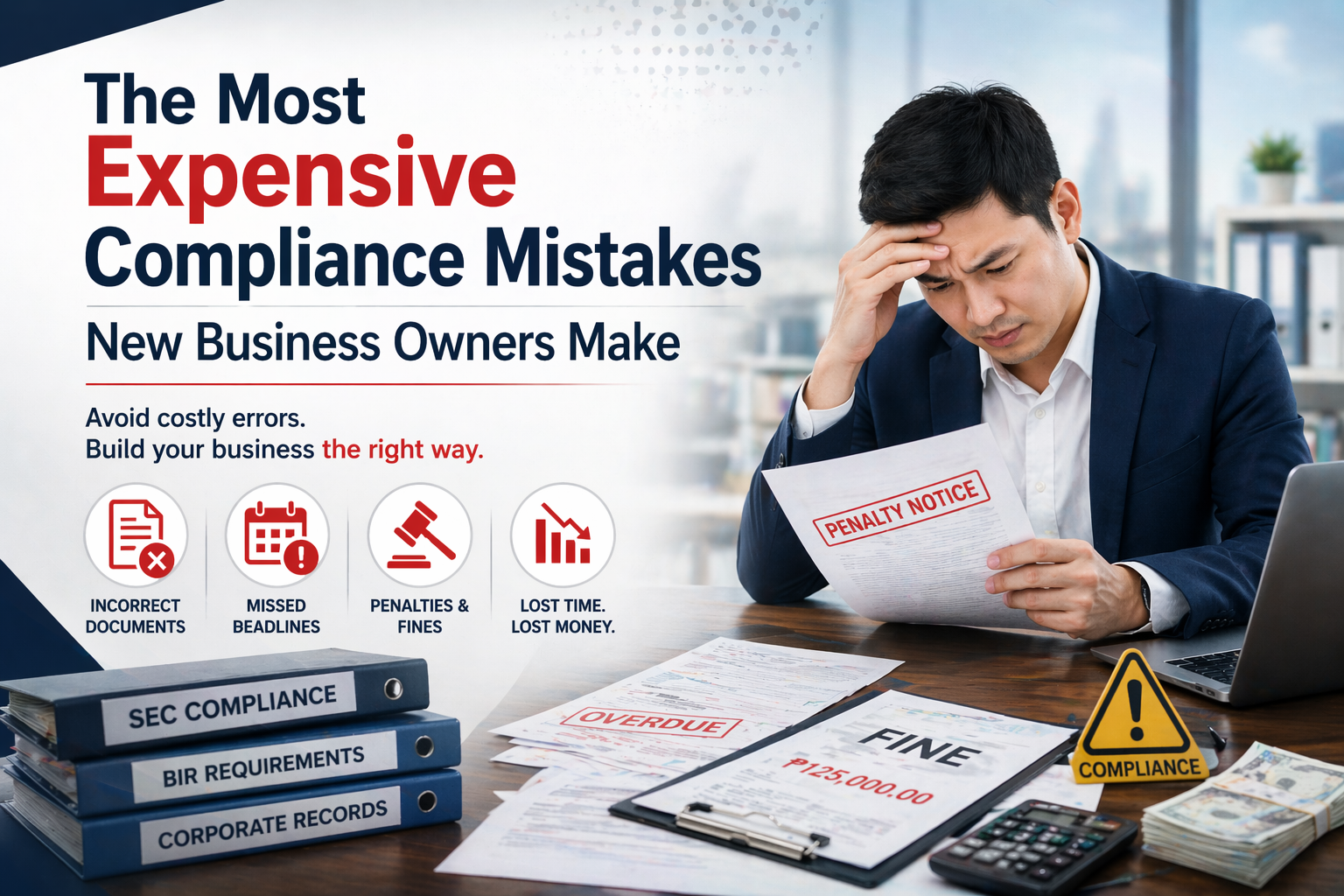
Starting a business in the Philippines requires more than a great idea and capital—it requires strict compliance with legal and regulatory requirements. While many entrepreneurs focus on growth and operations, compliance is often overlooked until problems arise.
Unfortunately, these mistakes are not just minor errors—they can be costly, disruptive, and even fatal to a business.
This article outlines the most expensive compliance mistakes new business owners make—and how to avoid them.
Why Compliance Matters from Day One
Compliance is not optional. It is a legal obligation that ensures your business operates within the framework of Philippine law.
Proper compliance allows you to:
- Avoid penalties and fines
- Build credibility with clients and partners
- Operate without legal interruptions
- Scale your business confidently
Ignoring compliance can lead to consequences that are far more expensive than doing things correctly from the start.
1. Operating Without Proper Registration
One of the most serious mistakes is starting operations without proper registration.
Businesses must register with:
- Securities and Exchange Commission (for corporations and partnerships)
- Department of Trade and Industry (for sole proprietors)
Operating without registration can result in:
- Legal penalties
- Inability to enforce contracts
- Loss of business credibility
2. Skipping BIR Registration
Some businesses delay registering with the Bureau of Internal Revenue, assuming they can “fix it later.”
This is a costly mistake.
Without BIR registration:
- You cannot legally issue official receipts
- You risk penalties and back taxes
- You may face audits and enforcement actions
Tax compliance must be completed before or immediately after starting operations.
3. Not Securing a Mayor’s Permit
Local compliance is often underestimated.
Businesses must obtain a Mayor’s Permit to legally operate within their city or municipality.
Failure to secure this permit can lead to:
- Business closure
- Fines and penalties
- Legal notices from local authorities
4. Missing Filing Deadlines
Compliance does not end after registration.
Businesses must regularly submit:
- Tax returns
- SEC reportorial requirements
- Permit renewals
Missing deadlines can result in:
- Surcharges and interest
- Accumulated penalties
- Possible suspension of operations
5. Improper Issuance of Receipts and Invoices
Issuing incorrect or unauthorized receipts is a common violation.
Businesses must:
- Secure Authority to Print (ATP)
- Issue proper receipts for every transaction
- Maintain accurate records
Failure to comply may result in:
- Penalties
- Disallowance of expenses
- Audit risks
6. Poor Record-Keeping
Many new business owners fail to maintain proper financial records.
This can lead to:
- Incorrect tax filings
- Difficulty during audits
- Inability to track business performance
Proper bookkeeping is essential for both compliance and decision-making.
7. Choosing the Wrong Business Structure
Selecting the wrong structure at the start can have long-term consequences.
This includes:
- Higher tax exposure
- Limited liability protection
- Difficulty in scaling
Proper structuring with the SEC ensures your business is aligned with your goals.
8. Ignoring Ongoing SEC Compliance
Corporations must comply with ongoing SEC requirements such as:
- General Information Sheet (GIS)
- Audited Financial Statements (AFS)
Failure to comply may result in:
- Penalties
- Suspension or revocation of registration
9. Lack of Professional Guidance
Many business owners attempt to manage compliance on their own without fully understanding the requirements.
This often leads to:
- Costly errors
- Delays in processing
- Missed obligations
Professional assistance helps ensure accuracy and efficiency.
10. Treating Compliance as a Low Priority
Perhaps the most expensive mistake of all is treating compliance as secondary to operations.
When compliance is neglected:
- Problems accumulate over time
- Penalties increase
- Business risks multiply
Compliance should be treated as a core part of business operations.
Final Thoughts
Compliance mistakes are expensive—not only in terms of money but also in lost opportunities and business disruption.
For new business owners in the Philippines, the key to avoiding these mistakes is simple:
- Register properly
- Understand your obligations
- Monitor deadlines
- Maintain accurate records
- Seek professional guidance when needed
In business, doing things right from the beginning is always less costly than fixing problems later.
Ultimately, compliance is not just about avoiding penalties—it is about building a strong, credible, and sustainable business.
Navigating the business landscape in the Philippines can be both rewarding and intricate. Whether you’re embarking on a new venture or scaling up, ensuring that your corporate endeavors are in line with local regulations is paramount.
At CBOS Business Solutions Inc., we pride ourselves on simplifying these processes for our clients. As a seasoned professional services company, we offer comprehensive assistance with SEC Registration, Visa processing, and a myriad of other essential business requirements. Our team of experts is dedicated to ensuring that your business is compliant, well-established, and ready to thrive in the Philippine market.
Why venture into the complexities of business registration and compliance alone? Allow our team to guide you every step of the way. After all, your success is our commitment.
Get in touch today and let us be your partner in achieving your business goals in the Philippines.
Email Address: gerald.bernardo@cbos.com.ph
Mobile No.: +639270032851
You can also click this link to schedule a meeting.
Leave a Reply