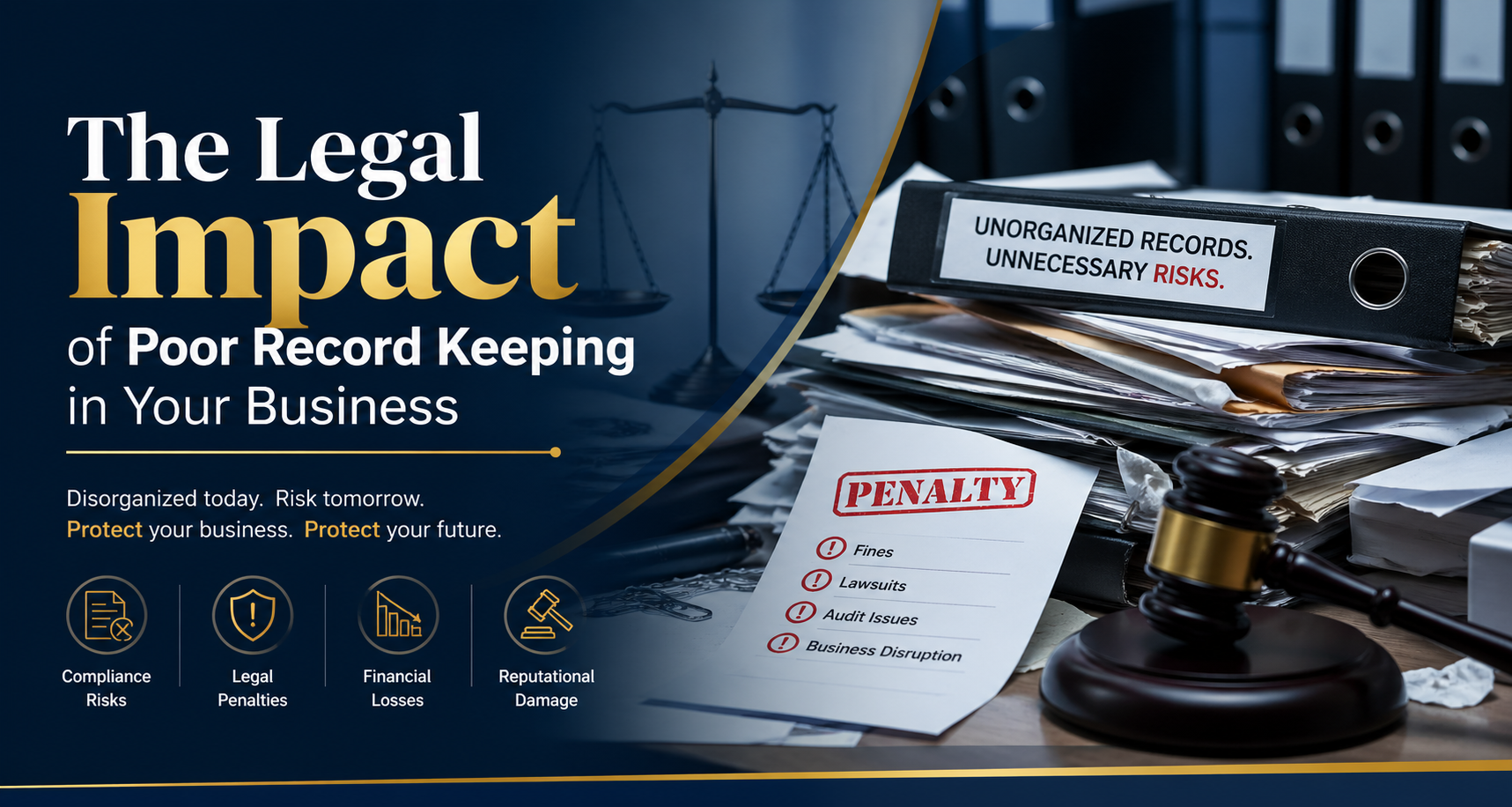
Many business owners view record keeping as a back-office task—something administrative that can wait until month-end, tax season, or when an accountant asks for documents. In reality, poor record keeping can create serious legal, tax, financial, and operational consequences.
When records are incomplete, inaccurate, or disorganized, your business may struggle to prove transactions, defend expenses, comply with regulations, or respond to audits. What seems like a paperwork issue can quickly become a legal risk.
This guide explains the legal impact of poor record keeping and why disciplined documentation is essential for businesses in the Philippines.
What Is Record Keeping?
Record keeping refers to maintaining organized, accurate, and accessible documentation of business activities.
This commonly includes:
- Sales records
- Receipts and invoices
- Expense documents
- Contracts
- Payroll records
- Tax filings
- Bank statements
- Corporate records
- Permits and licenses
Good records create evidence. Poor records create uncertainty.
1. Tax Penalties and Audit Problems
One of the biggest risks of weak record keeping involves tax compliance with the Bureau of Internal Revenue.
If records are missing or incomplete, your business may face:
- Difficulty supporting deductions or expenses
- Inconsistent tax returns
- Delayed responses to tax notices
- Additional assessments
- Penalties and interest
In many cases, the issue is not fraud—it is inability to prove compliance.
2. Inability to Defend Legal Claims
If disputes arise with customers, suppliers, employees, or partners, records matter.
Examples:
- Signed contracts
- Delivery confirmations
- Payment records
- Emails and approvals
- Timekeeping records
Without evidence, even a valid position becomes harder to defend.
3. Corporate Compliance Risks
For corporations, governance records are important.
Businesses registered with the Securities and Exchange Commission may need to maintain accurate records such as:
- Shareholder records
- Board resolutions
- Officer updates
- Annual reportorial documents
Poor records can create issues during ownership changes, due diligence, or compliance reviews.
4. Cash Flow and Financial Blindness
Poor records do not only create legal issues—they impair decision-making.
Without reliable books, owners may not know:
- Real profit levels
- Outstanding receivables
- Debt obligations
- Tax liabilities
- Inventory movement
This can lead to poor business decisions and preventable losses.
5. Banking and Loan Difficulties
Banks often review records before approving loans or opening facilities.
Weak documentation may signal:
- Operational risk
- Unclear income
- Poor controls
As a result, financing may be delayed, reduced, or denied.
6. Employment and Payroll Exposure
If you have employees, missing records can create risk involving:
- Wage disputes
- Attendance disagreements
- Benefit contribution issues
- Leave balances
- Contractor vs employee questions
Payroll documentation is a critical protection tool.
7. Lost Opportunities During Sale or Investment
Investors and buyers usually request due diligence records.
If records are weak, they may question:
- Revenue quality
- Expense accuracy
- Ownership clarity
- Hidden liabilities
Poor records can reduce valuation—or kill the deal entirely.
8. Reputational Damage
Clients, regulators, lenders, and investors trust businesses that are organized and transparent.
Repeated inability to provide records can harm reputation and confidence.
Common Signs of Poor Record Keeping
- Missing receipts
- Personal and business expenses mixed together
- Unreconciled bank accounts
- No clear filing system
- Delayed bookkeeping
- Inconsistent invoices
- Unknown tax deadlines
- Lost contracts or permits
These problems often compound over time.
How to Improve Record Keeping
Practical steps include:
- Use separate business bank accounts
- Keep digital and physical copies of key records
- Update books regularly
- Reconcile bank accounts monthly
- Store contracts and permits centrally
- Track tax deadlines
- Use bookkeeping support when needed
Good systems reduce stress and risk.
Why Small Businesses Need It Too
Some owners believe only large corporations need formal records.
In reality, small businesses are often more vulnerable because:
- Cash flow margins are tighter
- One penalty can hurt badly
- Owner knowledge is concentrated
- Informal practices grow quickly into bigger problems
Good record keeping is scalable protection.
Final Thoughts
Poor record keeping is not just messy administration—it can create real legal and financial consequences.
It may lead to:
- Tax penalties
- Lost disputes
- Financing problems
- Compliance issues
- Lower business value
For businesses in the Philippines, the practical lesson is simple:
If it happened in your business, it should be documented properly.
Because strong records do more than satisfy regulators—they protect profit, reputation, and long-term growth.
Navigating the business landscape in the Philippines can be both rewarding and intricate. Whether you’re embarking on a new venture or scaling up, ensuring that your corporate endeavors are in line with local regulations is paramount.
At CBOS Business Solutions Inc., we pride ourselves on simplifying these processes for our clients. As a seasoned professional services company, we offer comprehensive assistance with SEC Registration, Visa processing, and a myriad of other essential business requirements. Our team of experts is dedicated to ensuring that your business is compliant, well-established, and ready to thrive in the Philippine market.
Why venture into the complexities of business registration and compliance alone? Allow our team to guide you every step of the way. After all, your success is our commitment.
Get in touch today and let us be your partner in achieving your business goals in the Philippines.
Email Address: gerald.bernardo@cbos.com.ph
Mobile No.: +639270032851
You can also click this link to schedule a meeting.
Leave a Reply