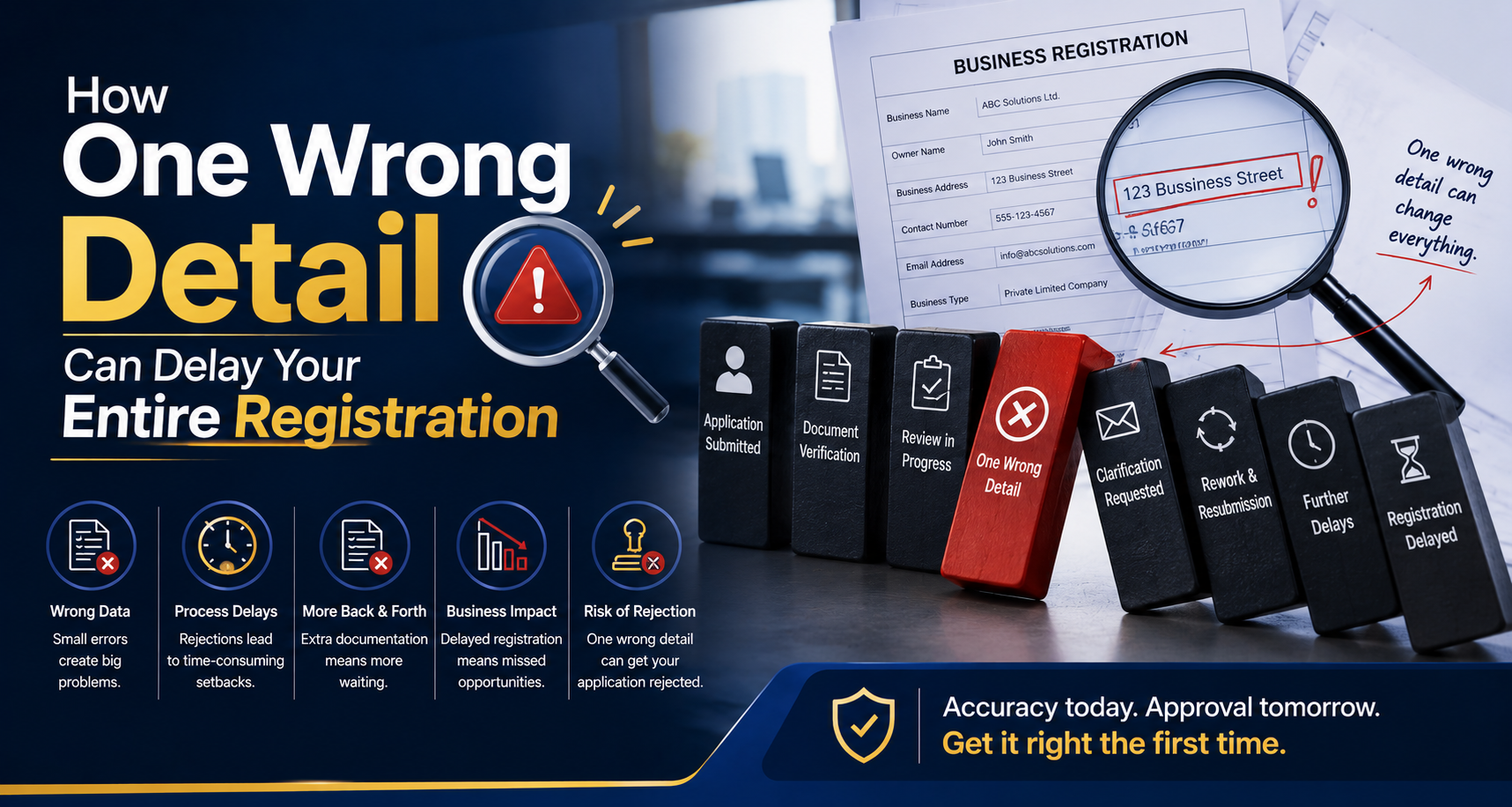
Many entrepreneurs believe business registration delays only happen when documents are missing. In reality, one of the biggest causes of delay is something far smaller—but far more damaging:
One incorrect detail.
A single error in spelling, address, ownership information, tax classification, or supporting document can stop an entire registration process. Even if all requirements are complete, one inconsistency may trigger verification, rejection, correction requests, or complete resubmission.
In business registration, details are not “minor.”
They are legal data relied upon by government agencies, banks, tax authorities, and future business partners.
This guide explains how one wrong detail can delay your entire registration—and how to avoid it.
Why Accuracy Matters in Registration
Government agencies process thousands of applications using strict standards.
When reviewing registrations, agencies commonly check:
- Consistency
- Legal sufficiency
- Identity verification
- Ownership information
- Tax registration alignment
- Permit eligibility
Even small discrepancies create concern because records must match across systems.
Depending on the structure, registration may involve the Securities and Exchange Commission, the Department of Trade and Industry, and the Bureau of Internal Revenue.
1. Name Spelling Errors
A simple spelling mismatch can create major delay.
Examples:
- Different middle initials
- Misspelled surnames
- Missing suffixes (Jr., Sr., III)
- Typographical errors in IDs vs forms
These issues can trigger identity verification problems or document rejection.
2. Address Inconsistencies
One address written differently across records may stop processing.
Examples:
- Different unit numbers
- Incomplete barangay details
- Different city formatting
- Lease documents not matching registration forms
Address consistency affects permits, tax registration, and banking.
3. Incorrect Ownership Information
Ownership details are heavily reviewed for corporations and partnerships.
Problems include:
- Wrong ownership percentages
- Missing shareholder details
- Inconsistent capital contributions
- Mismatch between IDs and corporate records
Errors here often require amended documents.
4. Wrong Business Activity or Purpose
Many owners underestimate the importance of properly describing business activities.
If the declared purpose is:
- Too vague
- Too broad
- Misaligned with permits or taxes
- Inconsistent with actual operations
reviewers may require revision or clarification.
5. Tax Registration Mistakes
One wrong tax assumption can delay operations significantly.
Examples:
- Wrong tax type selection
- Incorrect invoicing setup
- Mismatch between entity type and tax registration
- Wrong industry classification
After registration, correcting tax setup may consume additional time and expense.
6. Signature and Execution Errors
Even fully prepared documents may be delayed if:
- Signatures are incomplete
- Wrong pages are signed
- Dates are inconsistent
- Required authorizations are missing
Technical execution errors are common but avoidable.
7. Invalid or Outdated Supporting Documents
Some businesses submit:
- Expired IDs
- Old proof of address
- Invalid permits
- Outdated templates or forms
One invalid attachment can hold the entire application.
8. Banking and Permit Delays After Registration
Even after approval, one inconsistent detail can affect:
- Business bank account opening
- Mayor’s Permit processing
- BIR registration
- Investor due diligence
Problems often spread beyond the original filing.
Why Small Errors Become Big Delays
Government systems rely heavily on matching records.
If one detail conflicts, reviewers may need to:
- Pause processing
- Request clarification
- Verify authenticity
- Return documents for correction
This creates additional waiting time.
Common Mistakes Entrepreneurs Make
- Rushing forms without review
- Copy-pasting inconsistent information
- Using different addresses casually
- Ignoring formatting consistency
- Submitting without final verification
Most delays are preventable.
How to Avoid Costly Delays
Before submission:
Review Every Line Carefully
Treat forms like legal documents—not casual paperwork.
Ensure All Records Match
Names, addresses, ownership, and dates should be identical where required.
Use Updated Documents
Verify IDs, forms, and supporting records are current.
Confirm Tax and Business Activity Alignment
Operations, permits, and tax registration should support each other.
Conduct Final Cross-Checking
One final review often saves weeks of delay.
Final Thoughts
Business registration delays are not always caused by major problems. Sometimes, one wrong detail is enough to stop the process entirely.
For entrepreneurs in the Philippines, the practical lesson is simple:
Accuracy is speed.
The businesses that move fastest are usually not the ones rushing—they are the ones submitting clean, consistent, and carefully reviewed applications.
Because in registration, one small mistake can delay everything—but one careful review can prevent it.
Navigating the business landscape in the Philippines can be both rewarding and intricate. Whether you’re embarking on a new venture or scaling up, ensuring that your corporate endeavors are in line with local regulations is paramount.
At CBOS Business Solutions Inc., we pride ourselves on simplifying these processes for our clients. As a seasoned professional services company, we offer comprehensive assistance with SEC Registration, Visa processing, and a myriad of other essential business requirements. Our team of experts is dedicated to ensuring that your business is compliant, well-established, and ready to thrive in the Philippine market.
Why venture into the complexities of business registration and compliance alone? Allow our team to guide you every step of the way. After all, your success is our commitment.
Get in touch today and let us be your partner in achieving your business goals in the Philippines.
Email Address: gerald.bernardo@cbos.com.ph
Mobile No.: +639270032851
You can also click this link to schedule a meeting.
Leave a Reply