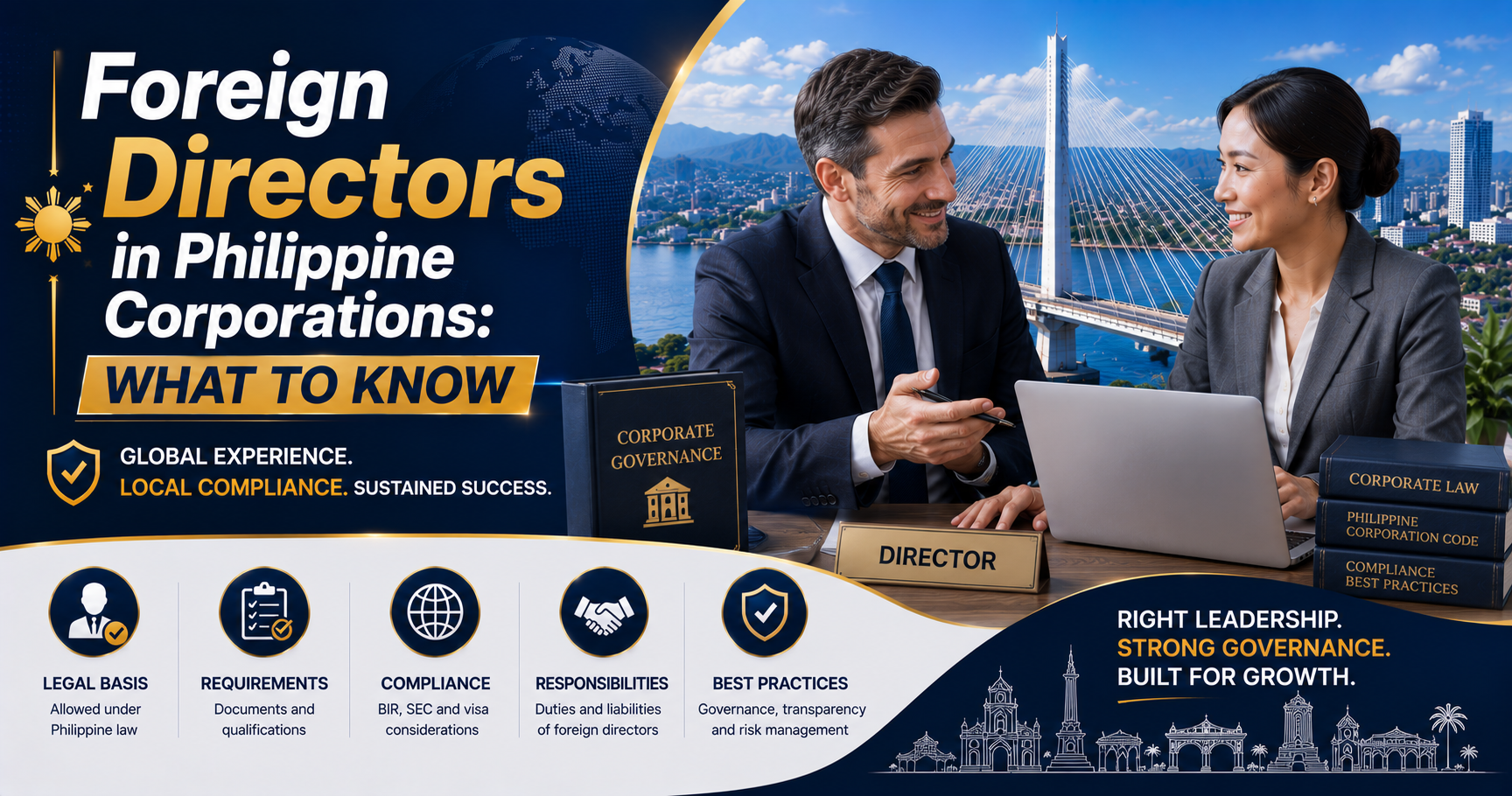
As foreign investment in the Philippines continues to grow, many businesses are exploring how foreign nationals can legally participate in corporate leadership. One of the most common questions asked by investors and expanding companies is:
Can foreigners become directors of Philippine corporations?
The answer depends on several legal and structural factors, including the type of business, ownership composition, industry restrictions, and corporate compliance requirements.
For businesses operating in Cebu and throughout the Philippines, understanding the rules surrounding foreign directors is essential for proper corporate governance and legal compliance.
This guide explains the key issues foreign investors and corporations should know in 2026.
Why Foreign Directors Matter
Foreign directors can provide:
- International business expertise
- Strategic leadership
- Global investor confidence
- Industry specialization
- Operational support for multinational businesses
For many corporations, foreign participation strengthens management and expansion capabilities.
Understanding the Difference Between Ownership and Directorship
One important point is that:
Share ownership and board membership are not always the same thing.
A corporation may involve:
- Filipino shareholders
- Foreign shareholders
- Filipino directors
- Foreign directors
The legal structure and industry classification influence what is allowed.
Philippine Corporations and Corporate Governance
Corporations in the Philippines are generally regulated by the Securities and Exchange Commission.
Corporate governance rules commonly involve:
- Directors
- Officers
- Shareholders
- Corporate records
- Ownership disclosures
Foreign participation must align with applicable corporate and investment laws.
Can Foreigners Serve as Directors?
In many cases, yes—but it depends on the corporation’s structure and industry.
Factors that may affect eligibility include:
- Foreign ownership percentage
- Industry-specific restrictions
- Constitutional or statutory limitations
- Corporate governance requirements
Some industries permit broader foreign participation than others.
Industries With Ownership Restrictions
Certain business sectors may require:
- Minimum Filipino ownership
- Majority Filipino control
- Specific governance composition rules
Because of this, businesses should review industry-specific requirements carefully before appointing foreign directors.
Why Proper Structuring Matters
Incorrect structuring can create:
- SEC compliance problems
- Delays in approvals
- Ownership disputes
- Banking and due diligence concerns
- Future investor complications
Corporate structure should be planned strategically—not improvised later.
Responsibilities of Corporate Directors
Directors generally help oversee:
- Corporate governance
- Strategic decisions
- Financial oversight
- Compliance direction
- Major corporate actions
Being listed as a director carries legal and fiduciary responsibilities.
Corporate Records Must Be Accurate
When foreign directors are involved, companies should ensure:
- Corporate records are updated
- Director information is accurate
- Ownership disclosures are clear
- Governance documents are maintained properly
Consistency across filings is important.
Immigration and Work Authorization Considerations
A common misunderstanding is assuming that becoming a director automatically authorizes a foreign national to work operationally in the Philippines.
In reality:
- Board participation
- Ownership rights
- Day-to-day employment
- Immigration status
are separate legal issues.
Depending on the activities performed, immigration and labor compliance involving the Bureau of Immigration and the Department of Labor and Employment may still apply.
Tax and Compliance Considerations
Corporations involving foreign participation should also maintain proper compliance with the Bureau of Internal Revenue.
This includes:
- Corporate tax obligations
- Record keeping
- Governance documentation
- Accurate reporting
Transparent records help avoid future problems.
Common Mistakes Companies Make
- Assuming foreign directors are automatically allowed in all industries
- Ignoring ownership restrictions
- Using nominee arrangements improperly
- Failing to update corporate records
- Mixing board roles with unauthorized employment
- Ignoring immigration implications
These mistakes can create serious legal and operational risk.
Best Practices for Corporations With Foreign Directors
To reduce risk:
✔ Review industry ownership rules carefully
✔ Maintain updated SEC records
✔ Keep governance documents organized
✔ Separate ownership, governance, and employment issues properly
✔ Coordinate immigration and labor compliance where necessary
✔ Use clear shareholder and board documentation
Good governance supports long-term stability.
Why Investors Prefer Properly Structured Corporations
Businesses with strong governance and clear director structures are often viewed more favorably by:
- Investors
- Banks
- Regulators
- Strategic partners
Professional structure builds credibility.
Final Thoughts
Foreign directors can legally participate in many Philippine corporations, but proper planning and compliance are critical.
The strongest corporations understand that foreign participation affects more than ownership—it also influences governance, compliance, immigration coordination, and investor confidence.
The practical lesson is simple:
Before appointing foreign directors, make sure your corporate structure is legally prepared to support them.
Because strong governance begins with clear structure, accurate records, and proper compliance from the start.
Navigating the business landscape in the Philippines can be both rewarding and intricate. Whether you’re embarking on a new venture or scaling up, ensuring that your corporate endeavors are in line with local regulations is paramount.
At CBOS Business Solutions Inc., we pride ourselves on simplifying these processes for our clients. As a seasoned professional services company, we offer comprehensive assistance with SEC Registration, Visa processing, and a myriad of other essential business requirements. Our team of experts is dedicated to ensuring that your business is compliant, well-established, and ready to thrive in the Philippine market.
Why venture into the complexities of business registration and compliance alone? Allow our team to guide you every step of the way. After all, your success is our commitment.
Get in touch today and let us be your partner in achieving your business goals in the Philippines.
Email Address: gerald.bernardo@cbos.com.ph
Mobile No.: +639270032851
You can also click this link to schedule a meeting.
Leave a Reply