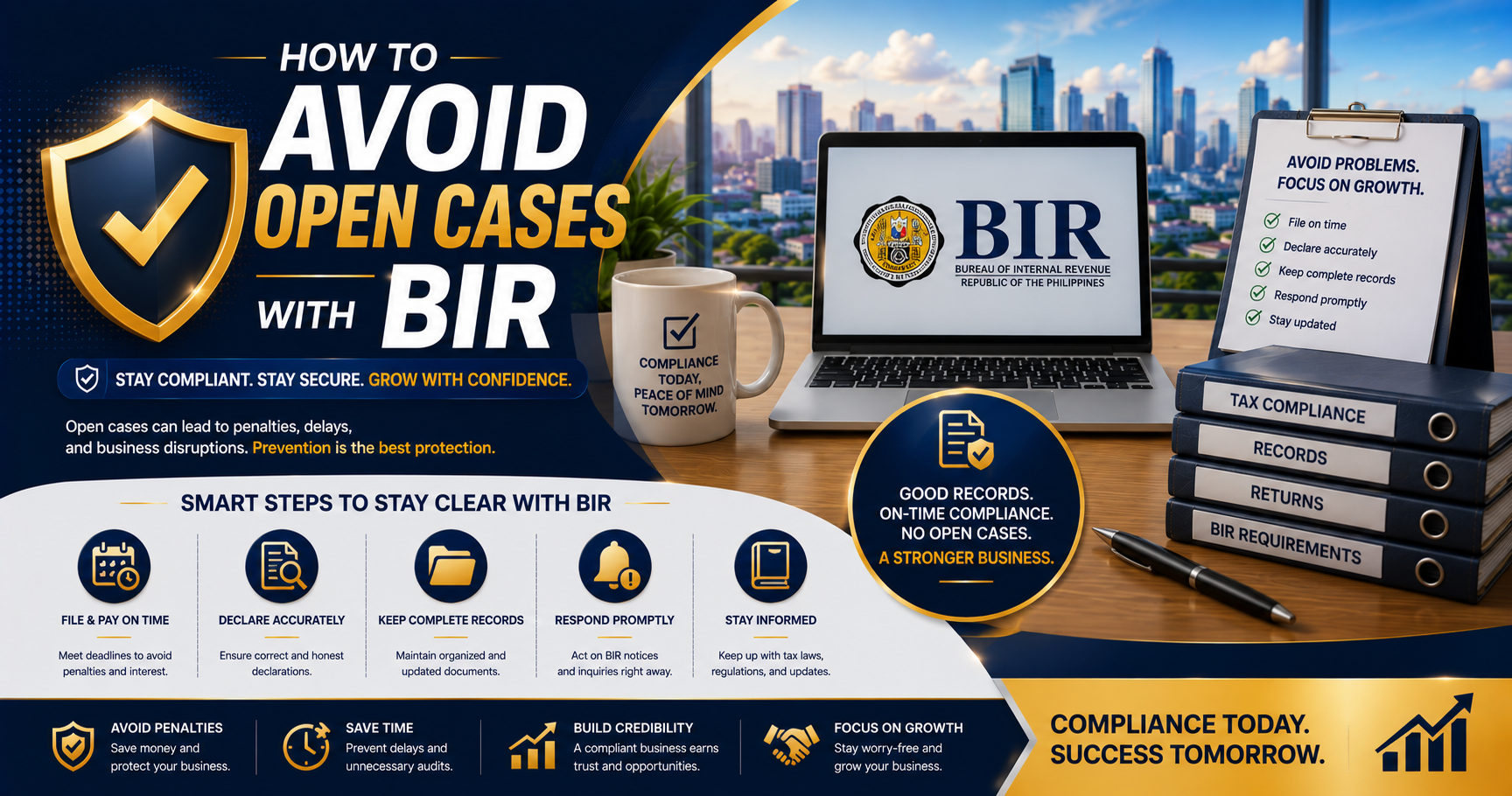
For many business owners in the Philippines, one of the most stressful tax-related discoveries is learning that their company has “open cases” with the Bureau of Internal Revenue (BIR).
Many entrepreneurs are surprised because they believed their business was compliant. Others only discover open cases when:
- Applying for business closure
- Renewing permits
- Requesting tax clearances
- Undergoing audits
- Opening bank facilities
- Preparing for investment or sale
In many situations, open cases are caused not by intentional wrongdoing—but by missed filings, registration issues, or incomplete compliance.
This guide explains what BIR open cases are, why they happen, and how businesses can avoid them in 2026.
What Are “Open Cases” With the BIR?
In general, open cases refer to unresolved tax compliance issues or filing obligations reflected in BIR records.
These may involve:
- Missing tax returns
- Late filings
- Unfiled reports
- Unresolved registration issues
- Inconsistencies in tax records
- Other pending compliance obligations
Even businesses with little or no income can sometimes develop open cases if filings were still required.
Why Open Cases Become Serious Problems
Open cases can affect:
- Tax clearances
- Business permit renewals
- Business closure processing
- Corporate transactions
- Loan and banking applications
- Investor due diligence
Unresolved issues may also lead to:
- Penalties
- Interest
- Compliance notices
- Delays in government transactions
Ignoring them usually makes the situation more expensive over time.
1. File Tax Returns on Time — Even If No Income Exists
One of the most common causes of open cases is failure to file required returns.
Many businesses assume:
- “No income means no filing.”
- “We were inactive, so nothing was needed.”
In many situations, filing obligations may still exist even during low or inactive operations.
Missing returns often trigger open cases automatically.
2. Complete BIR Registration Properly
Problems often begin during initial registration.
After registration with the Securities and Exchange Commission or the Department of Trade and Industry, businesses generally still need proper BIR setup.
Incomplete setup may lead to:
- Wrong tax obligations
- Incorrect registration data
- Missing filing schedules
- Future compliance confusion
Good registration prevents later problems.
3. Understand Your Filing Obligations Clearly
Businesses may have multiple filing responsibilities depending on:
- Business structure
- Tax type
- Revenue classification
- Employment setup
Some obligations may involve:
- Monthly filings
- Quarterly filings
- Annual filings
- Withholding taxes
- Information returns
Missing even one recurring requirement may create open cases.
4. Maintain Organized Bookkeeping Records
Poor bookkeeping increases the risk of:
- Missed deadlines
- Incorrect reporting
- Filing inconsistencies
- Audit complications
Businesses should maintain:
- Sales records
- Expense documentation
- Bank reconciliations
- Tax filing copies
Strong records support accurate compliance.
5. Monitor Filing Deadlines Carefully
Many open cases result from simple missed deadlines.
Businesses should maintain a compliance calendar tracking:
- Tax return due dates
- Permit renewals
- Corporate filings
- Payroll-related obligations
Late compliance often creates avoidable penalties.
6. Do Not Ignore BIR Notices
Some businesses receive notices but delay responding because they assume the issue is minor.
Ignoring notices may worsen:
- Penalties
- Assessments
- Compliance complications
Early response is usually safer and less expensive.
7. Update Registration Information Promptly
Businesses should update the BIR when major changes occur, such as:
- Address changes
- Business activity changes
- Closure or suspension of operations
- Ownership or structural changes
Outdated registration records can trigger filing mismatches and future open cases.
8. Close Businesses Properly
One of the biggest misconceptions is believing that stopping operations automatically ends tax obligations.
If a business stops operating but is not formally closed properly, filing obligations may continue accumulating.
This often creates multiple open cases over time.
9. Separate Personal and Business Finances
Mixing funds creates confusion during bookkeeping and tax reporting.
Separate systems improve:
- Compliance accuracy
- Audit readiness
- Financial clarity
Clean records reduce filing errors.
Common Causes of BIR Open Cases
- Missed tax returns
- Incorrect registration setup
- Unreported business changes
- Delayed closure processing
- Weak bookkeeping
- Ignored notices
- Late filings
Most open cases begin with small overlooked issues.
Best Practices to Avoid Open Cases
✔ File all required returns on time
✔ Maintain organized books and records
✔ Review filing obligations regularly
✔ Keep registration information updated
✔ Respond to notices immediately
✔ Monitor deadlines consistently
✔ Seek professional guidance when needed
Preventive compliance is cheaper than correction.
Why Staying Clean With BIR Matters
Strong BIR compliance supports:
- Easier permit renewals
- Better banking relationships
- Investor confidence
- Smoother audits
- Cleaner business closure or restructuring
Compliance affects business reputation and operational flexibility.
Final Thoughts
Open cases with the BIR are often not caused by major fraud—they usually begin with missed deadlines, weak systems, or neglected filings.
The businesses that avoid serious problems are typically the ones that:
- Stay organized
- Monitor deadlines carefully
- Keep accurate records
- Address issues early
The practical lesson is simple:
Tax compliance should be managed continuously—not only when problems appear.
Because preventing open cases is almost always easier, cheaper, and less stressful than resolving them later.
Navigating the business landscape in the Philippines can be both rewarding and intricate. Whether you’re embarking on a new venture or scaling up, ensuring that your corporate endeavors are in line with local regulations is paramount.
At CBOS Business Solutions Inc., we pride ourselves on simplifying these processes for our clients. As a seasoned professional services company, we offer comprehensive assistance with SEC Registration, Visa processing, and a myriad of other essential business requirements. Our team of experts is dedicated to ensuring that your business is compliant, well-established, and ready to thrive in the Philippine market.
Why venture into the complexities of business registration and compliance alone? Allow our team to guide you every step of the way. After all, your success is our commitment.
Get in touch today and let us be your partner in achieving your business goals in the Philippines.
Email Address: gerald.bernardo@cbos.com.ph
Mobile No.: +639270032851
You can also click this link to schedule a meeting.
Leave a Reply