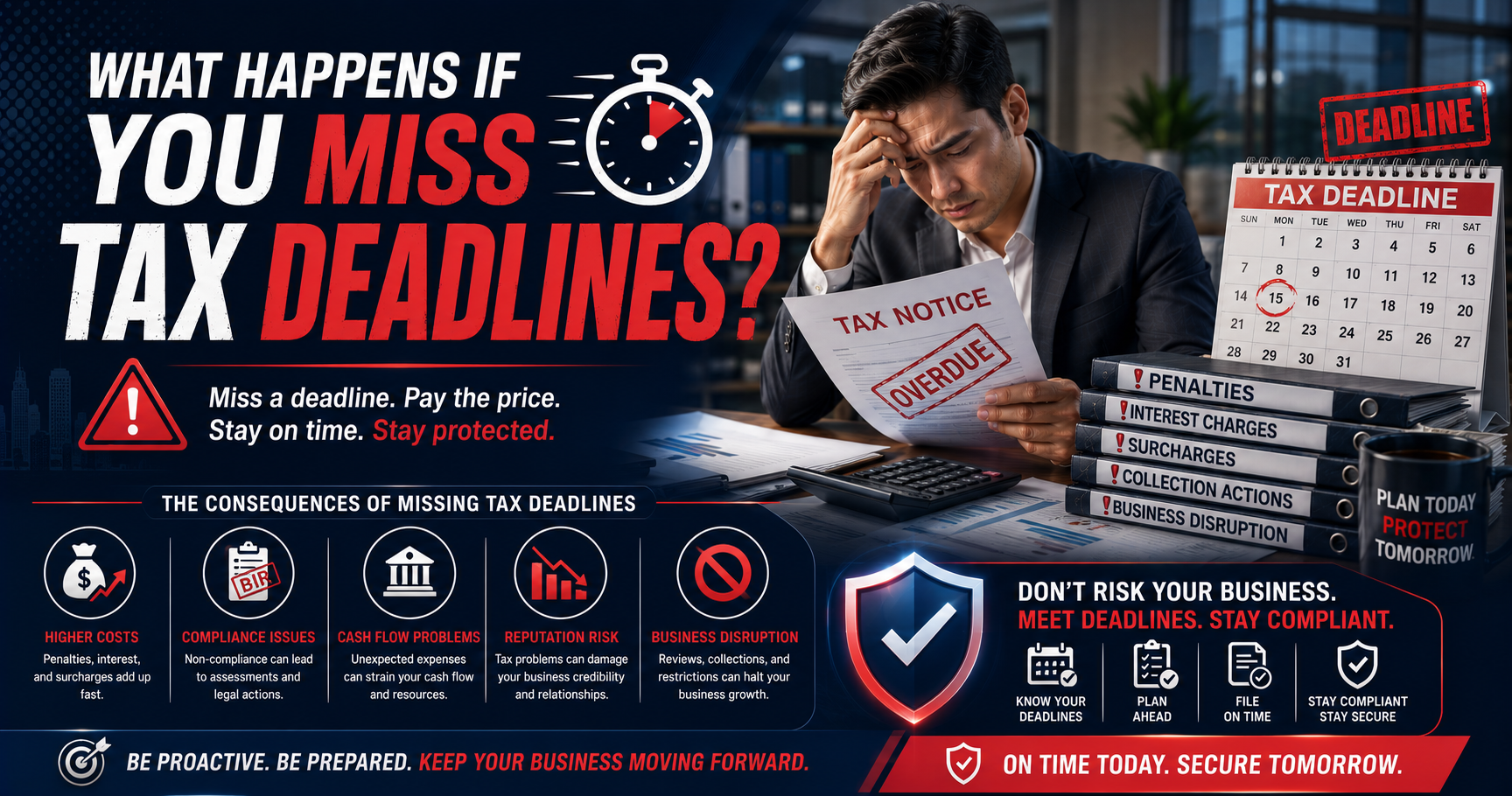
For many businesses and self-employed individuals in the Philippines, tax deadlines can feel overwhelming. Between operations, payroll, clients, permits, and daily business concerns, some taxpayers delay filing returns or assume that missing a deadline “just this once” will not create serious consequences.
Unfortunately, missed tax deadlines can quickly lead to penalties, interest, compliance problems, and long-term complications with the Bureau of Internal Revenue (BIR).
In many cases, the issue is not the tax itself—it is the failure to file or comply on time.
This guide explains what commonly happens when tax deadlines are missed in the Philippines and why proactive compliance is critical in 2026.
Why Tax Deadlines Matter
Tax deadlines are part of ongoing legal compliance.
Businesses and taxpayers may have obligations involving:
- Monthly filings
- Quarterly filings
- Annual tax returns
- Withholding taxes
- Information returns
- Other compliance submissions
Missing deadlines can trigger automatic consequences even if the amount due is small—or even zero in some situations.
1. Penalties and Surcharges May Apply
One of the most immediate consequences of missing deadlines is the imposition of penalties or surcharges under applicable tax rules.
These may increase the total amount payable significantly over time.
What began as a manageable obligation can quickly become more expensive because of delayed compliance.
2. Interest Continues to Accumulate
In some situations, interest may continue accruing on unpaid obligations until they are resolved.
The longer the delay, the larger the financial impact may become.
Businesses that postpone action often end up paying far more than the original liability.
3. Open Cases May Be Created
Missed filings commonly result in unresolved compliance records or “open cases” with the Bureau of Internal Revenue.
These open cases may later affect:
- Permit renewals
- Business closure processing
- Tax clearances
- Banking transactions
- Investor due diligence
Even inactive businesses may encounter problems if filings were still required.
4. Tax Notices and Compliance Reviews May Follow
Businesses that repeatedly miss deadlines may receive:
- Compliance notices
- Requests for clarification
- Additional reviews
- Audit-related inquiries
Weak filing history often increases regulatory attention.
5. Business Operations Can Be Affected
Tax problems do not stay isolated within accounting departments.
Missed deadlines may affect:
- Business permits
- Corporate transactions
- Loan applications
- Investor confidence
- Contract opportunities
Compliance problems can eventually disrupt operations.
6. Missed Deadlines Create Record-Keeping Problems
When filings are delayed, bookkeeping often becomes harder.
Businesses may struggle with:
- Reconstructing records
- Finding missing receipts
- Correcting past reports
- Reconciling accounts
Delayed compliance usually creates more administrative work later.
7. Stress and Compliance Backlogs Increase
One missed filing often leads to another.
Businesses begin saying:
- “We’ll catch up later.”
- “We’ll fix it next month.”
Over time, backlogs become harder and more expensive to resolve.
Common Reasons Businesses Miss Tax Deadlines
- Poor bookkeeping
- No compliance calendar
- Lack of internal responsibility
- Confusion about filing obligations
- Assuming no income means no filing
- Delayed BIR registration setup
- Ignoring notices or reminders
Most missed deadlines begin with weak systems—not intentional misconduct.
Why Small Businesses Are Especially Vulnerable
Small businesses often face greater risk because:
- Owners manage multiple responsibilities personally
- Accounting systems are less formal
- Cash flow pressure leads to delayed compliance
- Record keeping may be inconsistent
One missed deadline can create significant stress for small operations.
How to Avoid Missing Tax Deadlines
1. Maintain a Compliance Calendar
Track:
- Monthly deadlines
- Quarterly filings
- Annual obligations
- Permit renewals
2. Keep Bookkeeping Updated Regularly
Do not wait until year-end.
Regular bookkeeping makes filing easier and more accurate.
3. Understand Your Filing Obligations Clearly
Different businesses may have different requirements depending on:
- Structure
- Tax registration
- Operations
- Employment setup
4. Separate Personal and Business Finances
Clean financial records reduce reporting confusion.
5. Respond to Issues Early
Fixing one missed filing immediately is easier than resolving multiple years later.
6. Seek Professional Guidance When Needed
Proper support helps businesses avoid preventable errors and missed deadlines.
What If You Already Missed a Deadline?
The worst response is usually ignoring the problem.
Businesses should:
- Review outstanding obligations
- Organize records
- Respond promptly
- Resolve issues as early as possible
Delays generally increase financial and compliance exposure.
Why Strong Tax Compliance Supports Growth
Businesses with clean filing records are often better positioned for:
- Loans and financing
- Investor confidence
- Permit renewals
- Corporate transactions
- Expansion opportunities
Good compliance supports operational stability.
Final Thoughts
Missing tax deadlines may seem minor at first, but delayed compliance can create larger financial and operational consequences over time.
The businesses that avoid major problems are usually the ones that:
- Stay organized
- File consistently
- Monitor deadlines carefully
- Address issues early
The practical lesson is simple:
Tax compliance is easier to maintain regularly than to repair later.
Because businesses that stay ahead of deadlines protect not only their finances—but also their long-term stability and credibility.
Navigating the business landscape in the Philippines can be both rewarding and intricate. Whether you’re embarking on a new venture or scaling up, ensuring that your corporate endeavors are in line with local regulations is paramount.
At CBOS Business Solutions Inc., we pride ourselves on simplifying these processes for our clients. As a seasoned professional services company, we offer comprehensive assistance with SEC Registration, Visa processing, and a myriad of other essential business requirements. Our team of experts is dedicated to ensuring that your business is compliant, well-established, and ready to thrive in the Philippine market.
Why venture into the complexities of business registration and compliance alone? Allow our team to guide you every step of the way. After all, your success is our commitment.
Get in touch today and let us be your partner in achieving your business goals in the Philippines.
Email Address: gerald.bernardo@cbos.com.ph
Mobile No.: +639270032851
You can also click this link to schedule a meeting.
Leave a Reply