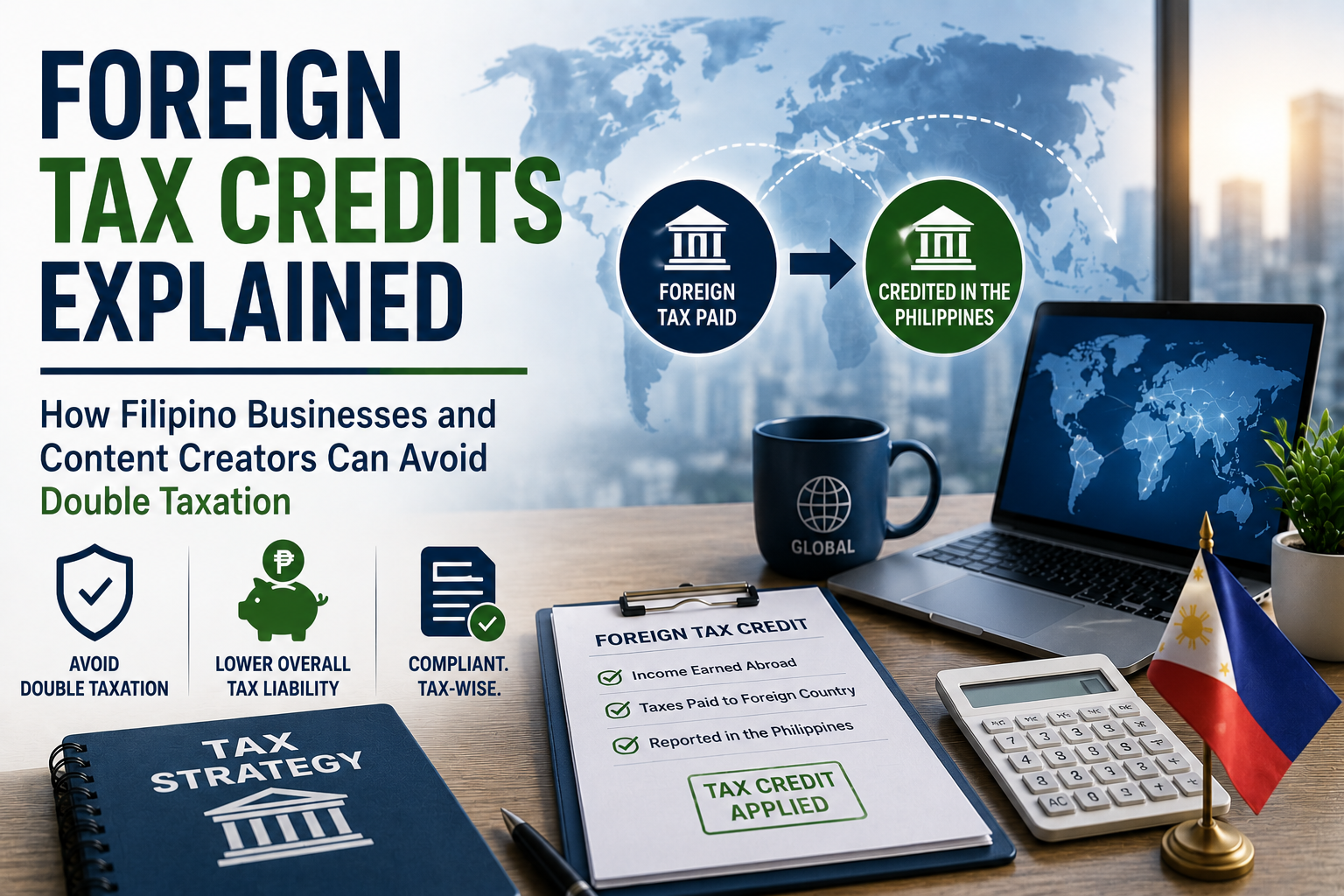
The digital economy has opened countless opportunities for Filipino entrepreneurs, freelancers, exporters, and content creators to earn income from clients and platforms around the world. However, earning income across borders often creates a significant tax concern: double taxation.
Imagine paying income tax to a foreign country because your earnings originated there—and then paying Philippine income tax on the same income. Without relief, the same income could effectively be taxed twice.
Fortunately, the Philippine National Internal Revenue Code (NIRC) provides a remedy through the Foreign Tax Credit (FTC) system. When properly claimed, foreign income taxes paid may be credited against Philippine income tax, helping taxpayers avoid double taxation while remaining compliant with both local and foreign tax laws.
This article explains how Foreign Tax Credits work, who qualifies, and why they are especially important for YouTube creators, digital entrepreneurs, exporters, and businesses earning foreign-source income.
What Is a Foreign Tax Credit?
A Foreign Tax Credit (FTC) is a tax relief mechanism that allows qualified Philippine taxpayers to claim income taxes paid to a foreign country as a credit against their Philippine income tax liability.
Instead of deducting foreign taxes merely as a business expense, taxpayers may reduce their Philippine income tax by the amount of foreign income tax paid, subject to the limitations prescribed under the Tax Code.
The objective is simple:
To prevent the same income from being taxed twice.
The Maximizing Tax Assets presentation identifies Foreign Tax Credits as one of the major tax assets available to qualified taxpayers under Philippine tax law.
Why Double Taxation Happens
Double taxation commonly occurs when:
- income is earned in one country;
- that country withholds or imposes income tax; and
- the taxpayer is also required to report the same income in the Philippines because of Philippine tax residency rules.
Without a foreign tax credit or an applicable tax treaty, the taxpayer could pay tax twice on the same earnings.
Who May Claim Foreign Tax Credits?
Under the National Internal Revenue Code, Foreign Tax Credits are generally available to qualified Philippine taxpayers, including:
- Resident citizens
- Domestic corporations
- Partners of general professional partnerships
- Beneficiaries of estates and trusts
These taxpayers may claim credits for qualified foreign income taxes, subject to statutory limitations and documentary requirements.
The presentation likewise identifies these categories of taxpayers as generally entitled to claim Foreign Tax Credits.
Who Is Not Entitled?
In general, the following are not entitled to claim Philippine Foreign Tax Credits:
- Non-resident citizens
- Resident and non-resident aliens
- Foreign corporations
Because eligibility depends on the taxpayer’s status under Philippine tax law, businesses should evaluate their residency classification before claiming the credit.
How Foreign Tax Credits Work
Consider this simplified example.
A Philippine corporation earns consulting income from a foreign client.
The foreign country withholds income tax before remitting payment.
When the corporation files its Philippine income tax return, it reports the foreign income and, subject to the applicable rules, claims the foreign tax paid as a credit against its Philippine income tax.
Instead of paying the full Philippine tax without regard to the foreign tax already paid, the corporation receives relief through the foreign tax credit mechanism.
Foreign Tax Credits and YouTube Income
One of the most practical applications of Foreign Tax Credits today involves YouTube creators and digital content creators.
Beginning in 2021, Google LLC implemented U.S. tax withholding requirements on certain royalty income earned by creators from U.S. viewers.
Payments received through the YouTube Partner Program are generally treated as royalty income under U.S. tax rules, requiring Google to collect tax information, withhold taxes where applicable, and report the income to U.S. tax authorities. The Maximizing Tax Assets presentation discusses this development and its implications for Philippine creators.
Why Tax Treaties Matter
The Philippines has entered into tax treaties with various countries, including the United States.
Tax treaties are designed to:
- reduce double taxation;
- allocate taxing rights between countries; and
- lower withholding tax rates under certain conditions.
For YouTube creators, properly invoking the Philippines–United States Tax Treaty may reduce the U.S. withholding tax rate compared with the default domestic rate, provided the creator establishes Philippine tax residency and complies with the treaty requirements.
The presentation illustrates that creators who establish Philippine residency and claim treaty benefits may qualify for a reduced U.S. withholding rate under the applicable treaty provisions.
What Happens If You Do Not Claim Treaty Benefits?
If a taxpayer fails to provide the required tax information or does not invoke the applicable treaty, the foreign withholding tax may be imposed at the higher domestic rate.
Although a Foreign Tax Credit may still be available in the Philippines, the amount of credit that may be claimed can be affected by the Tax Code and applicable treaty limitations.
Proper tax planning before foreign withholding occurs is therefore essential.
Limitations on Foreign Tax Credits
The Foreign Tax Credit is not unlimited.
The National Internal Revenue Code imposes limitations to ensure that the credit does not exceed the Philippine tax attributable to the foreign-source income.
Among the key limitations are:
- the credit with respect to taxes paid to any one foreign country cannot exceed the proportion of Philippine income tax attributable to income sourced from that country; and
- the aggregate foreign tax credit cannot exceed the proportion of Philippine income tax attributable to all foreign-source income.
These limitations are also discussed in Revenue Memorandum Circular No. 97-2021, as highlighted in the presentation.
Documentary Requirements
The Bureau of Internal Revenue generally requires taxpayers claiming Foreign Tax Credits to maintain adequate documentation.
Typical supporting documents include:
- proof of foreign income earned;
- proof of foreign taxes withheld or paid;
- records identifying the country where the income originated;
- tax withholding certificates or equivalent foreign tax documents; and
- other information necessary to verify the computation of the allowable credit.
Good documentation is essential because the taxpayer bears the burden of substantiating the claim.
Common Mistakes to Avoid
Many taxpayers lose valuable Foreign Tax Credits because of preventable errors.
1. Failing to Report Foreign Income
Foreign taxes generally cannot be credited if the related foreign income is not properly reported in the Philippine income tax return.
2. Losing Foreign Tax Documents
Without proof of foreign tax payment or withholding, the BIR may disallow the credit.
Maintain complete records from foreign payors and platforms.
3. Ignoring Tax Treaty Benefits
Many taxpayers pay higher foreign withholding taxes simply because they never claimed the benefits available under an applicable tax treaty.
For digital creators, completing the required tax residency information with the platform can make a significant difference.
4. Assuming All Foreign Taxes Are Fully Creditable
Foreign Tax Credits remain subject to statutory limitations.
The amount paid abroad does not automatically become the amount allowable as a Philippine tax credit.
Professional computation is often necessary.
Practical Tax Planning Tips
Businesses and content creators earning foreign-source income should consider the following best practices:
- Determine whether the income is subject to foreign withholding tax.
- Check whether a tax treaty exists between the Philippines and the foreign country.
- Complete tax residency documentation with foreign platforms and payors.
- Maintain complete records of foreign taxes withheld.
- Reconcile foreign income with Philippine income tax returns.
- Consult a CPA or tax lawyer before filing returns involving foreign-source income.
Proactive planning often results in substantial tax savings.
Final Thoughts
As Filipino businesses and digital entrepreneurs continue to expand globally, understanding the Foreign Tax Credit system has become increasingly important. Whether you are an exporter, consultant, software developer, YouTube creator, or multinational business, foreign-source income may expose you to taxation in more than one jurisdiction.
Fortunately, Philippine tax law and applicable tax treaties provide mechanisms to reduce or eliminate double taxation. By properly documenting foreign taxes paid, understanding treaty benefits, and complying with BIR requirements, taxpayers can legitimately reduce their Philippine income tax while remaining compliant with both local and international tax obligations.
In today’s global economy, effective international tax planning is no longer reserved for large multinational corporations. It is an essential part of responsible tax compliance for every Filipino taxpayer earning income beyond Philippine borders.
Disclaimer: This article is intended for general informational purposes only and should not be construed as legal or tax advice. The availability of Foreign Tax Credits depends on the taxpayer’s specific facts, applicable provisions of the National Internal Revenue Code, relevant tax treaties, BIR regulations and issuances, and prevailing jurisprudence. Tax treatment may differ depending on the source of income and the foreign jurisdiction involved. Consult a qualified CPA and tax lawyer before claiming Foreign Tax Credits or applying treaty benefits. The discussion is informed in part by the Maximizing Tax Assets presentation.
Navigating the business landscape in the Philippines can be both rewarding and intricate. Whether you’re embarking on a new venture or scaling up, ensuring that your corporate endeavors are in line with local regulations is paramount.
At CBOS Business Solutions Inc., we pride ourselves on simplifying these processes for our clients. As a seasoned professional services company, we offer comprehensive assistance with SEC Registration, Visa processing, and a myriad of other essential business requirements. Our team of experts is dedicated to ensuring that your business is compliant, well-established, and ready to thrive in the Philippine market.
Why venture into the complexities of business registration and compliance alone? Allow our team to guide you every step of the way. After all, your success is our commitment.
Get in touch today and let us be your partner in achieving your business goals in the Philippines.
Email Address: gerald.bernardo@cbos.com.ph
Mobile No.: +639270032851
You can also click this link to schedule a meeting.
Leave a Reply