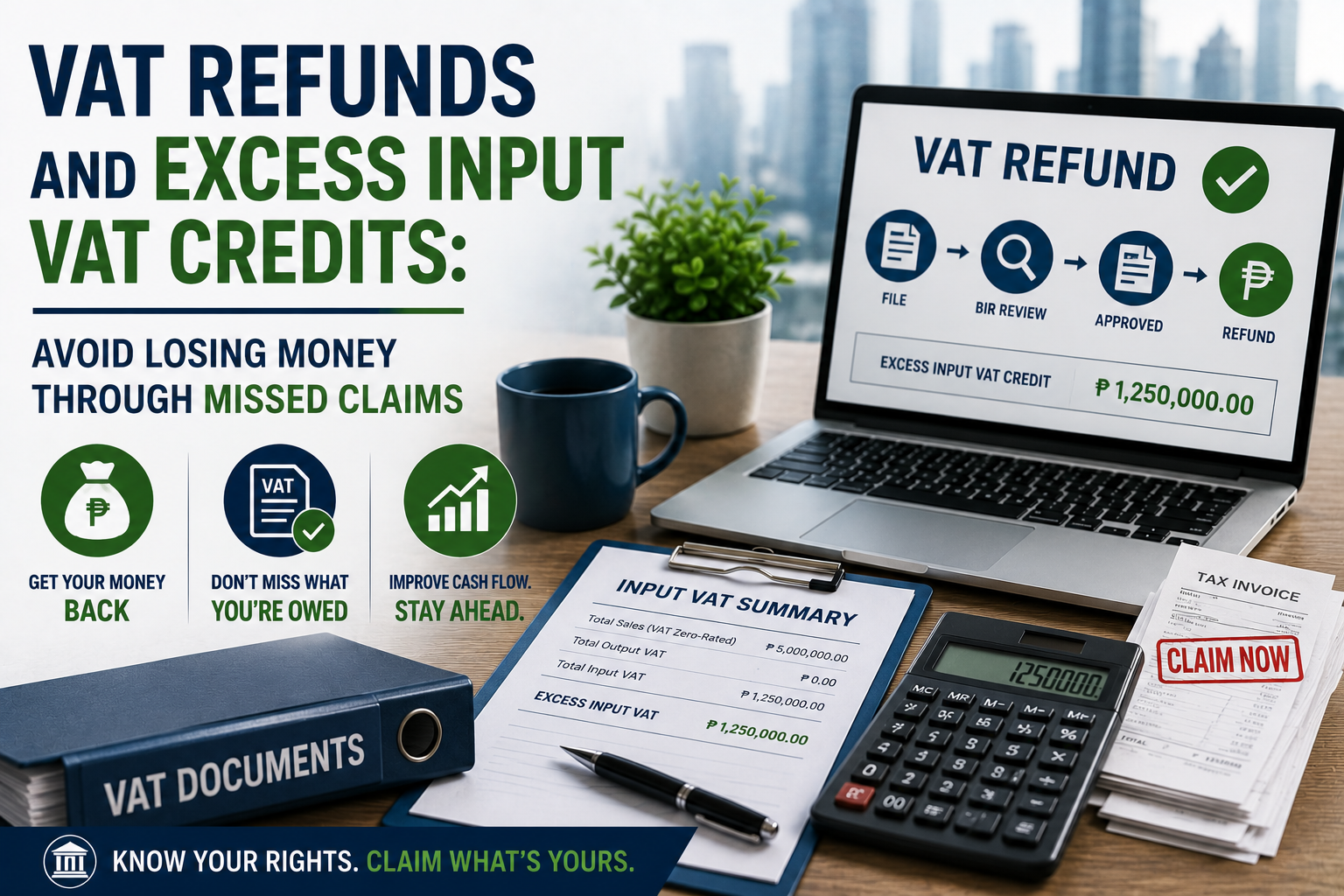
For many VAT-registered businesses, Value-Added Tax (VAT) is more than just a tax collected from customers—it is also a potential tax asset. Companies engaged in exports, zero-rated sales, or businesses with significant capital expenditures often accumulate millions of pesos in excess input VAT that can be recovered through tax credits or VAT refunds.
Unfortunately, countless businesses lose these valuable tax assets because they miss filing deadlines, fail to maintain complete documentation, or misunderstand the Bureau of Internal Revenue (BIR) refund process.
A properly managed VAT refund claim can significantly improve cash flow, strengthen working capital, and reduce the overall tax burden. Conversely, a missed claim may result in the permanent loss of a legitimate tax benefit.
This guide explains how VAT refunds and excess input VAT credits work, who qualifies, the documentary requirements, applicable deadlines, and practical tips for maximizing recovery.
What Is Input VAT?
Input VAT is the Value-Added Tax paid by a VAT-registered business on its purchases of goods, properties, or services used in the course of trade or business.
Examples include VAT paid on:
- Office supplies
- Professional services
- Equipment purchases
- Construction costs
- Rental expenses
- Utilities
- Raw materials
Normally, input VAT is credited against output VAT collected from customers.
However, some businesses consistently generate more input VAT than output VAT.
That excess becomes a valuable tax asset.
The Maximizing Tax Assets presentation identifies Excess Input VAT Credits as one of the major tax assets that businesses should properly monitor and utilize.
What Is Excess Input VAT?
Excess Input VAT arises when:
Input VAT > Output VAT
This commonly occurs when businesses:
- make zero-rated sales;
- export goods or services;
- are in the expansion stage;
- invest heavily in equipment or construction;
- incur significant startup costs.
Instead of allowing these VAT credits to remain unused indefinitely, the Tax Code provides mechanisms for recovery.
Who May Claim a VAT Refund?
VAT refunds are generally available to qualified VAT-registered taxpayers that generate zero-rated or effectively zero-rated sales, provided they satisfy the requirements of the National Internal Revenue Code and applicable BIR regulations.
Typical examples include:
- Exporters
- Business Process Outsourcing (BPO) companies, where applicable
- International service providers
- Enterprises selling to qualified export-oriented entities
- Other taxpayers entitled to zero-rated VAT treatment under the Tax Code
Qualification depends on the nature of the transaction and compliance with current tax laws.
What Are Zero-Rated Sales?
A zero-rated sale is a taxable transaction subject to 0% VAT.
Although the seller does not collect output VAT from the customer, the seller may still recover the input VAT incurred in making the sale, subject to compliance with legal requirements.
Common examples include:
- Export sales
- Certain sales to international carriers
- Qualified sales under special laws
- Certain cross-border services
Because no output VAT is collected, excess input VAT often accumulates over time.
Why VAT Refunds Matter
A VAT refund is more than a tax benefit—it is a cash flow opportunity.
Recovering excess input VAT allows businesses to:
- improve working capital;
- finance expansion;
- reduce borrowing;
- strengthen liquidity;
- recover taxes already paid.
For exporters with substantial operating costs, VAT refunds may amount to millions of pesos.
VAT Refund vs. Carry-Forward
Businesses generally have two ways of utilizing excess input VAT:
Option 1: Carry Forward
Excess input VAT may be carried forward and applied against future output VAT liabilities.
This option is often appropriate for businesses expecting future taxable sales.
Option 2: VAT Refund
Qualified taxpayers engaged in zero-rated transactions may instead seek a refund or tax credit of excess input VAT attributable to those transactions.
This allows recovery of taxes that otherwise cannot be utilized because no output VAT is generated.
Documentary Requirements
One of the most common reasons VAT refund claims are denied is insufficient documentation.
The BIR generally requires complete supporting documents, which may include:
- VAT invoices
- Official receipts, where applicable under the governing invoicing rules
- Importation documents
- Sales invoices supporting zero-rated sales
- Proof of export or qualifying transactions
- VAT returns
- Accounting records
- Schedules allocating input VAT
Every VAT refund claim should be fully supported by original records and proper accounting documentation.
Incomplete records frequently result in disallowed claims.
Observe the Statutory Deadlines
Timing is critical.
The National Internal Revenue Code imposes strict prescriptive periods for filing VAT refund claims.
Failure to file within the prescribed period generally results in the permanent loss of the refund.
Unlike many tax deductions that may be corrected through amended returns, an expired VAT refund claim usually cannot be revived.
Businesses should therefore maintain a VAT monitoring schedule to ensure that no filing deadline is missed.
The VAT Refund Process
Although the specific procedures may change as regulations evolve, the general process typically includes:
Step 1: Identify Excess Input VAT
Determine the portion of input VAT attributable to qualified zero-rated sales.
Step 2: Gather Supporting Documents
Compile:
- invoices,
- accounting records,
- VAT returns,
- proof of zero-rated transactions,
- importation records where applicable.
Step 3: File the Administrative Claim
Submit the refund application together with all documentary requirements to the BIR within the statutory period.
Step 4: BIR Evaluation
The BIR reviews:
- qualification of the taxpayer,
- validity of invoices,
- substantiation of input VAT,
- compliance with documentary requirements,
- computation of the claim.
Step 5: Refund or Tax Credit
If the claim is approved, the taxpayer may receive either:
- a cash refund; or
- a Tax Credit Certificate, depending on the applicable rules and circumstances.
Common Mistakes That Cause Refund Denials
Many legitimate claims fail because of avoidable errors.
1. Missing Filing Deadlines
Late filing is one of the most common reasons refund claims are denied.
No amount of documentation can cure an expired claim.
2. Incomplete Documentation
Missing invoices, invalid receipts, or incomplete schedules frequently result in partial or complete disallowance.
3. Improper VAT Invoices
Invoices that fail to comply with invoicing requirements may not support an input VAT claim.
Businesses should periodically review invoice compliance.
4. Incorrect Allocation of Input VAT
Only the portion of input VAT attributable to qualified zero-rated transactions may generally qualify for refund.
Improper allocation may reduce the allowable claim.
5. Poor Accounting Records
Differences between:
- VAT returns,
- books of account,
- financial statements,
- supporting schedules,
often trigger additional BIR scrutiny.
Annual reconciliation is essential.
Practical Tax Planning Tips
Businesses should adopt proactive VAT management practices.
Maintain a VAT Refund Monitoring Schedule
Track:
- input VAT accumulated;
- zero-rated sales;
- filing deadlines;
- documentary status;
- pending refund applications.
Review Documentation Quarterly
Waiting until year-end often results in missing invoices or incomplete records.
Quarterly reviews improve compliance.
Reconcile Accounting and Tax Records
Input VAT balances should always reconcile with:
- VAT returns;
- general ledger accounts;
- purchase journals;
- financial statements.
Conduct an Annual Tax Asset Review
Excess Input VAT should be reviewed together with other valuable tax assets, including:
- Creditable Withholding Taxes (CWT)
- Minimum Corporate Income Tax (MCIT)
- Net Operating Loss Carry-Over (NOLCO)
- Deferred Tax Assets
- Foreign Tax Credits
- Tax Credit Certificates
A comprehensive review helps ensure that no recoverable tax asset is overlooked.
Final Thoughts
Excess Input VAT represents real money that many businesses unknowingly leave unclaimed. For exporters, zero-rated sellers, and companies with substantial capital investments, VAT refunds can provide a significant source of cash flow and improve overall financial performance.
However, success depends on strict compliance with Philippine tax laws. Businesses must maintain complete documentation, properly substantiate zero-rated transactions, reconcile accounting records, and file claims within the statutory deadlines.
By treating excess input VAT as a strategic tax asset rather than simply an accounting balance, businesses can maximize legitimate tax recovery while remaining fully compliant with BIR requirements.
Proper VAT management is not merely about compliance—it is about ensuring that every peso of recoverable tax is preserved and claimed.
Disclaimer: This article is intended for general informational purposes only and should not be construed as legal or tax advice. The availability of VAT refunds and excess input VAT credits depends on the taxpayer’s specific facts, applicable provisions of the National Internal Revenue Code, BIR regulations and issuances, and prevailing jurisprudence. Businesses should consult a qualified CPA and tax lawyer before filing any VAT refund claim or implementing tax planning strategies. The discussion is informed in part by the Maximizing Tax Assets presentation, which identifies Excess Input VAT Credits as a significant corporate tax asset.
Navigating the business landscape in the Philippines can be both rewarding and intricate. Whether you’re embarking on a new venture or scaling up, ensuring that your corporate endeavors are in line with local regulations is paramount.
At CBOS Business Solutions Inc., we pride ourselves on simplifying these processes for our clients. As a seasoned professional services company, we offer comprehensive assistance with SEC Registration, Visa processing, and a myriad of other essential business requirements. Our team of experts is dedicated to ensuring that your business is compliant, well-established, and ready to thrive in the Philippine market.
Why venture into the complexities of business registration and compliance alone? Allow our team to guide you every step of the way. After all, your success is our commitment.
Get in touch today and let us be your partner in achieving your business goals in the Philippines.
Email Address: gerald.bernardo@cbos.com.ph
Mobile No.: +639270032851
You can also click this link to schedule a meeting.
Leave a Reply