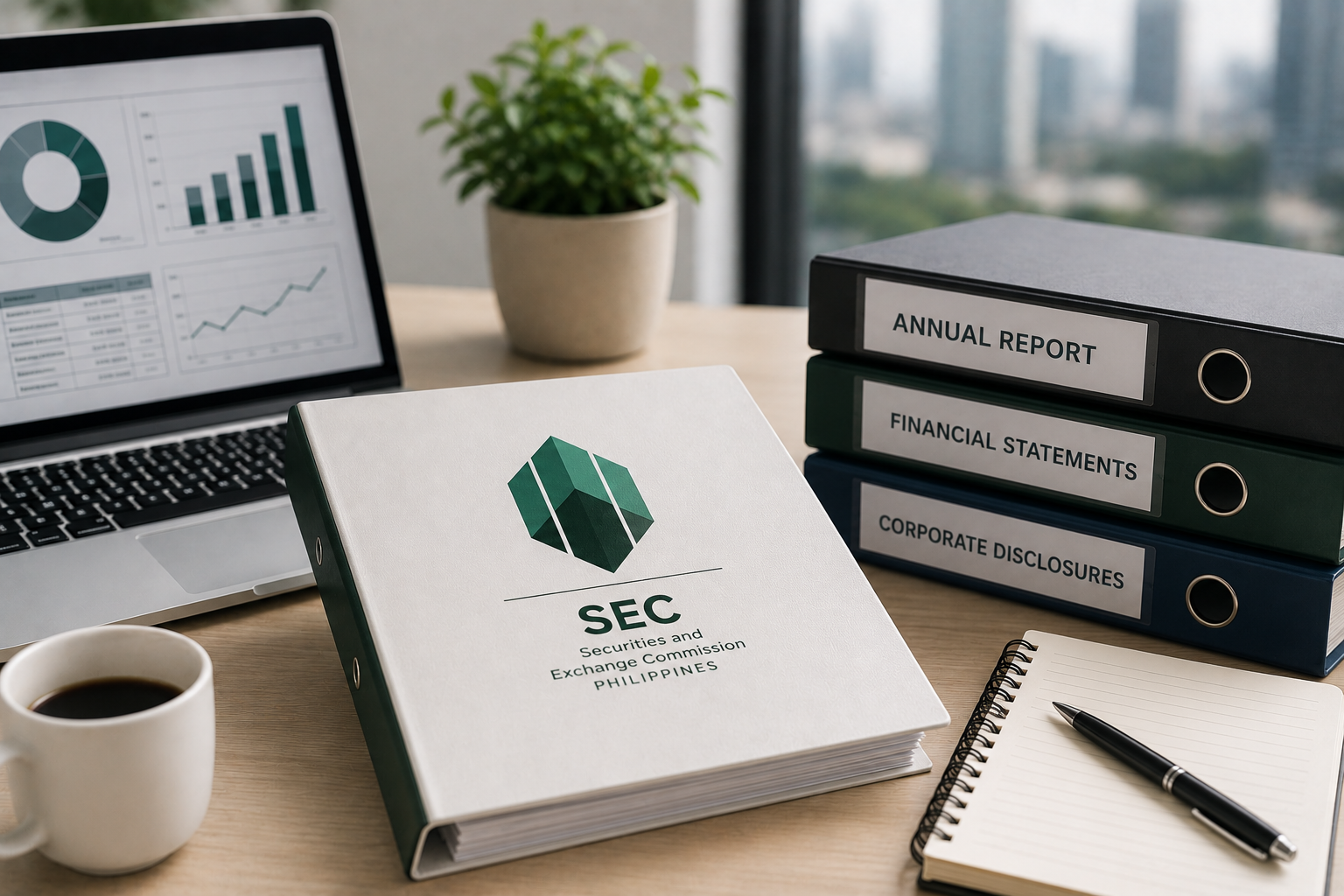
Registering a corporation with the Securities and Exchange Commission (SEC) is only the beginning of your compliance responsibilities. Once incorporated, every corporation must continue to satisfy various reportorial requirements to maintain good standing and avoid administrative penalties.
Many corporations mistakenly believe that filing taxes with the Bureau of Internal Revenue (BIR) is sufficient. In reality, the SEC imposes separate annual reportorial requirements, including the submission of financial statements, corporate information, and other regulatory filings. Failure to comply may result in fines, suspension, revocation of corporate registration, or complications in obtaining business permits, financing, and government clearances.
This guide explains the key SEC annual reportorial requirements, including the Annual Financial Statements (AFS), the General Information Sheet (GIS), important compliance deadlines, and practical tips for maintaining good corporate standing.
Why SEC Reportorial Compliance Matters
The Securities and Exchange Commission regulates corporations to promote transparency, accountability, and good corporate governance.
Annual reportorial requirements allow the SEC to monitor whether corporations continue to:
- operate lawfully;
- maintain updated corporate records;
- disclose accurate financial information;
- comply with the Revised Corporation Code and SEC regulations.
For businesses, timely compliance also helps:
- maintain active corporate status;
- facilitate loan applications;
- attract investors;
- avoid penalties and legal complications.
Who Must Comply?
Annual SEC reportorial requirements generally apply to:
- Domestic stock corporations
- Domestic non-stock corporations
- Foreign corporations licensed to do business in the Philippines
- One Person Corporations (OPCs), subject to applicable SEC rules
- Other entities registered with the SEC
The specific reports required may vary depending on the corporation’s legal structure and regulatory classification.
Annual Financial Statements (AFS)
One of the principal annual submissions required by the SEC is the Annual Financial Statements (AFS).
These statements present the corporation’s financial condition for the fiscal year and are prepared in accordance with the applicable Philippine Financial Reporting Standards (PFRS) or other applicable financial reporting frameworks.
A complete set of financial statements generally includes:
- Statement of Financial Position
- Statement of Comprehensive Income
- Statement of Changes in Equity
- Statement of Cash Flows
- Notes to the Financial Statements
The financial statements provide shareholders, regulators, creditors, and other stakeholders with an accurate picture of the corporation’s financial performance.
Audited Financial Statements
Many corporations are required to submit Audited Financial Statements, which must be examined and certified by an independent Certified Public Accountant (CPA), depending on the applicable laws and SEC or BIR requirements.
The independent auditor evaluates whether the financial statements fairly present the corporation’s financial position and operating results in accordance with the applicable accounting standards.
An audit enhances the credibility of financial reporting and supports regulatory compliance.
General Information Sheet (GIS)
Another important annual filing is the General Information Sheet (GIS).
The GIS provides the SEC with updated information regarding the corporation, including:
- Corporate name
- Principal office address
- Business activities
- Directors
- Officers
- Shareholders or members
- Capital structure
- Other corporate information required by the SEC
The purpose of the GIS is to ensure that the SEC maintains accurate and current records of every registered corporation.
Compliance Deadlines
Meeting filing deadlines is one of the most important aspects of SEC compliance.
General Information Sheet (GIS)
The GIS is generally required to be filed within thirty (30) calendar days from the date of the corporation’s annual stockholders’ meeting (for stock corporations) or annual members’ meeting (for non-stock corporations).
Because the filing period is based on the date of the annual meeting rather than a fixed calendar date, corporations should carefully monitor their meeting schedules.
Annual Financial Statements (AFS)
The deadline for filing the Annual Financial Statements depends on the corporation’s fiscal year-end and the filing schedule prescribed annually by the SEC.
The SEC typically issues an annual memorandum establishing a staggered filing schedule, often based on the last numerical digit of the corporation’s SEC registration or a similar classification.
Corporations should review the latest SEC circulars each year to determine their exact filing deadline.
Relationship Between SEC and BIR Filings
Although both agencies require financial information, SEC compliance is separate from BIR compliance.
The BIR primarily focuses on:
- taxation;
- income reporting;
- tax payments.
The SEC focuses on:
- corporate governance;
- financial reporting;
- corporate information;
- compliance with the Revised Corporation Code.
Accordingly, corporations should ensure consistency between:
- Annual Financial Statements;
- Annual Income Tax Returns;
- books of account;
- audited reports;
- corporate records.
Differences between SEC and BIR filings may trigger regulatory inquiries.
Common Compliance Mistakes
Many corporations incur penalties because of avoidable errors.
1. Missing Filing Deadlines
Late submission of the GIS or AFS may result in administrative fines and other regulatory consequences.
Maintaining a compliance calendar helps prevent missed deadlines.
2. Outdated Corporate Information
Corporations sometimes fail to update:
- directors;
- officers;
- principal office address;
- corporate secretary;
- share ownership information.
The GIS should accurately reflect current corporate information.
3. Inconsistent Financial Information
Financial statements submitted to the SEC should be consistent with:
- BIR filings;
- audited financial statements;
- accounting records.
Inconsistencies may raise regulatory concerns.
4. Poor Corporate Recordkeeping
Incomplete corporate records frequently delay report preparation.
Businesses should maintain organized files containing:
- Articles of Incorporation;
- By-Laws;
- Board resolutions;
- Stock and transfer books;
- Minutes of meetings;
- Financial statements;
- Tax records.
Good corporate governance begins with complete documentation.
5. Delaying Audit Preparation
Waiting until filing deadlines approach often creates unnecessary pressure.
Businesses should begin preparing financial statements and coordinating with their external auditor well before year-end reporting deadlines.
Practical Tips for SEC Compliance
To maintain good standing with the SEC:
Maintain a Compliance Calendar
Track important dates for:
- Annual Stockholders’ or Members’ Meeting;
- GIS filing;
- Annual Financial Statement submission;
- BIR annual filings;
- permit renewals.
Keep Corporate Records Updated
Immediately record changes involving:
- directors;
- officers;
- shareholders;
- registered office;
- capital structure.
Prompt updates simplify annual reporting.
Coordinate with Your CPA
Your CPA can assist with:
- preparing financial statements;
- completing audit requirements;
- reconciling tax records;
- ensuring consistency between SEC and BIR filings.
Review SEC Issuances Annually
The SEC regularly issues memoranda updating filing procedures, deadlines, and documentary requirements.
Corporations should review the latest issuances each year to ensure continued compliance.
Consequences of Non-Compliance
Failure to comply with SEC reportorial requirements may result in:
- administrative fines;
- penalties for late filing;
- issuance of notices of violation;
- suspension or revocation of the corporation’s registration in serious or repeated cases;
- delays in obtaining government permits and licenses;
- difficulties in securing financing or attracting investors.
Timely compliance helps preserve the corporation’s legal standing and reputation.
Final Thoughts
SEC reportorial compliance is an essential responsibility of every corporation in the Philippines. Filing the Annual Financial Statements and General Information Sheet accurately and on time not only satisfies regulatory requirements but also demonstrates transparency, accountability, and sound corporate governance.
Corporations that maintain organized records, monitor compliance deadlines, and coordinate closely with their accountants, auditors, and legal advisers are better positioned to avoid penalties and support long-term business growth.
Remember that SEC compliance is not a once-a-year obligation—it is part of an ongoing commitment to responsible corporate management. By treating reportorial requirements as an integral component of good governance rather than a mere regulatory burden, corporations can strengthen stakeholder confidence and maintain their good standing with the SEC.
Disclaimer: This article is intended for general informational purposes only and should not be construed as legal, accounting, or tax advice. SEC reportorial requirements, filing procedures, and deadlines may vary depending on the corporation’s legal structure, fiscal year-end, and applicable SEC rules and memoranda. Corporations should consult a qualified CPA, corporate secretary, or legal counsel and review the latest SEC issuances to ensure full compliance with current Philippine laws and regulations.
Leave a Reply