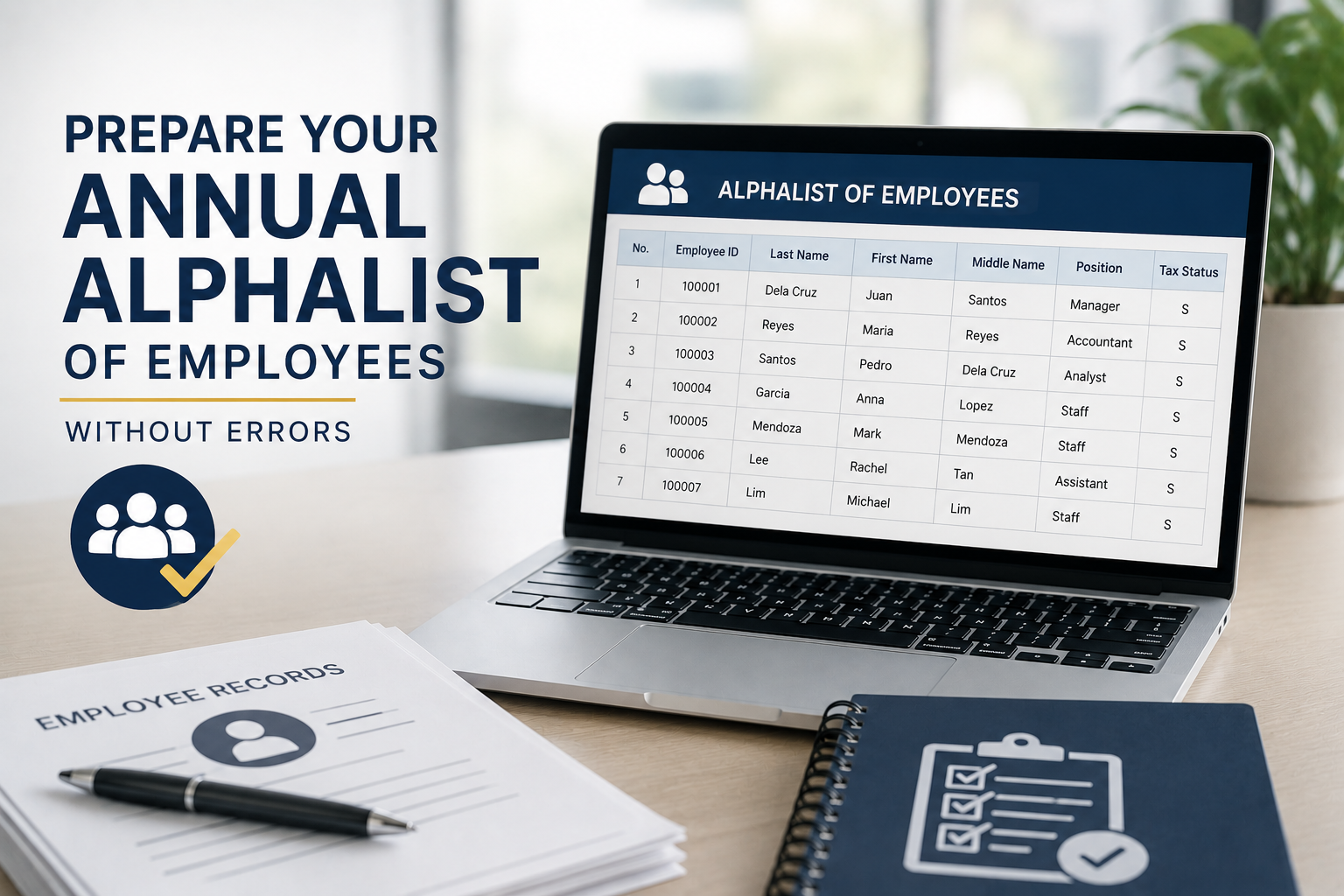
For employers in the Philippines, year-end tax compliance involves more than filing annual tax returns. One of the most important—and often overlooked—requirements is the preparation and submission of the Annual Alphalist of Employees. Although it may appear to be a simple list of employees and their compensation, even minor errors can lead to rejected submissions, BIR notices, penalties, and delays in employee tax compliance.
The Annual Alphalist is closely linked to BIR Form 1604-C and BIR Form 2316. Because the Bureau of Internal Revenue (BIR) cross-checks the information reported in these documents, inconsistencies can trigger tax audits and require costly corrections.
This guide explains what the Annual Alphalist is, who is required to submit it, common mistakes employers make, and practical tips for preparing an accurate submission.
What Is the Annual Alphalist of Employees?
The Annual Alphalist of Employees is a detailed schedule submitted to the BIR containing information about employees who received compensation during the taxable year.
It supplements the employer’s annual compensation tax reporting and allows the BIR to verify:
- Compensation income paid
- Taxes withheld from employees
- Employer payroll records
- BIR Form 2316 issued to employees
- Annual withholding tax returns
The Alphalist is an essential component of year-end payroll compliance.
Who Is Required to Submit the Annual Alphalist?
Generally, employers required to file BIR Form 1604-C must also submit the corresponding Annual Alphalist of Employees in accordance with applicable BIR regulations.
This typically includes:
- Sole proprietorships with employees
- Partnerships
- Domestic corporations
- Resident foreign corporations
- Branch offices
- Representative offices
- Government agencies
- Government-owned and controlled corporations (GOCCs)
- Non-stock and non-profit organizations with employees
If an employer withholds taxes on compensation, the Annual Alphalist is generally part of its year-end reporting obligations.
Why Is the Annual Alphalist Important?
The BIR uses the Annual Alphalist to reconcile information reported in several tax filings.
It compares the Alphalist with:
- BIR Form 1604-C
- BIR Form 2316
- Monthly compensation withholding tax returns
- Payroll records
- Income tax returns of employees, where applicable
Any inconsistencies may result in requests for clarification or further examination.
For employers, accurate reporting demonstrates compliance and reduces the likelihood of payroll-related tax issues.
Information Included in the Annual Alphalist
While the exact format and electronic submission requirements are prescribed by the BIR, the Annual Alphalist generally contains:
- Employee’s full name
- Taxpayer Identification Number (TIN)
- Employment status
- Gross compensation
- Taxable compensation
- Non-taxable compensation and benefits
- Taxes withheld
- Other payroll information required by the BIR
The information should be consistent with the employer’s payroll records and BIR Form 2316.
Relationship Between the Annual Alphalist, Form 1604-C, and Form 2316
These three reports are closely connected.
Annual Alphalist
Contains detailed employee-by-employee payroll information.
BIR Form 1604-C
Summarizes the employer’s annual compensation and withholding tax information.
BIR Form 2316
Issued individually to employees as proof of compensation received and taxes withheld.
All three documents should reconcile.
If an employee’s compensation differs between the Alphalist and Form 2316, the discrepancy may create compliance issues for both the employer and the employee.
Practical Steps for Preparing an Accurate Annual Alphalist
Step 1: Update Employee Records
Before preparing the Alphalist, verify each employee’s:
- Full legal name
- Taxpayer Identification Number (TIN)
- Employment status
- Date of hiring
- Date of separation, if applicable
Accurate employee information is the foundation of correct reporting.
Step 2: Reconcile Payroll Records
Compare:
- Payroll registers
- General ledger balances
- Compensation expense accounts
- Monthly withholding tax returns
Ensure that year-end totals are accurate.
Step 3: Verify Compensation Figures
Review:
- Basic salary
- Overtime pay
- Bonuses
- Allowances
- Taxable benefits
- Non-taxable benefits
- Separation pay, where applicable
Confirm that compensation has been correctly classified under applicable tax rules.
Step 4: Reconcile Taxes Withheld
Verify that:
- taxes withheld from employees;
- taxes remitted to the BIR; and
- payroll records
all agree.
Differences should be investigated before filing.
Step 5: Compare with BIR Form 2316
The compensation and withholding tax information in the Annual Alphalist should exactly match the information reported in each employee’s BIR Form 2316.
This reconciliation minimizes reporting discrepancies.
Common Errors Employers Should Avoid
1. Incorrect Taxpayer Identification Numbers (TINs)
One incorrect digit in an employee’s TIN may result in rejected submissions or mismatched BIR records.
Always verify TINs before finalizing the Alphalist.
2. Misspelled Employee Names
Employee names should match the official records maintained by the BIR and other government agencies.
Avoid abbreviations or inconsistent name formats.
3. Incorrect Classification of Compensation
Improperly classifying taxable compensation as non-taxable—or vice versa—may lead to incorrect withholding tax computations.
Payroll personnel should review the applicable tax rules before year-end reporting.
4. Failure to Include Resigned Employees
Employers sometimes report only active employees.
Employees who resigned, retired, or were terminated during the taxable year may still need to be included if they received compensation during the reporting period.
5. Differences Between Payroll and Accounting Records
Payroll records should reconcile with:
- Compensation expense accounts
- General ledger
- Financial statements
- Annual withholding tax returns
Unreconciled figures frequently become audit issues.
6. Late Preparation
Waiting until the filing deadline often results in rushed work and avoidable errors.
Preparing the Alphalist well before year-end allows sufficient time for reconciliation and corrections.
Practical Tips for Payroll and HR Compliance
Maintain Updated Employee Master Files
Regularly update:
- Employee names
- TINs
- Addresses
- Employment status
- Payroll classifications
Accurate employee data improves reporting accuracy.
Reconcile Payroll Monthly
Do not wait until year-end.
Monthly reconciliation between payroll, accounting, and tax records simplifies annual reporting.
Coordinate HR, Payroll, and Accounting
The Human Resources, Payroll, and Accounting departments should work together throughout the year to ensure consistent employee information and payroll records.
Strong internal coordination minimizes reporting errors.
Conduct an Internal Payroll Audit
Before filing annual reports, review:
- Payroll summaries
- BIR Form 2316
- BIR Form 1604-C
- Annual Alphalist
- Withholding tax remittances
An internal review helps identify discrepancies before submission.
Stay Updated with BIR Issuances
The BIR periodically updates electronic submission requirements, file formats, and validation procedures.
Employers should monitor the latest Revenue Regulations, Revenue Memorandum Circulars, and Revenue Memorandum Orders affecting payroll reporting.
Consequences of Errors and Non-Compliance
Failure to prepare an accurate Annual Alphalist may result in:
- Administrative penalties
- Delayed acceptance of annual tax submissions
- Requests for clarification from the BIR
- Payroll tax audit findings
- Employee concerns regarding incorrect tax records
- Additional administrative work to correct submissions
Timely and accurate reporting helps reduce compliance risks.
Best Practices Before Submission
Before submitting the Annual Alphalist, employers should confirm that:
- Employee information is complete and accurate.
- Payroll records reconcile with accounting records.
- BIR Form 2316 has been prepared for all applicable employees.
- BIR Form 1604-C agrees with the Annual Alphalist.
- Taxes withheld match taxes remitted.
- Required electronic files comply with current BIR submission standards.
- Internal reviews have been completed by payroll, accounting, and management.
A thorough review before submission is one of the most effective ways to prevent filing errors.
Final Thoughts
Preparing the Annual Alphalist of Employees is more than a routine administrative task—it is a critical component of payroll tax compliance. Because the BIR uses the Alphalist to validate payroll information, withholding taxes, and employee compensation, accuracy is essential.
Employers who maintain updated employee records, reconcile payroll throughout the year, and coordinate closely with their HR, Payroll, Accounting, and tax advisers are better positioned to avoid penalties and unnecessary BIR inquiries.
Ultimately, effective payroll compliance is built on accurate records, timely reporting, and proactive internal controls. Investing time in preparing a correct Annual Alphalist not only satisfies regulatory requirements but also strengthens your organization’s overall tax compliance and corporate governance.
Disclaimer: This article is intended for general informational purposes only and should not be construed as legal, accounting, or tax advice. Requirements relating to the Annual Alphalist of Employees, BIR Form 1604-C, and payroll tax reporting are governed by the National Internal Revenue Code, applicable BIR regulations, revenue issuances, and electronic filing guidelines, which may be amended from time to time. Employers should consult a qualified CPA or tax lawyer and review the latest BIR issuances to ensure full compliance with current Philippine payroll and withholding tax requirements.
Leave a Reply