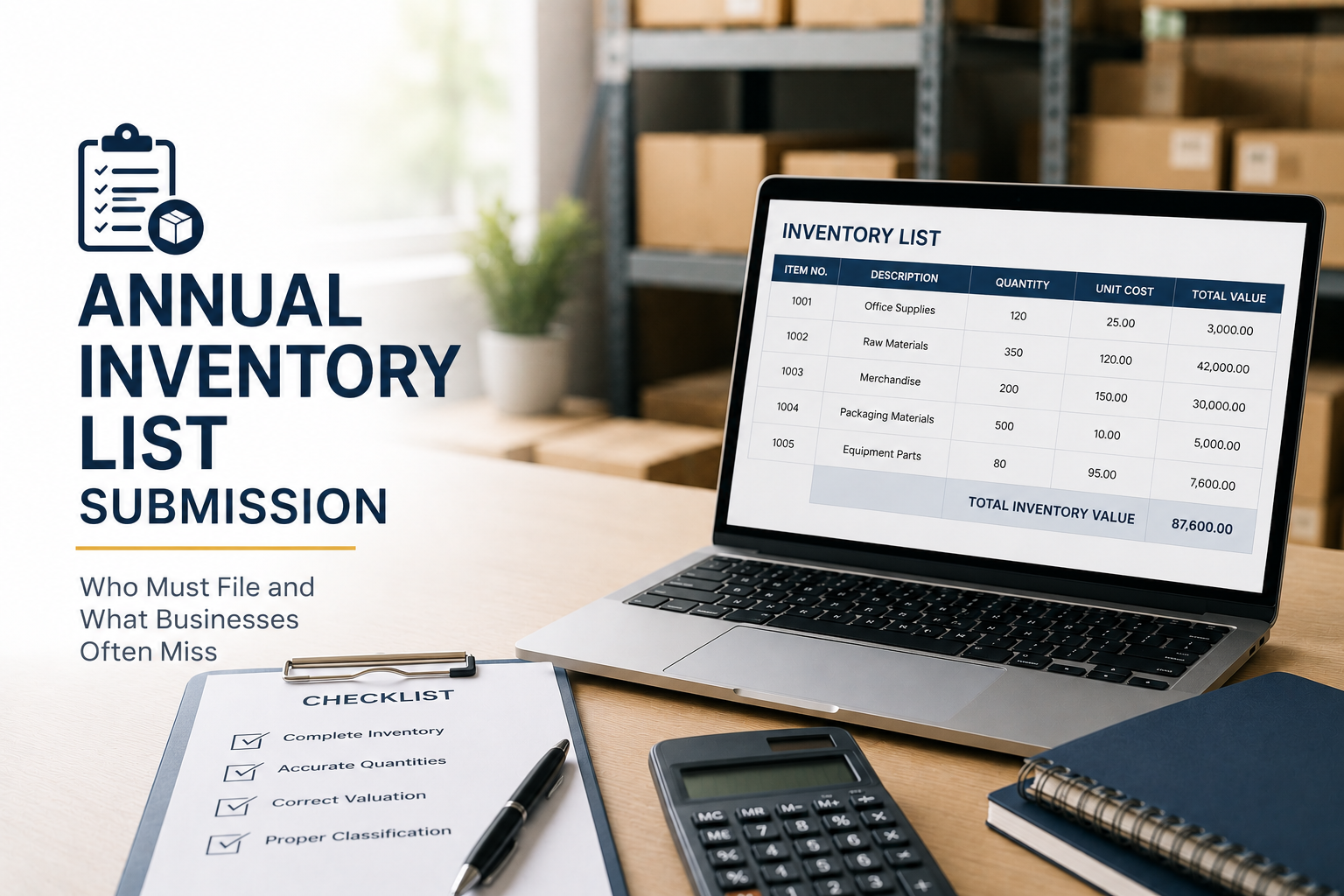
Inventory is one of the largest assets reported by many businesses. Whether you operate a retail store, manufacturing company, wholesaler, restaurant, pharmacy, hardware store, or distribution business, your inventory directly affects your cost of sales, taxable income, and financial statements. Because of its significance, the Bureau of Internal Revenue (BIR) requires certain taxpayers to submit an Annual Inventory List as part of their tax compliance obligations.
Unfortunately, many businesses either overlook this requirement or submit incomplete inventory records that do not reconcile with their books of account and financial statements. These errors can trigger BIR inquiries, tax assessments, and unnecessary audit issues.
This guide explains who is required to file an Annual Inventory List, the documentary requirements, the importance of reconciling inventory records with financial statements, and practical tips for maintaining compliance.
What Is the Annual Inventory List?
The Annual Inventory List is a detailed report submitted to the Bureau of Internal Revenue by qualified taxpayers showing the quantity and value of inventory on hand at the end of the taxable year.
The inventory list serves as supporting documentation for:
- Cost of Sales
- Cost of Goods Sold (COGS)
- Ending Inventory
- Financial Statements
- Annual Income Tax Return
It enables the BIR to verify whether the inventory reported in the taxpayer’s books and financial statements is properly supported.
Why Is the Annual Inventory List Important?
Inventory directly affects taxable income.
The basic formula illustrates its significance:
Beginning Inventory
- Purchases
− Ending Inventory
= Cost of Goods Sold
Since Cost of Goods Sold is one of the largest deductible expenses for trading and manufacturing businesses, inaccurate inventory records may significantly affect income tax computations.
The Annual Inventory List provides transparency and allows the BIR to validate reported inventory balances.
Who Is Required to Submit an Annual Inventory List?
Generally, businesses engaged in activities involving inventories may be required to submit an Annual Inventory List, particularly those maintaining inventories of goods held for sale, raw materials, work-in-process, or finished goods.
This commonly includes:
- Retail businesses
- Wholesalers
- Manufacturers
- Importers
- Exporters
- Restaurants
- Pharmacies
- Hardware stores
- Supermarkets
- Construction companies maintaining inventories
- Other businesses maintaining inventory for commercial purposes
The submission requirement and applicable thresholds are governed by BIR regulations and revenue issuances. Businesses should verify whether they are covered by the latest rules.
What Types of Inventory Are Reported?
Depending on the nature of the business, the Annual Inventory List may include:
Merchandise Inventory
Goods purchased for resale.
Examples:
- Grocery products
- Clothing
- Electronics
- Hardware supplies
Raw Materials
Materials used in manufacturing products.
Examples:
- Steel
- Chemicals
- Fabric
- Packaging materials
Work-in-Process (WIP)
Products that are still undergoing production at year-end.
Finished Goods
Completed products ready for sale.
Supplies
Certain consumable supplies maintained for business operations, where applicable.
Documentary Requirements
The BIR generally requires sufficient details to support the reported inventory balances.
Depending on the applicable regulations and the nature of the business, inventory records typically include:
- Description of inventory items
- Stock Keeping Unit (SKU) or item codes, where applicable
- Quantity on hand
- Unit of measure
- Unit cost
- Total inventory value
Businesses should maintain supporting documents such as:
- Purchase invoices
- Importation documents
- Receiving reports
- Delivery receipts
- Warehouse records
- Inventory count sheets
- Stock cards
- Inventory movement reports
These records help substantiate inventory balances during a BIR audit.
Physical Inventory Count
An Annual Inventory List should be based on an actual physical inventory count conducted at or near the end of the taxable year.
Physical inventory helps verify:
- actual quantities on hand;
- damaged goods;
- obsolete inventory;
- slow-moving items;
- inventory shortages.
Without an actual inventory count, reported balances may not accurately reflect the company’s true financial position.
Reconciling Inventory with Financial Statements
One of the most important year-end procedures is ensuring that inventory records reconcile with the company’s financial statements.
The following records should agree:
- Inventory subsidiary ledger
- General ledger
- Trial balance
- Statement of Financial Position
- Cost of Goods Sold schedule
- Annual Income Tax Return
Any unexplained differences may invite questions during a BIR audit.
Inventory and Cost of Goods Sold
Inventory has a direct effect on taxable income.
If ending inventory is overstated:
- Cost of Goods Sold decreases.
- Net income increases.
- Income tax may increase.
If ending inventory is understated:
- Cost of Goods Sold increases.
- Net income decreases.
- Taxable income may be understated, potentially resulting in deficiency tax assessments.
Accurate inventory valuation is therefore essential.
Common Mistakes Businesses Make
Many businesses encounter tax issues because of avoidable inventory errors.
1. No Physical Inventory Count
Some businesses estimate inventory instead of performing an actual count.
This increases the risk of inaccurate financial reporting.
2. Incomplete Inventory Records
Missing:
- quantities;
- descriptions;
- unit costs;
- inventory locations;
may result in unsupported inventory balances.
3. Failure to Reconcile Accounting Records
Inventory schedules should reconcile with:
- books of account;
- financial statements;
- tax returns.
Unreconciled balances frequently trigger audit questions.
4. Incorrect Inventory Valuation
Inventory should be valued using an acceptable accounting method consistent with applicable accounting standards and tax rules.
Changing valuation methods without proper justification may create reporting issues.
5. Ignoring Obsolete Inventory
Damaged or obsolete inventory should be evaluated appropriately.
Keeping obsolete items at full value may overstate assets and distort financial statements.
6. Missing Filing Deadlines
Businesses sometimes prepare the inventory list but fail to submit it within the period prescribed by the BIR.
Late submissions may result in penalties and additional compliance concerns.
Best Practices for Inventory Compliance
Conduct Year-End Physical Counts
Schedule physical inventory counts before year-end or immediately thereafter, in accordance with your accounting policies and applicable regulations.
Maintain Perpetual Inventory Records
Businesses using inventory systems should regularly update:
- purchases;
- sales;
- returns;
- transfers;
- adjustments.
Accurate records simplify year-end reporting.
Reconcile Inventory Monthly
Do not wait until year-end.
Monthly reconciliation helps identify:
- shortages;
- recording errors;
- duplicate entries;
- inventory variances.
Coordinate Accounting and Operations
Warehouse personnel, purchasing staff, accounting, and management should work together to verify inventory balances.
Strong internal controls improve reporting accuracy.
Retain Supporting Documents
Keep organized records of:
- purchase invoices;
- receiving reports;
- warehouse logs;
- inventory count sheets;
- adjustment approvals;
- disposal records for obsolete inventory.
Complete documentation supports inventory balances during BIR examinations.
Consequences of Non-Compliance
Failure to maintain accurate inventory records or submit required inventory reports may expose businesses to:
- BIR audit findings;
- disallowance of inventory-related deductions;
- deficiency income tax assessments;
- penalties for non-compliance;
- questions regarding Cost of Goods Sold computations;
- delays during tax examinations.
Proper inventory management reduces both tax and financial reporting risks.
Practical Year-End Inventory Checklist
Before submitting your Annual Inventory List, confirm that:
- A physical inventory count has been completed.
- Inventory quantities match warehouse records.
- Inventory values are computed using the company’s approved valuation method.
- Inventory schedules reconcile with the general ledger.
- Ending inventory agrees with the financial statements.
- Cost of Goods Sold has been properly computed.
- Supporting documents are complete and organized.
- The inventory list is prepared in the format required by the BIR.
- Submission deadlines have been verified.
Completing this checklist can significantly reduce year-end compliance issues.
Final Thoughts
The Annual Inventory List is more than a regulatory filing—it is a critical document that supports the accuracy of a company’s financial statements, tax returns, and inventory records. Because inventory directly affects taxable income, errors in inventory reporting can have significant financial and tax consequences.
Businesses should treat inventory management as an ongoing process rather than a year-end exercise. Regular stock reconciliations, accurate accounting records, timely physical counts, and complete documentation not only improve operational efficiency but also strengthen compliance with BIR requirements.
By working closely with accountants, warehouse personnel, and tax advisers, businesses can ensure that their Annual Inventory List accurately reflects their operations, minimizes audit risks, and supports reliable financial reporting.
Disclaimer: This article is intended for general informational purposes only and should not be construed as legal, accounting, or tax advice. Annual Inventory List requirements, filing thresholds, documentary requirements, and submission procedures are governed by the National Internal Revenue Code, applicable BIR regulations, revenue issuances, and administrative guidelines, which may be amended from time to time. Businesses should consult a qualified Certified Public Accountant (CPA) or tax lawyer and review the latest BIR issuances to determine their reporting obligations and ensure full compliance with Philippine tax laws.
Leave a Reply