A Practical Guide for Finance Teams and Entrepreneurs
Annual tax compliance is one of the most important responsibilities of every business operating in the Philippines. Yet many companies only begin preparing their tax returns when filing deadlines are fast approaching. This last-minute approach often results in incomplete records, filing errors, missed tax-saving opportunities, and unnecessary penalties imposed by the Bureau of Internal Revenue (BIR).
An effective solution is to develop an Annual Tax Compliance Checklist—a structured tool that helps businesses monitor filing obligations, organize supporting documents, assign responsibilities, and ensure that no compliance requirement is overlooked.
Whether you are a startup entrepreneur, an SME owner, or part of a finance department, having a well-designed tax compliance checklist can significantly improve your organization’s efficiency and reduce tax-related risks.
This guide explains how to create an annual tax compliance checklist that supports timely and accurate compliance with Philippine tax laws.
What Is an Annual Tax Compliance Checklist?
An Annual Tax Compliance Checklist is a comprehensive list of all tax-related activities that a business must complete throughout the year.
It serves as a compliance management tool that helps businesses:
- Track statutory deadlines
- Monitor recurring tax obligations
- Organize financial records
- Assign responsibilities to team members
- Prepare for tax filing season
- Reduce the likelihood of penalties and BIR audits
Instead of relying on memory or reacting to approaching deadlines, businesses can proactively manage compliance through an organized process.
Why Every Business Needs One
Regardless of size, every registered business has tax responsibilities.
A compliance checklist helps businesses:
- Avoid late filing and payment penalties
- Improve bookkeeping accuracy
- Strengthen internal controls
- Ensure consistency between financial records and tax returns
- Reduce the risk of BIR assessments and audits
- Improve coordination between finance, accounting, payroll, and management
More importantly, it allows business owners to focus on growing their business rather than resolving preventable compliance issues.
Step 1: List All Your Tax Obligations
The first step is identifying every annual tax requirement that applies to your business.
Depending on your taxpayer classification, these may include:
- Annual Income Tax Return (AITR)
- Annual Financial Statements
- BIR Form 1604-C
- BIR Form 1604-E
- BIR Form 1604-F
- Annual Alphalist of Employees
- BIR Forms 2316
- Annual Inventory List, where applicable
- SEC Annual Reportorial Requirements (for corporations)
- Local Government permit renewals, where applicable
Every business should tailor its checklist according to its legal structure, industry, and registration status.
Step 2: Create a Tax Compliance Calendar
Once your filing obligations are identified, organize them into a yearly calendar.
Include:
- Filing deadlines
- Payment deadlines
- Documentary submission dates
- Internal review schedules
- Audit preparation timelines
Many businesses also establish internal deadlines several days or weeks before statutory due dates to allow time for review and corrections.
Step 3: Keep Your Books of Accounts Updated
No checklist will be effective without accurate bookkeeping.
Throughout the year, ensure that:
- Sales are recorded promptly.
- Purchases are properly documented.
- Business expenses are supported by valid invoices and receipts.
- Journal entries are updated.
- General Ledger balances are accurate.
- Bank accounts are reconciled regularly.
Proper bookkeeping makes year-end tax preparation significantly easier.
Step 4: Include Payroll Compliance
Payroll should form part of every tax compliance checklist.
Review:
- Employee payroll records
- Taxpayer Identification Numbers (TINs)
- Compensation paid
- Taxes withheld
- Government contributions
Payroll records should reconcile with:
- BIR Form 2316
- Annual Alphalist of Employees
- BIR Form 1604-C
Regular payroll reviews reduce employee-related tax issues.
Step 5: Monitor Withholding Taxes
Businesses acting as withholding agents should include withholding tax reconciliation in their checklist.
Review:
- Expanded Withholding Tax (EWT)
- Final Withholding Tax (FWT)
- Compensation Withholding Tax
Verify that:
- Monthly withholding tax returns agree with accounting records.
- BIR Forms 2307 and 2306 have been properly issued.
- Taxes withheld have been remitted on time.
This minimizes discrepancies during annual reporting.
Step 6: Prepare Financial Statements Early
Many businesses postpone financial statement preparation until tax filing season.
Instead, include periodic financial reviews in your checklist.
Review:
- Trial Balance
- Accounts Receivable
- Accounts Payable
- Bank reconciliations
- Fixed Assets
- Depreciation schedules
- Loan balances
If an independent audit is required, coordinate with your CPA well before filing deadlines.
Early preparation provides ample time to address accounting adjustments.
Step 7: Schedule Inventory Reviews
Businesses maintaining inventories should conduct periodic inventory reviews instead of waiting until year-end.
Your checklist should include:
- Physical inventory count
- Inventory valuation
- Obsolete inventory review
- Inventory reconciliation
- Warehouse verification
Inventory records should agree with accounting records and financial statements.
Step 8: Review Tax Credits and Deductions
Year-end is the ideal time to verify whether all available tax benefits have been properly documented.
Review:
- Creditable Withholding Taxes (BIR Form 2307)
- Minimum Corporate Income Tax (MCIT)
- Net Operating Loss Carry-Over (NOLCO)
- Excess Input VAT
- Foreign Tax Credits, where applicable
- Deferred Tax Assets
Supporting documents should be complete before claiming any tax benefit.
Step 9: Organize Supporting Documents
A complete filing system is essential for both compliance and audit readiness.
Maintain organized copies of:
- Sales invoices
- Official receipts, where applicable
- Purchase invoices
- Payroll records
- Bank statements
- Contracts
- Inventory reports
- Financial Statements
- Tax returns
- Tax certificates
- SEC documents, where applicable
Organizing documents throughout the year eliminates last-minute searches during filing season.
Step 10: Assign Responsibilities
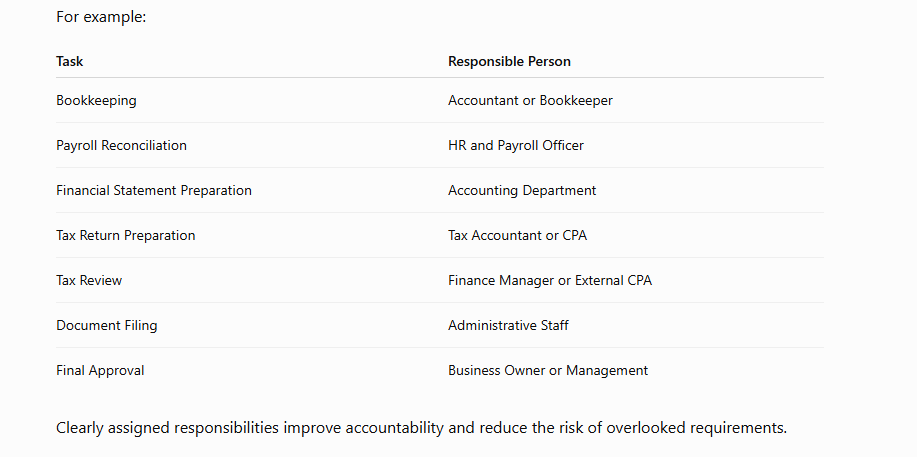
An effective compliance checklist clearly identifies who is responsible for each task.
Step 11: Conduct Internal Compliance Reviews
Before filing annual reports, conduct an internal review.
Confirm that:
- Financial Statements reconcile with tax returns.
- Books of Accounts are complete.
- Payroll records are accurate.
- Inventory records are updated.
- Tax credits are properly supported.
- Supporting documents are complete.
- Filing deadlines have been met.
Internal reviews help identify issues before they become BIR findings.
Sample Annual Tax Compliance Checklist
Your checklist may include the following:
Bookkeeping
✔ Update Books of Accounts regularly
✔ Reconcile bank accounts monthly
✔ Record all sales and purchases
✔ Review adjusting entries
Payroll
✔ Verify employee TINs
✔ Reconcile payroll records
✔ Prepare BIR Form 2316
✔ Review withholding taxes
Financial Statements
✔ Prepare Trial Balance
✔ Review General Ledger
✔ Update fixed asset schedules
✔ Coordinate external audit, if applicable
Tax Compliance
✔ Prepare Annual Income Tax Return
✔ File annual withholding tax returns
✔ Review tax credits
✔ Reconcile quarterly and annual returns
Inventory
✔ Conduct physical inventory count
✔ Reconcile inventory balances
✔ Prepare inventory schedules
Documentation
✔ Organize invoices and receipts
✔ File tax certificates
✔ Maintain contracts and supporting records
✔ Archive prior-year tax returns
Common Mistakes When Creating a Compliance Checklist
Even businesses with checklists may encounter problems if the checklist is incomplete or poorly maintained.
Avoid these common mistakes:
Focusing Only on Filing Deadlines
A checklist should include preparation activities—not just submission dates.
Ignoring Monthly Reviews
Waiting until year-end defeats the purpose of having a checklist.
Monthly and quarterly reviews should be incorporated into the compliance process.
Failing to Update the Checklist
Tax regulations evolve through Revenue Regulations (RRs), Revenue Memorandum Circulars (RMCs), and other BIR issuances.
Your checklist should be reviewed annually to reflect current requirements.
Not Assigning Responsibility
Tasks without clearly designated owners are more likely to be delayed or overlooked.
Assign accountability for each compliance activity.
Poor Recordkeeping
Even the best checklist cannot compensate for incomplete or inaccurate accounting records.
Good bookkeeping remains the foundation of successful tax compliance.
Best Practices for Effective Tax Compliance
Businesses can strengthen compliance by adopting these practices:
- Maintain accurate Books of Accounts throughout the year.
- Perform monthly reconciliations.
- Schedule quarterly tax reviews.
- Conduct year-end tax planning before filing season.
- Monitor new BIR and SEC issuances.
- Maintain complete supporting documentation.
- Use digital calendars and reminders for statutory deadlines.
- Review the compliance checklist annually.
- Work closely with qualified CPAs and tax advisers.
A proactive compliance system is far more effective than reacting to deadlines as they arise.
Final Thoughts
Creating an Annual Tax Compliance Checklist is one of the most practical investments a business can make in its financial and regulatory health. Rather than viewing tax compliance as a once-a-year obligation, businesses should integrate it into their regular operations through organized planning, accurate bookkeeping, timely reconciliations, and clearly assigned responsibilities.
For finance teams, a structured checklist improves workflow, accountability, and reporting accuracy. For entrepreneurs, it provides peace of mind by reducing the risk of missed deadlines, penalties, and audit issues. More importantly, it allows business owners to devote more time to growing their business while maintaining confidence that their tax obligations are being managed effectively.
A well-maintained compliance checklist is not simply an administrative tool—it is an essential component of sound corporate governance and long-term business success.
Leave a Reply