The enactment of the Revised Corporation Code of the Philippines, or Republic Act No. 11232, marked one of the most important reforms in Philippine corporate law.
For decades, corporations operated under rules designed for a very different business environment. The former Corporation Code required multiple incorporators, generally imposed limited corporate terms, and relied heavily on traditional meetings, physical documents, and rigid governance procedures.
The Revised Corporation Code changed that framework.
It made incorporation more accessible, recognized the One Person Corporation, granted corporations perpetual existence, allowed remote participation in meetings, strengthened minority-investor protections, modernized corporate governance, and expanded the regulatory authority of the Securities and Exchange Commission.
These reforms did more than simplify registration. They changed how Filipino entrepreneurs establish businesses, attract investors, manage ownership, plan succession, and protect personal assets.
This article explains why the Revised Corporation Code permanently transformed the Philippine business landscape—and why every business owner, director, officer, and investor should understand its impact.
What Is the Revised Corporation Code?
Republic Act No. 11232 replaced the former Corporation Code under Batas Pambansa Blg. 68.
The law governs the formation, operation, governance, reorganization, and dissolution of corporations in the Philippines. It applies to several forms of corporations, including:
- Stock corporations
- Non-stock corporations
- One Person Corporations
- Close corporations
- Educational corporations
- Religious corporations
- Foreign corporations authorized to do business in the Philippines
- Other entities subject to SEC jurisdiction
At its core, the law modernized the corporate system to support entrepreneurship, investment, accountability, and long-term business continuity.
1. It Made Incorporation Accessible to a Single Entrepreneur
Perhaps the most transformative reform was the introduction of the One Person Corporation, commonly called an OPC.
Under the old framework, an ordinary stock corporation generally required at least five incorporators. Entrepreneurs who wanted the advantages of a corporation often had to involve family members, friends, or nominees simply to satisfy the minimum number.
The Revised Corporation Code eliminated that barrier.
A qualified natural person, trust, or estate may now establish a corporation with only one stockholder, subject to the law’s restrictions and documentary requirements.
Why this changed Philippine business
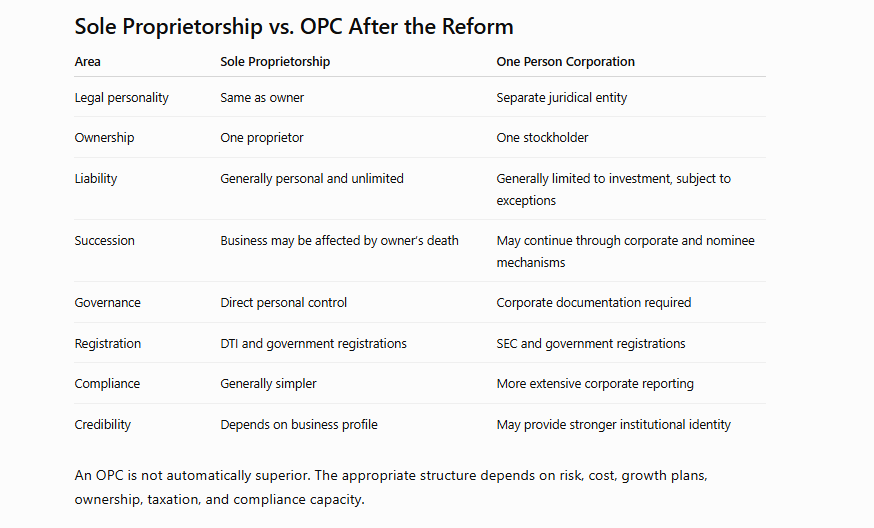
The OPC gave solo entrepreneurs a formal alternative to the sole proprietorship.
A sole proprietorship does not have a legal personality separate from its owner. In contrast, an OPC generally possesses its own juridical personality. It may:
- Own property in its corporate name
- Enter into contracts
- Employ workers
- Incur obligations
- Sue and be sued
- Continue despite changes affecting the owner
- Separate business liabilities from personal liabilities, subject to legal exceptions
This reform made the corporate structure available to consultants, online entrepreneurs, family-business founders, professionals engaged in permitted activities, and other individuals who previously considered incorporation too complicated.
2. It Removed the Old Five-Incorporator Requirement
The Revised Corporation Code allows an ordinary stock corporation to be formed by one or more incorporators, but generally not more than fifteen.
Incorporators may include qualified:
- Natural persons
- Partnerships
- Associations
- Corporations
This broadened the range of persons and entities that may organize a corporation.
Practical impact
The reform made corporate formation more commercially realistic.
For example, two legitimate business partners no longer need to add three nominal incorporators merely to meet a statutory requirement. A parent corporation may also participate as an incorporator in a subsidiary, subject to applicable laws and ownership restrictions.
The change reduces artificial ownership arrangements and allows the corporation’s records to reflect the actual investors.
3. It Gave Corporations Perpetual Existence
Under the former Corporation Code, corporations were generally organized for a limited term, traditionally up to fifty years, unless that term was extended.
The Revised Corporation Code adopted perpetual existence as the general rule unless the Articles of Incorporation provide otherwise.
Why perpetual existence matters
A corporation is designed to survive beyond its founders.
Perpetual existence supports:
- Long-term investment
- Family-business succession
- Business continuity
- Stable employment relationships
- Long-term leases and financing
- Multi-generational ownership
- Institutional investment
- Preservation of contracts and licenses
Business owners no longer need to treat corporate-term extension as a recurring risk that could accidentally result in expiration.
However, perpetual existence does not mean permanent immunity from regulation. A corporation must continue filing its annual reports, observing corporate formalities, and complying with SEC rules.
4. It Made the Corporate Form More Attractive to Startups and SMEs
The Revised Corporation Code generally removed a universal minimum capital-stock requirement, except when a special law or industry regulation imposes one.
This gave smaller enterprises greater flexibility in determining their initial capital.
Why this matters to entrepreneurs
A startup’s capital requirements should reflect its actual operations—not an arbitrary amount unrelated to its business model.
The reform helps businesses allocate resources toward:
- Product development
- Equipment
- Technology
- Hiring
- Marketing
- Working capital
- Regulatory compliance
However, businesses must still distinguish among:
- Authorized capital stock
- Subscribed capital stock
- Paid-up capital
- Capital requirements imposed by regulators
- Foreign-investment capitalization requirements
- Industry-specific minimum capital
Banks, insurance companies, financing companies, lending companies, investment houses, and other regulated entities may still be subject to separate capitalization rules.
5. It Recognized Modern Technology in Corporate Governance
The old corporate framework was built largely around physical meetings, printed notices, and in-person participation.
The Revised Corporation Code recognized that corporate decision-making can occur through modern communication systems.
It allows participation and voting through:
- Remote communication
- Electronic participation
- Voting in absentia, where permitted
- Other secure methods recognized by law and SEC rules
Business impact
Directors and stockholders may participate even when they are located in different cities or countries.
This provides significant advantages for:
- Foreign investors
- Corporations with geographically dispersed stockholders
- Family corporations whose members reside abroad
- Multinational groups
- Companies with regional operations
- Businesses responding to emergencies
Remote participation can reduce costs and improve attendance, but corporations must still establish proper controls involving identity verification, notice, quorum, voting, security, and record preservation.
6. It Strengthened the Role and Accountability of Directors
The Revised Corporation Code did not merely make business formation easier. It also reinforced the responsibilities of directors, trustees, and corporate officers.
Directors exercise corporate powers, manage corporate affairs, and control corporate property as members of the board.
They are expected to act:
- In good faith
- With reasonable diligence
- For a legitimate corporate purpose
- Within the authority granted by law
- In the corporation’s best interest
- Without improperly prioritizing personal interests
Why this matters
A corporate title is not ceremonial.
Directors may face liability when they:
- Approve unlawful acts
- Act in bad faith or with gross negligence
- Enter into undisclosed self-dealing transactions
- Divert corporate opportunities
- Misuse corporate assets
- Participate in fraudulent conduct
- Violate fiduciary duties
Business owners who appoint relatives, employees, or associates as directors should ensure that those persons understand their legal responsibilities.
7. It Improved Protection for Minority Stockholders
A corporation is often controlled by the stockholders holding the majority of voting shares. However, majority control is not unlimited.
The Revised Corporation Code strengthens the framework protecting minority investors through rights involving:
- Voting
- Inspection of corporate records
- Access to information
- Preemptive rights, where applicable
- Appraisal rights
- Proper notice of meetings
- Participation in major corporate decisions
- Fair treatment in related-party transactions
Why this changed the investment environment
Investors are more willing to contribute capital when they have enforceable rights and access to reliable corporate information.
Minority protection also reduces the risk that controlling shareholders will:
- Divert corporate assets
- Issue shares solely to dilute other owners
- Approve unfair related-party transactions
- Withhold material information
- Use the corporation exclusively for personal benefit
Strong minority rights improve investor confidence and corporate credibility.
8. It Required Greater Transparency in Related-Party Transactions
Transactions involving directors, officers, controlling stockholders, affiliates, or family members may create conflicts of interest.
The Revised Corporation Code provides standards governing self-dealing and related-party transactions.
Depending on the transaction, compliance may require:
- Full disclosure
- Fair and reasonable terms
- Proper board approval
- Compliance with quorum requirements
- Abstention by interested directors
- Stockholder ratification
- Appropriate financial-statement disclosure
Practical importance
A related-party transaction is not automatically unlawful. The concern is whether it is transparent, fair, properly approved, and beneficial to the corporation.
Corporations should document agreements involving:
- Management fees
- Loans and advances
- Rentals
- Shared services
- Asset transfers
- Director compensation
- Consulting arrangements
- Purchases and sales between affiliates
Undocumented or unfair related-party transactions may create corporate, tax, accounting, and regulatory exposure.
9. It Improved Business Succession Planning
Many Philippine enterprises are family-owned. Before the Revised Corporation Code, business succession was often complicated by informal ownership arrangements, nominee incorporators, and limited corporate terms.
The reforms provide better options for succession through:
- Perpetual corporate existence
- One Person Corporations
- Nominee and alternate-nominee arrangements for OPCs
- Clearer share-ownership structures
- Formal stock transfers
- Corporate holding arrangements
- Estate and trust participation, subject to law
- More flexible governance provisions
Why succession matters
A business may fail even when it is profitable if ownership transition is poorly planned.
A corporation can help separate the operating business from the personal estate of the founder. Instead of dividing each business asset directly among heirs, ownership may be represented through shares, subject to estate, tax, succession, and corporate requirements.
Corporate structuring does not eliminate estate taxes or inheritance disputes, but it can create a more organized framework for transferring control and economic ownership.
10. It Modernized the One Person Corporation’s Succession Mechanism
An OPC must generally designate a nominee and an alternate nominee who may assume responsibility when the single stockholder dies or becomes incapacitated, subject to statutory conditions.
This feature helps prevent the corporation from becoming legally paralyzed when something happens to its sole owner.
Business significance
The nominee system supports continuity while succession issues are being resolved.
However, business owners should coordinate the OPC documents with their:
- Last will and testament
- Estate plan
- Share-transfer plan
- Insurance coverage
- Family agreements
- Tax planning
- Corporate records
The nominee does not automatically become the ultimate beneficial owner merely because they temporarily manage the OPC.
11. It Expanded Opportunities for Corporate Reorganization
The Revised Corporation Code provides mechanisms for:
- Merger
- Consolidation
- Sale of substantially all assets
- Share issuance
- Capital restructuring
- Revival
- Dissolution
- Conversion into appropriate corporate structures, where allowed
These mechanisms help companies respond to changing business conditions.
Common business applications
Corporate reorganization may be used to:
- Combine related businesses
- Separate operating and investment assets
- Create a holding company
- Admit new investors
- Consolidate family ownership
- Sell a business division
- Rescue an inactive corporation
- Simplify a corporate group
- Prepare for succession or expansion
However, corporate approval does not automatically make a transaction tax-free.
Separate tax rules govern income tax, VAT, Documentary Stamp Tax, capital gains tax, withholding taxes, and tax-free exchanges. Legal, accounting, and tax reviews should be completed before implementation.
12. It Allowed Expired Corporations to Apply for Revival
The Revised Corporation Code permits an expired corporation to apply for the revival of its corporate existence, subject to SEC approval and applicable conditions.
This is valuable for companies that:
- Accidentally allowed their corporate term to expire
- Own property under the expired corporate name
- Need to resolve contracts or litigation
- Want to resume operations
- Must regularize their records
- Need to complete asset transfers or liquidation
Important limitation
Revival does not automatically erase prior obligations.
The corporation may still need to address:
- SEC filing deficiencies
- BIR liabilities
- Local permit issues
- Creditor claims
- Ownership disputes
- Employee obligations
- Regulatory endorsements
Revival restores corporate existence but does not create a clean slate.
13. It Strengthened SEC Enforcement Powers
The Revised Corporation Code gave the Securities and Exchange Commission broader powers to investigate, supervise, and enforce corporate compliance.
The SEC may act on matters involving:
- Fraudulent practices
- Failure to file required reports
- Unauthorized corporate acts
- Misleading corporate information
- Abuse of corporate powers
- Violations involving directors and officers
- Obstruction of regulatory processes
- Continued corporate inoperation
- Delinquent corporations
Why stronger enforcement was necessary
Modern corporate flexibility requires corresponding accountability.
The law makes it easier to organize and manage corporations, but it also expects businesses to maintain transparent records and observe continuing obligations.
Corporations that repeatedly fail to file the General Information Sheet or Financial Statements may face:
- Administrative penalties
- Delinquent status
- Suspension
- Revocation
- Difficulty obtaining certifications
- Problems with banks, investors, and government transactions
14. It Recognized Corporations Vested with Public Interest
Certain corporations affect not only their owners but also investors, depositors, customers, employees, and the public.
The Revised Corporation Code imposes enhanced governance standards on corporations vested with public interest.
These may include requirements involving:
- Independent directors
- Compliance officers
- Internal controls
- Risk management
- Enhanced disclosures
- Board committees
- Stronger reporting mechanisms
Business impact
The law recognizes that governance obligations should increase as a corporation’s public and economic significance grows.
The larger the potential effect on investors and the public, the greater the expectation of accountability.
15. It Encouraged Professional Corporate Governance
The reforms shifted Philippine corporate practice away from informal, personality-driven management toward documented governance.
A properly governed corporation should maintain:
- Accurate minutes
- Valid board resolutions
- Updated ownership records
- Conflict-of-interest disclosures
- Proper delegations of authority
- Financial reports
- Compliance calendars
- Corporate policies
- Internal controls
This is especially important in family corporations, where ownership, management, and personal relationships frequently overlap.
Formal governance does not weaken family control. It helps prevent misunderstandings, protect assets, and preserve the business across generations.
16. It Reinforced the Separate Legal Personality of Corporations
The corporation remains legally separate from its stockholders.
This principle allows the corporation to:
- Own property separately
- Incur its own debts
- Enter into contracts independently
- Continue despite ownership changes
- Protect stockholders through limited liability
However, courts may disregard the corporate personality when the corporation is used to commit fraud, evade obligations, or operate merely as an alter ego.
Business owners should avoid:
- Mixing personal and corporate bank accounts
- Paying personal expenses without proper treatment
- Using corporate assets as personal property
- Entering contracts without board authority
- Maintaining inadequate capitalization
- Ignoring corporate records
- Using the corporation to conceal unlawful conduct
The Revised Corporation Code expanded business flexibility, but it did not abolish the need to respect corporate separateness.
17. It Changed How Entrepreneurs View Incorporation
Before the reforms, incorporation was often perceived as a structure intended mainly for large enterprises or groups of investors.
The Revised Corporation Code changed that perception.
Today, incorporation may be suitable for:
- A solo entrepreneur
- A startup founder
- A family enterprise
- A holding company
- An investment vehicle
- A professional services organization, when legally permitted
- A foreign investor entering the Philippines
- A small business seeking long-term continuity
The law positioned the corporation as a flexible business vehicle rather than an inaccessible legal structure.
How the Revised Corporation Code Affects Family Businesses
Family corporations can use the law to create clearer rules on:
- Ownership succession
- Board representation
- Director qualifications
- Voting
- Share transfers
- Dividend policy
- Conflict resolution
- Related-party transactions
- Employment of relatives
- Retirement of founders
Without written governance rules, family disagreements may become corporate disputes.
The Articles of Incorporation, Bylaws, shareholders’ agreements, estate-planning documents, and tax strategy should be coordinated rather than prepared independently.
How It Affects Foreign Investors
The Revised Corporation Code made corporate organization more flexible, but foreign ownership remains subject to separate laws.
Foreign investors must still consider:
- Constitutional ownership restrictions
- The Foreign Investment Negative List
- Anti-Dummy Law concerns
- Minimum capitalization requirements
- Industry-specific licenses
- Beneficial-ownership reporting
- Visa and work-permit rules
- Tax registration
- Applicable investment incentives
The ability to form a corporation with fewer incorporators does not override foreign-equity limitations.
Foreign investors should obtain legal advice before finalizing ownership and management arrangements.
Common Mistakes Under the Revised Corporation Code
Treating the OPC as a Sole Proprietorship
The sole stockholder must still maintain corporate separation, records, contracts, and approvals.
Failing to File Annual SEC Reports
Incorporation creates continuing obligations. It is not completed once the Certificate of Incorporation is issued.
Using Nominee Stockholders to Conceal Ownership
Nominee arrangements may raise beneficial-ownership, foreign-investment, tax, and anti-dummy concerns.
Ignoring Board Approval
Major transactions should be supported by valid corporate authorization.
Mixing Personal and Corporate Funds
This weakens internal control and may support arguments that the corporation is merely an alter ego.
Failing to Update the Stock and Transfer Book
Ownership rights and voting disputes often arise when transfers are not properly recorded.
Assuming Limited Liability Is Absolute
Fraud, bad faith, gross negligence, unlawful acts, and abuse of the corporate form may result in personal liability.
Practical Compliance Checklist for Business Owners
Every corporation should verify that:
Formation and Registration
- The Articles of Incorporation reflect the actual business.
- The Bylaws are consistent with current operations.
- SEC, BIR, and local registrations are complete.
- Required industry licenses have been obtained.
Governance
- Directors and officers were validly elected or appointed.
- Board and stockholder meetings are properly documented.
- Authority limits are clearly defined.
- Conflicts of interest are disclosed.
- Related-party transactions are reviewed.
Ownership
- Share issuances are supported by valid consideration.
- Stock certificates are properly issued.
- The Stock and Transfer Book is updated.
- Foreign-ownership limitations are monitored.
- Beneficial-ownership information is accurate.
Reporting
- The General Information Sheet is filed on time.
- Annual Financial Statements are properly prepared and submitted.
- SEC amendments are filed when required.
- Filing confirmations are preserved.
Financial Controls
- Personal and corporate funds are separated.
- Books of Accounts are updated.
- Tax returns reconcile with Financial Statements.
- Significant transactions receive legal and accounting review.
Why the Change Is Permanent
The Revised Corporation Code changed Philippine business forever because it addressed the realities of modern entrepreneurship.
It recognized that:
- A single person can build a legitimate corporation.
- Business ownership may involve juridical entities.
- Corporations should continue indefinitely unless owners decide otherwise.
- Meetings do not always require physical presence.
- Investors require stronger rights and transparency.
- Family businesses need succession mechanisms.
- Regulators need stronger enforcement tools.
- Technology should be integrated into governance.
- Corporate flexibility must be balanced with accountability.
These reforms are now embedded in how businesses organize, invest, govern, and grow.
Final Thoughts
The Revised Corporation Code was not merely an amendment to an old statute. It represented a fundamental shift in the Philippine approach to business organization.
It made corporations easier to establish, more adaptable to modern technology, better suited for long-term succession, and more accessible to entrepreneurs. At the same time, it strengthened governance, investor protection, transparency, and SEC oversight.
For business owners, the most important lesson is that greater flexibility comes with greater responsibility.
A corporation must be treated as a real legal entity—not merely a registration certificate used for convenience. Its funds, property, contracts, ownership records, meetings, approvals, financial statements, and regulatory filings must be properly maintained.
When used correctly, the Revised Corporation Code provides entrepreneurs with a powerful framework for asset protection, business continuity, investment, expansion, and succession. When ignored, the same framework can expose directors, officers, and stockholders to disputes, sanctions, and personal liability.
The law changed Philippine business forever because it made incorporation more inclusive and modern while demanding a higher standard of accountability from everyone who chooses to operate through a corporation.
Leave a Reply