A Business Owner’s Guide to the Revised Corporation Code of the Philippines
For nearly four decades, Philippine corporations were governed by Batas Pambansa Blg. 68, commonly known as the Corporation Code of the Philippines. Enacted in 1980, the old Code established the basic rules for incorporating, managing, financing, reorganizing, and dissolving Philippine corporations.
As business models evolved, however, several provisions became increasingly restrictive. Entrepreneurs were required to find multiple incorporators, corporate existence was generally limited to fifty years, and many governance procedures were designed around physical meetings and traditional paper-based records.
Congress addressed these limitations through Republic Act No. 11232, or the Revised Corporation Code of the Philippines. The law repealed B.P. Blg. 68 and took effect on February 23, 2019.
R.A. No. 11232 retained many fundamental principles of Philippine corporate law, including separate juridical personality, limited liability, board management, and stockholder rights. Its most significant contribution was to modernize the corporate framework by allowing One Person Corporations, perpetual corporate existence, fewer incorporators, remote participation, revival of expired corporations, and stronger regulatory enforcement.
This guide compares the old Corporation Code with R.A. No. 11232 and explains what the changes mean for business owners, directors, officers, and investors.
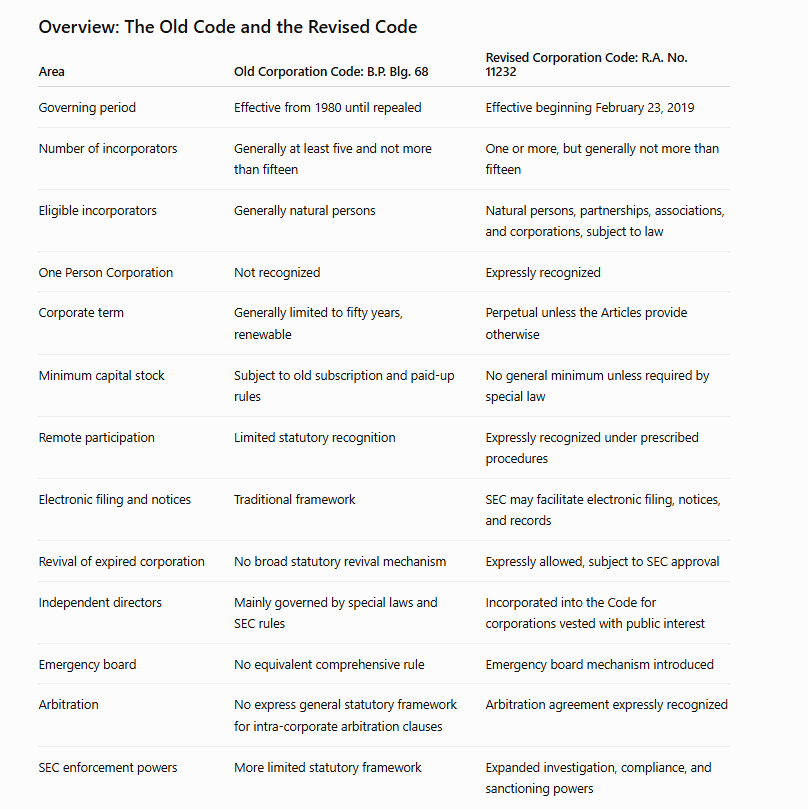
The SEC has published a detailed comparative matrix showing the provisions of B.P. Blg. 68 alongside their revised counterparts under R.A. No. 11232.
1. Number of Incorporators
Under the Old Corporation Code
The old Code generally required a stock corporation to have at least five incorporators, but not more than fifteen.
The incorporators ordinarily had to be natural persons of legal age, and a majority had to be residents of the Philippines.
This requirement created practical difficulties for businesses genuinely owned by only one or two people. Entrepreneurs sometimes invited relatives, friends, employees, or nominal shareholders merely to meet the statutory minimum.
Under R.A. No. 11232
The Revised Corporation Code allows a corporation to be formed by one or more persons, but generally not more than fifteen incorporators.
Incorporators may include:
- Natural persons
- Partnerships
- Associations
- Corporations
This is subject to restrictions imposed by the Constitution, special laws, foreign-investment rules, and industry regulations.
Why the Change Matters
A corporation’s incorporation documents can now more accurately reflect its real ownership.
Two genuine business partners no longer need three nominal incorporators. A corporation may also participate directly in establishing a subsidiary instead of using individual representatives as incorporators.
This reduces artificial ownership arrangements and improves transparency in corporate records.
2. Introduction of the One Person Corporation
Under the Old Corporation Code
B.P. Blg. 68 did not recognize an ordinary corporation with only one stockholder.
An individual entrepreneur who wanted sole ownership normally operated as a sole proprietor or involved additional persons to meet the five-incorporator requirement.
Under R.A. No. 11232
R.A. No. 11232 introduced the One Person Corporation, commonly called an OPC.
An OPC is a corporation with a single stockholder. Subject to statutory restrictions, the single stockholder may generally be:
- A natural person
- A trust
- An estate
The OPC possesses a juridical personality separate from its sole stockholder.
Practical Effect
A solo entrepreneur may now obtain many of the advantages of the corporate form without bringing in nominal co-owners.
An OPC may:
- Own assets in its own name
- Enter into contracts
- Employ personnel
- Borrow money
- Sue and be sued
- Continue through succession mechanisms
- Limit the owner’s liability, subject to legal exceptions
However, the sole stockholder must demonstrate that the OPC is adequately financed and that corporate and personal assets are kept separate. Otherwise, the stockholder may face personal liability where the corporation is merely used as an alter ego or where the requirements for limited liability are not respected.
3. Corporate Term
Under the Old Corporation Code
A corporation generally had a maximum term of fifty years from incorporation.
Its existence could be extended through an amendment of the Articles of Incorporation, but the extension had to be processed before expiration and was subject to statutory procedures.
Failure to extend the term could cause the corporation to expire.
Under R.A. No. 11232
A corporation now generally has perpetual existence, unless its Articles of Incorporation expressly provide for a limited term.
Existing corporations formed under the old Code were also generally granted perpetual existence, unless they elected to retain their original corporate term under the procedure established by law.
Why the Change Matters
Perpetual existence strengthens business continuity.
It supports:
- Long-term investment
- Multi-generational family businesses
- Long-term financing
- Continuing employment
- Ownership succession
- Long-term contracts and leases
Corporations no longer need to monitor a fifty-year expiration date merely to preserve their legal existence.
Perpetual existence does not mean the corporation may ignore compliance. The SEC may still impose sanctions, delinquent status, suspension, or revocation for continuing violations.
4. Minimum Capital Requirements
Under the Old Corporation Code
The old Code generally required that at least twenty-five percent of the authorized capital stock be subscribed and that at least twenty-five percent of the subscription be paid, subject to a minimum paid-up capital requirement.
Although the actual amount was not always commercially burdensome, the rule imposed a uniform statutory formula.
Under R.A. No. 11232
The Revised Corporation Code provides that stock corporations are generally not required to have a minimum capital stock, unless a special law requires one.
Important Qualification
The removal of a general minimum does not eliminate:
- Capital requirements for regulated industries
- Foreign-investment capitalization requirements
- Paid-up capital required by licensing agencies
- Financial-capacity requirements under special laws
- Subscription obligations stated in corporate documents
Banks, insurance companies, financing companies, lending companies, investment houses, and similar regulated businesses remain subject to separate capitalization rules.
Business Effect
Startups and small enterprises may organize their corporations based on actual financing needs instead of a uniform statutory threshold.
Nevertheless, business owners should avoid deliberate undercapitalization. A corporation that lacks sufficient capital for its foreseeable obligations may create governance, creditor-protection, and veil-piercing risks.
5. Eligibility of Incorporators
Under the Old Code
Incorporators were generally natural persons.
Juridical entities such as corporations and partnerships usually participated through individual nominees or representatives.
Under the Revised Code
Partnerships, associations, and corporations may now directly act as incorporators, subject to applicable requirements.
They generally act through representatives authorized by formal documents such as:
- Board resolutions
- Partnership resolutions
- Secretary’s certificates
- Other proof of authority
Practical Benefit
The revised rule supports more transparent group structures.
For example, a parent company can directly incorporate a subsidiary and be identified as an incorporator rather than arranging for officers or employees to hold shares in their personal names.
6. Residency Requirements
Under the Old Corporation Code
The former Code contained residency requirements affecting incorporators and directors.
A majority of incorporators were generally required to be Philippine residents, and a majority of directors had to be residents of the Philippines.
Under R.A. No. 11232
The general residency requirement for directors was removed from the Revised Corporation Code.
However, separate residency, nationality, or local-officer requirements may still arise under:
- The Constitution
- Foreign-investment laws
- Industry-specific statutes
- SEC rules
- Tax laws
- Licensing requirements
Business Effect
The change makes Philippine corporations more accessible to foreign and overseas-based investors.
It also allows boards to be composed based more on expertise, investment participation, and governance needs rather than a broad general residency rule.
7. Corporate Bylaws
Under the Old Corporation Code
Corporations were generally expected to adopt and file their Bylaws within one month after receiving the Certificate of Incorporation.
Failure to file Bylaws within the prescribed period could create compliance problems.
Under R.A. No. 11232
The Revised Corporation Code permits Bylaws to be filed:
- Together with the Articles of Incorporation; or
- Within the period and under the procedure permitted by the Code
The Code also recognizes that certain entities, particularly OPCs, are not required to file Bylaws.
Practical Impact
Entrepreneurs can establish their governance rules from the beginning by filing the Articles and Bylaws together.
This helps define:
- Meeting procedures
- Officer positions
- Voting rules
- Authority limits
- Share-transfer procedures
- Committee structures
- Internal governance controls
8. Remote Participation in Meetings
Under the Old Corporation Code
The old Code was based primarily on physical meetings.
Although later SEC rules and special regulations addressed teleconferencing and electronic participation, the statute itself did not contain the same comprehensive recognition of remote participation found in the revised law.
Under R.A. No. 11232
Directors, trustees, stockholders, and members may participate through remote communication or vote in absentia where permitted, subject to safeguards established by law, the Bylaws, and SEC regulations.
The corporation should establish procedures for:
- Identity verification
- Notice
- Quorum determination
- Secure voting
- Participation records
- Meeting minutes
- Data protection
- Preservation of electronic evidence
Why the Change Matters
Corporate decisions can now be made more efficiently when directors and investors are located in different cities or countries.
This is particularly valuable for:
- Multinational corporations
- Family corporations with overseas members
- Foreign investors
- Regional enterprises
- Companies operating during emergencies
Remote participation reduces cost but does not eliminate formal meeting requirements.
9. Electronic Filing, Records, and Notices
Under the Old Code
B.P. Blg. 68 was developed when corporate registration and reporting were mainly paper-based.
Traditional submissions, notices, and recordkeeping were the norm.
Under the Revised Code
R.A. No. 11232 expressly authorizes the SEC to develop and implement electronic systems for:
- Registration
- Filing
- Submission of reports
- Issuance of notices
- Monitoring compliance
- Preservation of records
The SEC’s current systems for company registration and amendments operate within this modernized regulatory framework.
Business Effect
Companies may complete many regulatory processes online, reducing physical submissions and in-person transactions.
However, electronic filing does not reduce the corporation’s duty to ensure that:
- Information is accurate
- Signatories are properly authorized
- Documents are complete
- Confirmations are preserved
- Beneficial-ownership information is correct
10. Directors and Independent Directors
Under the Old Corporation Code
The old Code primarily set general requirements for directors and trustees.
Independent-director requirements were largely developed through the Securities Regulation Code, special laws, listing rules, and SEC governance regulations.
Under R.A. No. 11232
The Revised Corporation Code expressly requires corporations vested with public interest to have independent directors comprising at least the proportion prescribed by law.
Covered corporations may include:
- Corporations registered under securities laws
- Publicly listed companies
- Banks and quasi-banks
- Pre-need companies
- Insurance companies
- Other corporations classified as vested with public interest
Purpose of the Reform
Independent directors are expected to provide objective oversight and protect the corporation, investors, and other stakeholders from:
- Controlling-shareholder abuse
- Undisclosed conflicts
- Unfair related-party transactions
- Weak risk controls
- Management domination
The revised rule reflects the shift from basic corporate administration to modern corporate governance.
11. Disqualification of Directors, Trustees, and Officers
Under the Old Code
The former Code contained disqualification rules, but the Revised Code expanded and clarified the framework.
Under R.A. No. 11232
A person may be disqualified based on specified circumstances, including certain criminal convictions, administrative findings, fraud-related violations, and other grounds recognized by the Code or the SEC.
Business Implication
Corporations should conduct due diligence before electing or appointing directors and officers.
The company should review:
- Regulatory history
- Criminal or administrative findings
- Conflicts of interest
- Qualifications required by special laws
- Fit-and-proper standards
- Independence requirements
A director should not be appointed merely to complete the required number of board members.
12. Emergency Board
Under the Old Code
The old Corporation Code did not contain the same comprehensive statutory emergency-board mechanism.
A corporation could become unable to act when board vacancies prevented the remaining directors from forming a quorum.
Under R.A. No. 11232
The Revised Corporation Code introduced an emergency board rule.
Where a vacancy prevents the remaining directors from constituting a quorum and immediate action is necessary to prevent grave, substantial, and irreparable loss or damage, the remaining directors may temporarily designate a qualified officer to fill the vacancy for the limited emergency.
Limits of the Rule
Emergency-board authority should be:
- Temporary
- Necessary
- Limited to the emergency
- Properly documented
- Reported as required
- Terminated when the emergency ends
It is not a substitute for properly electing or appointing directors.
13. Director Compensation
Under the Old Corporation Code
Under Section 30 of B.P. Blg. 68, directors generally received no compensation in their capacity as directors except reasonable per diems, unless compensation was approved by stockholders representing at least a majority of the outstanding capital stock.
Total yearly compensation of directors, as directors, could not exceed ten percent of the corporation’s net income before income tax for the preceding year.
Under R.A. No. 11232
The Revised Corporation Code retains the basic stockholder-approval and ten-percent limitation principles, while also adding enhanced reporting and disclosure requirements for corporations vested with public interest.
Practical Importance
Businesses should distinguish between:
- Director’s fees
- Per diems
- Officer salaries
- Employee compensation
- Consultancy fees
- Reimbursements
- Dividends
These payments may have different:
- Approval requirements
- Tax consequences
- Withholding obligations
- Deductibility rules
- Disclosure requirements
Corporate approval should reflect the real capacity in which the person is being paid.
14. Corporate Opportunity and Self-Dealing Rules
Under the Old Corporation Code
The old Code already imposed fiduciary duties and regulated contracts involving directors.
Under R.A. No. 11232
The Revised Code retains and reinforces rules governing:
- Self-dealing directors
- Interlocking directors
- Disloyalty
- Usurpation of corporate opportunities
- Conflicts of interest
- Liability for unlawful acts
Business Effect
The modernization of the Code does not reduce director accountability.
A director who uses corporate information, assets, or opportunities for personal benefit may be required to account for profits and may face personal liability.
Related-party transactions should therefore have:
- Written agreements
- Full disclosure
- Fair commercial terms
- Proper board approval
- Abstention by interested directors where required
- Stockholder ratification where applicable
15. Revival of Expired Corporations
Under the Old Corporation Code
Once a corporation’s term expired, there was no broad statutory mechanism equivalent to the revival process created under R.A. No. 11232.
The entity generally entered the winding-up period and had limited powers for liquidation.
Under R.A. No. 11232
An expired corporation may apply with the SEC for revival of its corporate existence, subject to:
- SEC approval
- Compliance with documentary requirements
- Consent or endorsement from other regulators, where applicable
- Protection of vested rights
- Settlement of outstanding deficiencies
Why This Is Important
Revival may assist a corporation that:
- Accidentally expired
- Still owns real property
- Has unresolved contracts
- Needs to continue litigation
- Wants to resume business
- Must regularize its legal status
Revival does not automatically erase liabilities, taxes, penalties, creditor claims, or reportorial deficiencies.
16. Delinquent Status and Continuous Inoperation
Under the Old Code
The old Code provided consequences for failure to organize and commence business, but the Revised Code introduced a more structured delinquency framework.
Under R.A. No. 11232
A corporation that fails to formally organize and commence business within the statutory period may have its Certificate of Incorporation deemed revoked.
A corporation that becomes continuously inoperative for the period specified by law may be placed under delinquent status after notice.
It may be given an opportunity to resume operations and comply within the prescribed period.
Practical Lesson
An inactive corporation should not simply be ignored.
Its owners should decide whether to:
- Resume operations
- Update SEC filings
- Apply for revival or regularization
- Enter formal dissolution
- Complete BIR and local-government closure procedures
Abandoning the corporation may allow penalties and compliance problems to accumulate.
17. Arbitration of Intra-Corporate Disputes
Under the Old Corporation Code
B.P. Blg. 68 did not contain a general express statutory framework authorizing arbitration provisions for intra-corporate disputes in the Articles or Bylaws.
Under R.A. No. 11232
The Revised Corporation Code expressly allows an arbitration agreement to be incorporated into the Articles of Incorporation or Bylaws.
It may cover disputes between:
- The corporation and its stockholders
- Stockholders among themselves
- The corporation and its members
- Members among themselves
The dispute must generally arise from the implementation of the Articles, Bylaws, or intra-corporate relationships and must be legally arbitrable.
Business Advantage
Arbitration may offer:
- Confidentiality
- Specialized decision-makers
- Procedural flexibility
- Potentially faster resolution
- Reduced disruption to operations
The clause should be carefully drafted to define its scope, appointment procedures, seat, rules, and enforcement framework.
18. Corporations Vested with Public Interest
Under the Old Code
Enhanced governance requirements were found primarily in special legislation and SEC rules.
Under R.A. No. 11232
The Revised Code formally recognizes corporations vested with public interest and subjects them to enhanced requirements.
These may involve:
- Independent directors
- Compliance officers
- Disclosure controls
- Additional reporting
- Risk-management systems
- Governance policies
- Director-compensation disclosures
Why the Change Matters
The law acknowledges that some corporations affect more than their immediate owners.
Where a business handles public investments, deposits, insurance funds, or other significant stakeholder interests, stronger governance is required.
19. Non-Stock Corporations and Voting
Under the Old Corporation Code
The old Code provided traditional meeting and voting procedures for non-stock corporations.
Under R.A. No. 11232
The revised law modernized participation rights and recognizes remote communication and voting in absentia where permitted.
It also clarifies rules involving:
- Membership
- Voting rights
- Meetings
- Trustees
- Distribution of assets
- Dissolution
Practical Effect
Associations, foundations, chambers, clubs, and other non-stock corporations may adopt more flexible governance systems, provided they follow the Code, their Articles, Bylaws, and SEC rules.
20. Corporate Records and Inspection Rights
Under the Old Code
Stockholders and members had rights to inspect corporate books and records for legitimate purposes.
Under R.A. No. 11232
The Revised Code retains inspection rights but imposes clearer responsibilities and consequences.
Corporate records may include:
- Articles and Bylaws
- Minutes of meetings
- Stock and Transfer Book
- Membership records
- Board resolutions
- Ownership information
- Accounting records
- Reports submitted to the SEC
A requesting stockholder should act in good faith and for a legitimate purpose.
Improper refusal, falsification, concealment, or misuse of corporate records may result in sanctions.
21. Beneficial Ownership and Transparency
Under the Old Code
The old Code did not contain the same modern regulatory emphasis on identifying the natural persons who ultimately own or control corporations.
Under R.A. No. 11232 and Related SEC Rules
The revised framework strengthened the SEC’s authority to require disclosure of corporate ownership and control information.
Corporations may be required to identify:
- Registered stockholders
- Ultimate beneficial owners
- Persons exercising control
- Nominees
- Intermediaries
- Related entities
Business Importance
The use of nominees does not eliminate disclosure obligations.
False or misleading ownership records may create exposure under:
- Corporation law
- Securities rules
- Anti-money laundering regulations
- Foreign-investment restrictions
- The Anti-Dummy Law
- Tax regulations
22. Stronger SEC Powers and Penalties
Under the Old Corporation Code
The SEC already possessed registration and enforcement authority, but the old statute’s penalty framework became outdated over time.
Under R.A. No. 11232
The Revised Code expanded and modernized the SEC’s authority to:
- Investigate violations
- Issue compliance orders
- Impose administrative sanctions
- Examine corporate records
- Compel reporting
- Address fraudulent practices
- Suspend or revoke registrations
- Penalize obstruction or retaliation
- Coordinate with other government agencies
The Code also updated fines and sanctions for violations.
Practical Consequence
Corporate compliance is no longer limited to filing documents at incorporation.
The SEC may examine whether the corporation:
- Operates according to its registered purpose
- Files accurate annual reports
- Discloses ownership correctly
- Maintains proper records
- Observes governance requirements
- Avoids fraudulent or unauthorized activities
Provisions That Largely Remained the Same
Although R.A. No. 11232 introduced major reforms, many core corporate-law principles remained intact.
These include:
Separate Juridical Personality
A corporation remains legally separate from its stockholders, directors, and officers.
Limited Liability
Stockholders generally risk only their investment, subject to unpaid subscriptions, personal guarantees, fraud, bad faith, statutory liability, and veil-piercing doctrines.
Board Management
Corporate powers remain generally exercised through the Board of Directors or Trustees.
Fiduciary Duties
Directors and officers remain accountable for bad faith, gross negligence, unlawful acts, disloyalty, and conflicts of interest.
Stockholder Approval for Fundamental Changes
Major transactions still require the stockholder approvals prescribed by law, including certain:
- Amendments to the Articles
- Capital changes
- Mergers
- Dissolutions
- Sales of substantially all assets
- Investments outside the primary purpose
Corporate Formalities
Corporations must still maintain records, conduct valid meetings, issue properly authorized shares, and file required reports.
The Revised Code modernized the system; it did not eliminate corporate discipline.
How the Changes Affect Existing Corporations
A corporation established under B.P. Blg. 68 did not need to reincorporate merely because R.A. No. 11232 took effect.
However, existing corporations should review whether their documents remain consistent with the revised law.
Areas for review include:
- Corporate term
- Number and qualifications of directors
- Remote-meeting provisions
- Electronic notices
- Arbitration clauses
- Share-transfer restrictions
- Officer positions
- Independent-director requirements
- Beneficial-ownership reporting
- Nominee arrangements
- Corporate governance policies
Where an existing Bylaw provision conflicts with R.A. No. 11232, the law prevails.
The corporation may need to amend its Articles or Bylaws to make full use of the revised framework.
Advantages of R.A. No. 11232 for Business Owners
The Revised Corporation Code offers several practical benefits:
Easier Formation
A corporation may be formed by fewer genuine owners.
Greater Continuity
Perpetual existence supports succession and long-term investment.
Access for Solo Entrepreneurs
The OPC provides a formal corporate option for a single owner.
Modern Governance
Remote meetings and electronic participation reduce geographical limitations.
Flexible Capitalization
The absence of a universal minimum capital requirement supports startups and SMEs.
Better Reorganization Options
Revival, merger, restructuring, and succession mechanisms are more adaptable.
Stronger Investor Confidence
Enhanced disclosures, minority protections, and independent-director rules promote accountability.
Continuing Responsibilities Under the Revised Code
Greater flexibility does not mean less compliance.
Corporations must still:
- File the General Information Sheet
- File Annual Financial Statements
- Maintain corporate books
- Keep the Stock and Transfer Book current
- Hold required meetings
- Document board and stockholder actions
- Update SEC information
- Maintain accurate beneficial-ownership records
- Keep corporate and personal assets separate
- Comply with BIR and local-government requirements
- Follow industry regulations
- Preserve proof of filings
The corporation should maintain a compliance calendar and assign specific responsibilities to its corporate secretary, accounting personnel, directors, officers, and external advisers.
Common Misunderstandings About R.A. No. 11232
“One incorporator means no corporate formalities.”
Incorrect. An OPC must still maintain corporate records, submit reports, document decisions, and separate personal and corporate assets.
“Perpetual existence means the SEC cannot revoke the corporation.”
Incorrect. The SEC may suspend or revoke registration for statutory violations and continuing non-compliance.
“No minimum capital means a corporation needs no funding.”
Incorrect. The business still requires adequate capital for its operations and liabilities. Special capitalization rules may also apply.
“Remote meetings require no documentation.”
Incorrect. Notice, quorum, voting, identity verification, and minutes remain necessary.
“Limited liability protects directors from every claim.”
Incorrect. Directors and officers may be personally liable for fraud, bad faith, gross negligence, unlawful acts, conflicts of interest, or specific statutory violations.
“An inactive corporation can simply be abandoned.”
Incorrect. Formal closure, dissolution, tax cancellation, and regulatory compliance may still be required.
Practical Review Checklist for Existing Corporations
Business owners should ask:
Corporate Structure
- Does the corporation still have the appropriate number of directors?
- Would an OPC or another structure be more suitable?
- Does the ownership record reflect the real investors?
Articles and Bylaws
- Do they recognize perpetual existence?
- Are remote meetings permitted and properly regulated?
- Are officer duties clearly defined?
- Are share-transfer restrictions still appropriate?
- Should an arbitration provision be added?
Governance
- Are directors properly elected?
- Are conflicts of interest disclosed?
- Are related-party transactions documented?
- Are board and stockholder resolutions complete?
Compliance
- Are the GIS and Financial Statements current?
- Are beneficial owners accurately disclosed?
- Is the Stock and Transfer Book updated?
- Are SEC confirmations and corporate records preserved?
Financial Separation
- Are corporate funds separate from personal funds?
- Are owner withdrawals properly classified?
- Are shareholder advances documented?
- Are director compensation and dividends properly approved?
Final Thoughts
The difference between the old Corporation Code and R.A. No. 11232 is not merely technical.
B.P. Blg. 68 established the traditional Philippine corporate framework, but it reflected a period when corporations generally had several individual incorporators, limited terms, physical meetings, and paper-based regulatory processes.
R.A. No. 11232 preserved the essential principles of corporate law while adapting them to modern entrepreneurship and investment.
Its most important reforms include:
- Fewer incorporators
- One Person Corporations
- Perpetual corporate existence
- No general minimum capital stock
- Remote participation
- Electronic regulatory processes
- Independent-director requirements
- Emergency-board powers
- Revival of expired corporations
- Intra-corporate arbitration
- Stronger SEC oversight and penalties
For business owners, these reforms provide greater flexibility, but they also demand stronger governance, transparency, documentation, and accountability.
The corporation remains a powerful vehicle for limited liability, succession, investment, and growth. Its benefits are best preserved when the owners respect the corporation’s separate identity, follow proper approval procedures, maintain accurate records, and comply with continuing SEC and tax obligations.
Leave a Reply