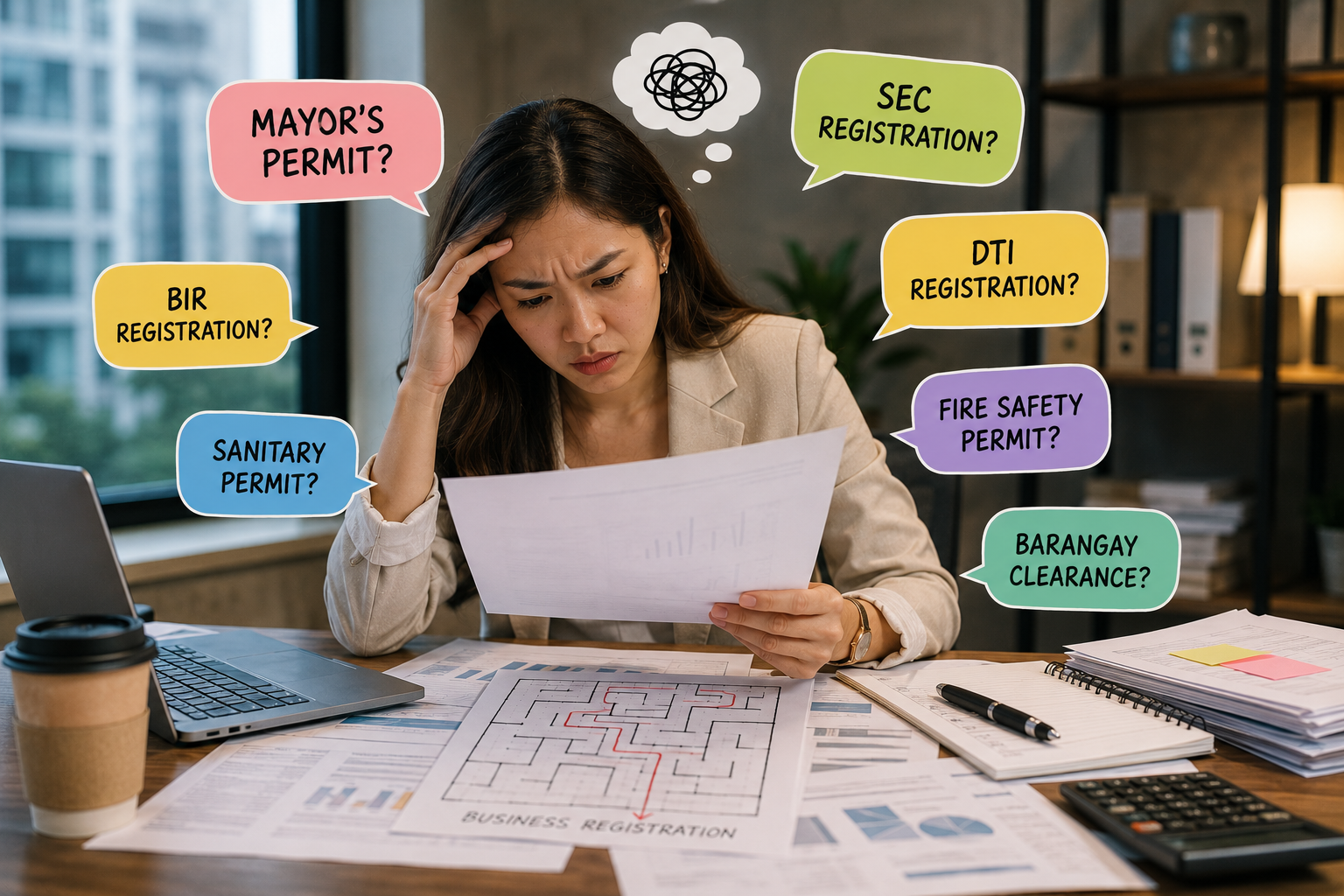
You’ve registered the company with the SEC.
So you’re ready to operate, right?
Then someone says:
“You still need to register with the BIR.”
Okay.
Then:
“What about your Business Permit?”
Then:
“Do you have the barangay requirement?”
Then:
“What about fire safety?”
And just when you think you’re finished:
“Does your industry require another license?”
This is why starting a corporation can feel like entering a registration maze.
The difficult part isn’t simply completing forms.
It’s understanding which registrations apply to your particular business, which government agency handles them, and when they need to be completed.
There is no single universal permit checklist that fits every corporation in the Philippines.
Your requirements can depend on:
Business structure
Location
Industry
Business activities
Employees
Foreign ownership
Physical premises
Investment incentives
Other regulatory factors
Let’s break down the maze.
First: Registration and Permits Aren’t All the Same Thing
Business owners often use these terms interchangeably:
SEC Registration
BIR Registration
Business Permit
License
But they serve different purposes.
A simplified way to understand the system is:
SEC
Who is the corporation?
BIR
How is the business registered for tax purposes and what tax-compliance framework applies?
LGU
What local requirements apply where the business operates?
Specialized Regulatory Agency
Does this particular business activity require additional authority, accreditation, or licensing?
Once you separate these layers, the registration process becomes easier to understand.
1. SEC Registration: Creating the Corporation
For a corporation, the Securities and Exchange Commission (SEC) is a fundamental starting point.
SEC incorporation establishes the corporation as a juridical entity under Philippine corporate law.
Depending on the corporation, information and documentation can involve:
Corporate name
Articles of Incorporation
Business purposes
Principal office
Incorporators
Directors
Officers
Capital structure
Share subscriptions
Other applicable requirements
Once approved, the corporation receives its SEC registration documentation.
But remember:
SEC registration creates the corporation.
It does not automatically replace every other registration or permit required for operations.
2. BIR Registration: Establishing Your Tax Compliance
The Bureau of Internal Revenue (BIR) handles national tax registration and compliance.
A corporation needs to understand its BIR obligations based on its specific circumstances.
These can involve areas such as:
Taxpayer registration
Books of accounts
Invoicing
Income tax
VAT or percentage tax, where applicable
Withholding taxes
Employee-related tax requirements
Other applicable tax obligations
The exact tax profile depends on the corporation.
Why This Matters
A company can be legally incorporated with the SEC but still have tax-registration and compliance requirements that need to be addressed.
That’s why:
SEC registered ≠ tax compliance completed
Corporate formation and tax registration are connected stages, not substitutes for each other.
3. Barangay Requirements
Businesses may also encounter requirements from the barangay where the establishment is located as part of the local permitting process.
The exact documentation and procedure can vary depending on the location and current LGU system.
Possible Supporting Information
Depending on local requirements, businesses may need documentation relating to:
Business location
Lease or property ownership
SEC registration
Identification
Other local requirements
Important
Don’t assume the procedure used by a business in one barangay or city will be identical to yours.
Always verify the current process for your actual business location.
4. Mayor’s Permit or Business Permit
The Mayor’s Permit, often referred to as a Business Permit, is a major component of local business regulation.
It is generally processed through the relevant city or municipal government.
Requirements can vary between LGUs.
A business in Cebu City may encounter a different workflow or documentary checklist from a business in:
Mandaue City
Lapu-Lapu City
Talisay City
Davao City
Another municipality or city
Common Areas of Review
Depending on the LGU and business, the process can involve matters related to:
Business registration documents
Business address
Lease or ownership documentation
Barangay requirements
Zoning or locational requirements
Fire safety
Sanitation or health requirements
Other local clearances
This is why your business location should be investigated before signing a long-term lease whenever possible.
5. Fire Safety Requirements
Fire safety requirements can form part of the local business-permitting process.
The specific requirements depend on factors such as the premises, occupancy, business activity, and applicable regulations.
Businesses shouldn’t treat fire safety as something to investigate only after the office has already been fully fitted out.
Before Opening
Consider whether your premises need to address matters such as:
Fire protection equipment
Emergency exits
Building safety documentation
Inspection requirements
Other applicable fire-safety measures
The actual requirements should be verified with the relevant authorities.
6. Zoning and Locational Requirements
Not every type of business can necessarily operate from every property.
A location suitable for an ordinary office may not necessarily be appropriate for:
Manufacturing
Warehousing
Food production
Certain healthcare activities
High-traffic retail
Industrial operations
This is where zoning and land-use considerations become important.
The Expensive Mistake
Sign lease → Pay deposit → Fit out property → Apply for permits → Discover location problem
Better Sequence
Identify business activity → Check location suitability → Verify documents → Sign lease → Process registrations
Checking first can save substantial time and money.
7. Sanitary and Health Requirements
Certain businesses may encounter additional sanitation or health-related requirements depending on their activities and local regulations.
These can be particularly relevant to businesses involving:
Food
Personal care
Hospitality
Healthcare
Other activities affecting public health
Requirements vary by LGU and industry.
Don’t assume an ordinary office checklist applies to a restaurant—or vice versa.
8. Employer Registrations
If your corporation hires employees, another compliance layer begins.
Applicable employer obligations can involve agencies such as:
Social Security System (SSS)
PhilHealth
Pag-IBIG Fund
BIR
The company also needs appropriate payroll and employment-record processes.
Why Founders Miss This
Employer requirements often aren’t top of mind during incorporation.
Founders focus on:
“How do we create the company?”
But the next question should be:
“What happens when the company hires its first employee?”
Include employer compliance in the registration roadmap from the beginning.
9. Industry-Specific Licenses
This is where a generic registration checklist can become dangerous.
Some business activities are regulated beyond ordinary SEC, BIR, and LGU registration.
Depending on the industry, additional requirements can potentially involve agencies regulating areas such as:
Food and drugs
Construction
Recruitment
Education
Healthcare
Transportation
Telecommunications
Financial services
Lending and financing
Import/export activities
Other specialized sectors
Ask This Before Registering
“Which government agency regulates what we’re actually selling or doing?”
If another agency regulates the activity, its requirements should be incorporated into your setup plan.
10. Foreign Ownership Requirements
Foreign investors need another layer of analysis.
Not all Philippine business activities have identical foreign ownership rules.
Depending on the activity, foreign participation may be permitted, restricted, or subject to particular conditions.
Other considerations may include:
Capitalization
Business activity
Land ownership restrictions
Industry-specific laws
Employment of foreign personnel
Better Approach
Before preparing the Articles of Incorporation:
Define activity → Review foreign ownership rules → Review capitalization → Design corporate structure → Register
Don’t build the company first and investigate foreign ownership later.
11. Foreign Employee Requirements
Foreign ownership and foreign employment are separate issues.
A foreign shareholder’s ability to invest in a Philippine corporation doesn’t automatically resolve the requirements for that person to work in the Philippines.
Foreign executives and employees may need appropriate employment and immigration authorization depending on their circumstances.
Why This Matters
If a foreign executive is critical to the launch, delays involving employment or immigration documentation can affect the entire operational timeline.
Include foreign personnel planning early.
12. BOI Registration
The Board of Investments (BOI) is relevant to businesses evaluating investment incentives under the Philippines’ investment framework.
BOI registration is not an ordinary requirement for every corporation.
It is something eligible businesses may pursue when their projects and activities meet applicable qualification requirements.
Potential incentives depend on the prevailing legal framework and the registered project.
Important
Don’t assume:
Corporation = BOI qualified
Eligibility needs to be assessed.
If incentives are important to your investment model, investigate BOI registration during the planning stage.
13. PEZA Registration
The Philippine Economic Zone Authority (PEZA) is another investment-promotion agency relevant to qualifying businesses and projects.
PEZA is commonly associated with qualified activities within the economic-zone framework, including certain export-oriented, IT, manufacturing, and other eligible enterprises.
But PEZA registration isn’t simply another checkbox on the ordinary business-registration list.
The project must meet applicable requirements.
Important
If PEZA incentives are central to your business model, evaluate eligibility and location considerations before committing to the final setup.
So Which Permits Does YOUR Corporation Need?
Start with five questions.
Question 1: What Is Your Legal Structure?
Are you establishing a:
Domestic stock corporation
One Person Corporation
Partnership
Branch or other foreign corporate presence
Another structure
Your structure affects registration requirements.
Question 2: What Exactly Will You Do?
Don’t say:
“General business.”
Be specific.
Are you:
Consulting?
Selling products?
Manufacturing?
Exporting?
Developing software?
Operating a restaurant?
Running a BPO?
Constructing buildings?
Recruiting employees for clients?
Your activity determines regulatory requirements.
Question 3: Where Will You Operate?
Identify the exact city or municipality.
Local requirements differ.
Question 4: Who Owns the Business?
Determine whether the ownership is:
Filipino-owned
Partly foreign-owned
Wholly foreign-owned
Foreign ownership can affect the corporate structure and other requirements.
Question 5: Will You Have Employees?
If yes, employer compliance needs to be incorporated into your setup.
Once these five questions are answered, your permit checklist becomes much more specific.
Sample Registration Roadmap for an Ordinary Corporation
For illustration, a straightforward corporation may encounter a roadmap broadly resembling:
STEP 1 — Corporate Planning
↓
STEP 2 — SEC Incorporation
↓
STEP 3 — Tax Registration and Setup
↓
STEP 4 — Applicable Barangay/LGU Requirements
↓
STEP 5 — Business/Mayor’s Permit and Related Local Compliance
↓
STEP 6 — Employer Registrations, if applicable
↓
STEP 7 — Industry-Specific Licenses, if applicable
↓
STEP 8 — Operational and Ongoing Compliance
However, the actual sequence can vary because government systems may be integrated and requirements differ by business and location.
Treat this as a planning framework—not a universal government checklist.
The Permit Checklist Before You Spend Money
Before opening your business, verify these areas:
Corporate
☐ Appropriate business structure selected
☐ SEC requirements identified
☐ Corporate purpose reviewed
☐ Ownership reviewed
☐ Foreign equity checked, if applicable
Tax
☐ BIR registration addressed
☐ Books and records addressed
☐ Invoicing requirements understood
☐ Tax obligations identified
Location
☐ Business address verified
☐ Barangay requirements checked
☐ Business/Mayor’s Permit requirements checked
☐ Zoning/locational requirements checked
☐ Fire safety requirements checked
☐ Sanitary/health requirements checked where applicable
Employees
☐ SSS requirements reviewed
☐ PhilHealth requirements reviewed
☐ Pag-IBIG requirements reviewed
☐ Payroll tax requirements reviewed
Specialized
☐ Industry regulator identified
☐ Special licenses checked
☐ Foreign personnel requirements reviewed
☐ BOI eligibility reviewed if relevant
☐ PEZA eligibility reviewed if relevant
Don’t wait until opening week to complete this checklist.
Why the Registration Maze Feels So Complicated
Because you’re not actually dealing with one registration.
You’re dealing with several layers:
Corporate
Tax
Local
Employment
Industry
Investment
Immigration, where applicable
The mistake is trying to navigate each layer only when it suddenly appears.
The better approach is to map all of them before registration begins.
There Is No Universal “Complete Business Permit Package”
Be cautious when someone says:
“These are all the permits every Philippine corporation needs.”
That statement is usually too broad.
A small consulting office and a manufacturing plant don’t have identical requirements.
A Filipino-owned corporation and a foreign-invested company may have different considerations.
A business in Cebu and a business in Davao may encounter different LGU procedures.
A restaurant and a software company certainly don’t follow identical regulatory paths.
The correct question isn’t:
“What permits does a corporation need?”
It’s:
“What registrations and permits does THIS corporation need for THIS activity in THIS location?”
That distinction can save weeks of confusion.
Find Your Way Through the Registration Maze
CBOS Business Solutions Inc. assists entrepreneurs, corporations, startups, and foreign investors with business-registration requirements in the Philippines.
From SEC registration and BIR registration to local business permits, employer requirements, and applicable PEZA or BOI registration support, a coordinated registration roadmap can help you understand what needs to happen before your company begins operations.
Don’t collect permits randomly.
Identify your business. Map the requirements. Complete them in the right sequence.
Planning to establish a corporation in Cebu, Davao, or elsewhere in the Philippines? Contact CBOS today and let our team help you navigate the business-registration process.
Disclaimer: This article provides general educational information and is not a universal permit checklist or legal, tax, immigration, or investment advice. Registration and licensing requirements vary according to the company’s location, activities, ownership, premises, employees, and other circumstances. Government procedures and requirements can change. Always verify current requirements with the relevant SEC, BIR, LGU, regulatory agency, and qualified professional advisers.
Leave a Reply