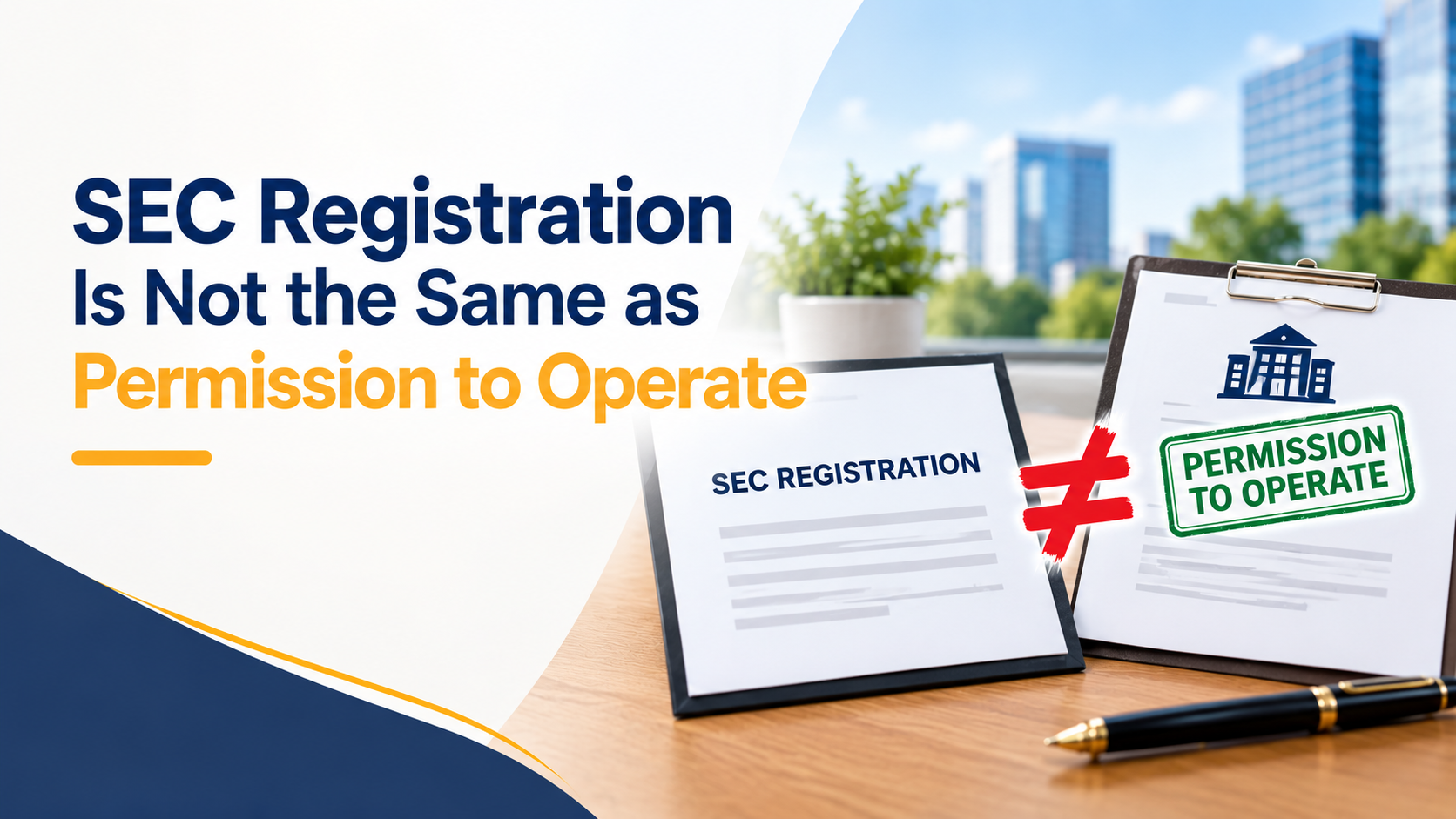
A newly incorporated business receives its SEC Certificate of Incorporation. The founders celebrate. The next question is usually: “Can we start operating now?”
The answer depends on what other registrations and permits the business still needs. SEC incorporation establishes the corporation as a juridical entity. It does not automatically complete every government requirement connected with actual business operations. Understanding this distinction can prevent a new company from starting too early.
The SEC Creates the Corporation
For a corporation, SEC registration is fundamental. This is where the company’s legal structure, purposes, ownership, capitalization, principal office, and other corporate information are established.
But think of SEC registration as the creation of the legal entity. The authority to carry on particular activities may still depend on other agencies.
The Local Government Has Its Own Requirements
A company also operates somewhere physically. That brings local government requirements into the picture. Depending on the city or municipality and the nature of the business, local requirements may involve matters such as:
- Barangay clearance
- Business or Mayor’s Permit
- Zoning or locational clearance
- Fire-safety requirements
- Sanitary requirements
- Occupancy or building documents
- Other industry- or location-specific clearances
A business should not assume that requirements in Cebu City, Davao City, Makati, or another LGU are identical. Local implementation can differ.
Tax Registration Is Another Separate Layer
The corporation must also address applicable registration and tax-compliance requirements with the Bureau of Internal Revenue. Corporate, tax, and LGU records should be coordinated.
If one agency reflects a different business address or activity from another, the inconsistency may eventually require correction. This is why registration should be handled as one coordinated process rather than several disconnected applications.
Employers Have Additional Responsibilities
Once the business begins hiring employees, employer-related obligations arise. The company should identify the registrations, payroll, labor, and statutory benefit requirements applicable to its workforce. This is another reason why the question “Are we ready to operate?” cannot be answered simply by looking at the SEC Certificate.
Some Industries Need Their Own Regulator
Certain business activities cannot legally be approached as ordinary commercial activities. Companies in regulated sectors may require licenses, accreditations, permits, certificates, endorsements, or other approvals from the relevant government authority.
- Financial services
- Food
- Healthcare
- Education
- Tourism
- Construction
- Energy
- Telecommunications
- Transportation
- Environmental activities
Foreign Employees Require a Separate Review
A foreign investor may own shares in a Philippine corporation. That does not automatically mean the same person can begin working in the Philippines without further requirements. Corporate ownership, employment authorization, and immigration status are separate regulatory questions. When foreign personnel are involved, these issues should be considered early.
BOI and PEZA Are Another Layer
Companies considering investment incentives may also need to review BOI, PEZA, or other investment-promotion frameworks. These registrations involve their own qualification standards, documentary requirements, commitments, and continuing compliance. They should be integrated into the company’s setup plan where relevant.
Think of Business Registration as a Sequence
- Create the entity
- Secure the registrations applicable to the location
- Complete tax registration
- Address employer requirements
- Obtain industry approvals
- Complete investment registration where applicable
- Maintain continuing compliance
The exact sequence and requirements will depend on the company. That is why a tailored registration checklist is more useful than a generic list downloaded from the internet.
How CBOS Can Help
CBOS Business Solutions Inc. helps businesses coordinate SEC registration, local business permits, regulatory requirements, and investment-related registrations.
Disclaimer: Government requirements vary according to business activity, ownership, location, industry, and corporate structure. This article is general information only and should not be used as a substitute for current agency verification.
Leave a Reply