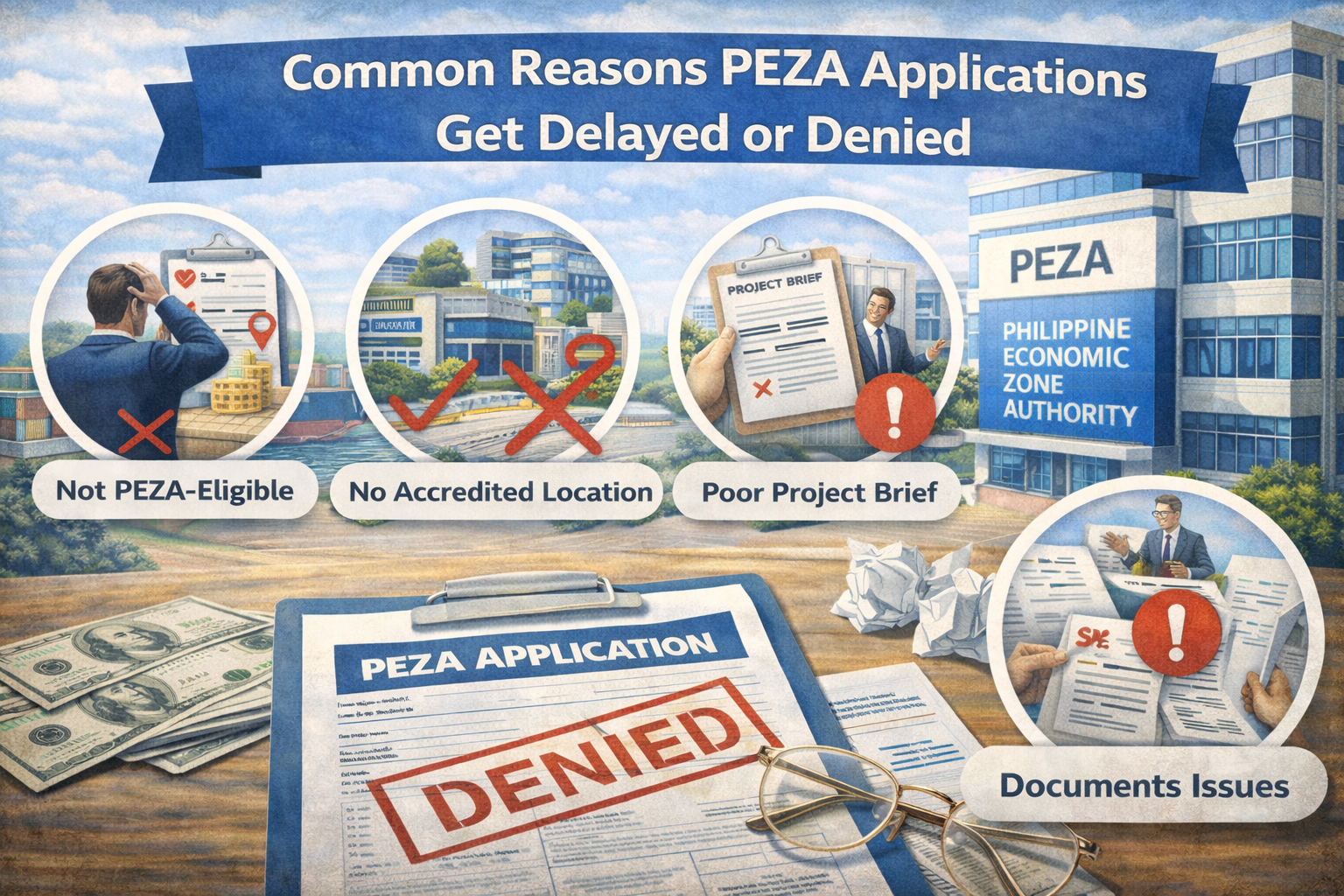
Common Reasons PEZA Applications Get Delayed or Denied
PEZA registration is highly attractive—but it is not automatic.
As a lawyer handling PEZA applications for local and foreign companies, I often see the same concern from clients:
“Complete man among papers—ngano nadugay or gi-deny?”
The legal reality is this: most PEZA delays and denials are preventable. They usually stem from preparation issues, not policy changes.
Below are the most common reasons PEZA applications get delayed or denied, explained in clear, practical terms—so you can avoid costly mistakes.
1. The Business Is Not Actually PEZA-Qualified
This is the number one reason applications fail.
PEZA primarily approves:
Export manufacturing
IT-BPM and digital services
Export-oriented service providers
Businesses earning mainly from foreign clients
❌ Businesses serving purely the local market
❌ Retail, trading, restaurants, or consumer-facing shops
📌 Intent to export is not enough—your business model must clearly qualify. PEZA evaluates substance, not promises.
2. No PEZA-Accredited Location
PEZA registration requires physical location inside:
A PEZA-accredited economic zone, or
A PEZA-registered IT park or building
Common problems:
Applying without a signed lease
Choosing a non-accredited building
Assuming home-based or virtual offices are acceptable
📌 No accredited location = no PEZA approval.
3. Poorly Written or Inconsistent Project Brief
The Project Brief is the heart of your PEZA application.
Delays happen when:
Business activities are vague or unclear
Export percentages are unrealistic
Financial projections do not align
The brief contradicts SEC documents
📌 PEZA relies heavily on this document to assess legitimacy and viability.
4. SEC Documents Not Aligned With PEZA Activity
Your SEC registration must match your PEZA application.
Common issues:
Business purpose does not mention export or IT services
Articles of Incorporation too broad or unrelated
Wrong corporate structure
📌 If your SEC documents don’t support your PEZA activity, approval is delayed—or denied.
5. Unrealistic Capitalization and Employment Projections
PEZA evaluates whether your company can actually deliver what it promises.
Red flags include:
Very low capital with high operational claims
Overstated hiring projections
Inconsistent financial assumptions
📌 PEZA prefers realistic, defensible numbers over aggressive estimates.
6. Incomplete or Incorrect Supporting Documents
Even strong applications get delayed due to:
Missing signatures
Expired IDs
Incorrect notarization
Inconsistent company details
📌 PEZA does not “fix” documents—it returns them.
7. Underestimating Compliance Obligations
PEZA incentives come with strict post-approval requirements.
Applications may be denied if:
The company shows no capacity for compliance
Management lacks understanding of reporting duties
Internal controls are weak or unclear
📌 PEZA favors businesses that demonstrate long-term compliance readiness.
8. Applying Too Early—or Too Late
Timing matters.
❌ Applying before SEC registration is finalized
❌ Applying without a confirmed location
❌ Applying after operations have already started improperly
📌 PEZA expects orderly, sequential compliance.
A Lawyer’s Perspective: Why Many Applications Stall
Most PEZA problems are caused by:
DIY applications without legal review
Misunderstanding PEZA’s purpose
Treating PEZA like a “tax shortcut”
📌 PEZA is an incentive program—not a workaround.
How to Avoid PEZA Delays and Denials
✔ Confirm PEZA eligibility first
✔ Secure a PEZA-accredited location early
✔ Align SEC documents with PEZA activity
✔ Prepare a clear, realistic project brief
✔ Ensure document consistency and accuracy
✔ Demonstrate compliance capability
📌 Preparation determines approval speed.
Final Thoughts
PEZA registration is highly beneficial—but only for businesses that are properly structured, qualified, and prepared.
📌 Most PEZA denials are not policy decisions—they are preparation failures.
If your business truly qualifies, a well-prepared application significantly improves approval timelines and reduces the risk of rejection.
Navigating the business landscape in the Philippines can be both rewarding and intricate. Whether you’re embarking on a new venture or scaling up, ensuring that your corporate endeavors are in line with local regulations is paramount.
At CBOS Business Solutions Inc., we pride ourselves on simplifying these processes for our clients. As a seasoned professional services company, we offer comprehensive assistance with SEC Registration, Visa processing, and a myriad of other essential business requirements. Our team of experts is dedicated to ensuring that your business is compliant, well-established, and ready to thrive in the Philippine market.
Why venture into the complexities of business registration and compliance alone? Allow our team to guide you every step of the way. After all, your success is our commitment.
Get in touch today and let us be your partner in achieving your business goals in the Philippines.
Email Address: gerald.bernardo@cbos.com.ph
Mobile No.: +639270032851
You can also click this link to schedule a meeting.
Leave a Reply