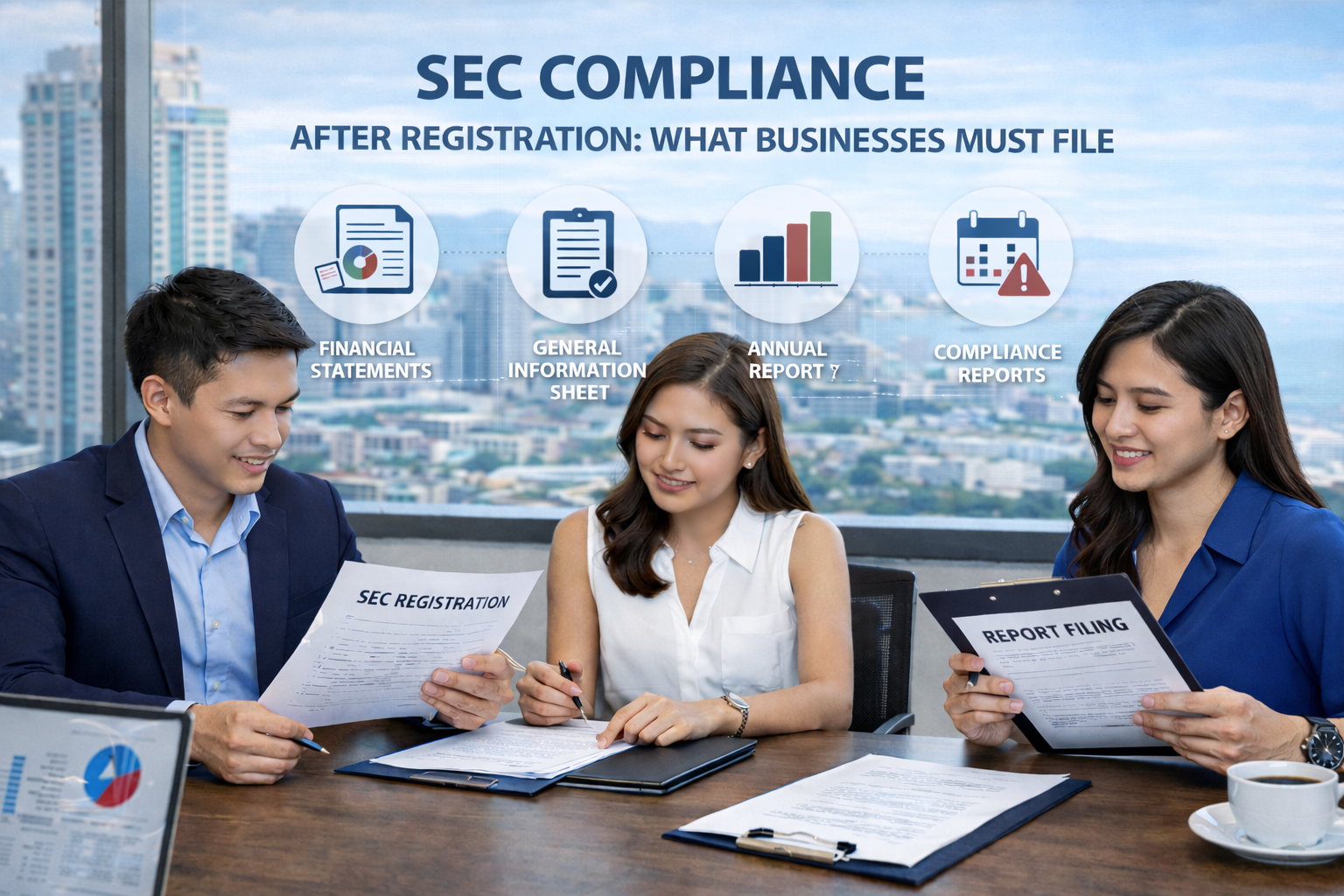
Registering a company with the Securities and Exchange Commission (SEC) is a major milestone for any entrepreneur. However, many business owners mistakenly believe that once the Certificate of Incorporation is issued, the compliance obligations are finished.
From a legal standpoint, SEC registration is only the beginning.
Corporations and One Person Corporations (OPCs) must comply with several reporting and documentation requirements to maintain their good standing with the SEC. Failure to comply can result in penalties, suspension, or even revocation of the company’s registration.
Understanding the key SEC compliance filings helps businesses remain legally compliant while protecting their corporate status.
Why SEC Compliance Matters
The SEC regulates corporations to ensure transparency, accountability, and proper corporate governance.
Regular filings allow regulators to verify:
The company’s financial condition
The status of directors and officers
Corporate activities and operations
📌 Maintaining compliance protects the credibility and legal standing of the corporation.
1. General Information Sheet (GIS)
One of the most important compliance requirements is the General Information Sheet (GIS).
The GIS provides updated information about the corporation, including:
Names of directors and officers
Shareholder structure
Corporate address
Contact details
Corporations are generally required to file the GIS annually after their stockholders’ meeting.
📌 This document ensures the SEC has updated information about the company’s leadership.
2. Audited Financial Statements (AFS)
Corporations must submit Audited Financial Statements (AFS) prepared by a licensed accountant.
The AFS typically includes:
Balance sheet
Income statement
Statement of cash flows
Notes to financial statements
These reports allow the SEC to assess the financial health and transparency of the company.
📌 Financial reporting promotes accountability and investor confidence.
3. Annual Corporate Reports
Companies may also be required to file various annual reports depending on their activities.
These may include updates on:
Corporate governance
Changes in officers or directors
Amendments to corporate documents
📌 These filings ensure that corporate records remain accurate.
4. Amendments to Corporate Documents
If a company changes certain corporate details, it must notify the SEC by filing the appropriate amendments.
Examples include changes to:
Corporate name
Business purpose
Capital structure
Corporate address
📌 Corporate records must always reflect current information.
5. Board Resolutions and Corporate Actions
Certain corporate actions must be documented through board resolutions and properly recorded in company records.
These actions may include:
Appointment of new officers
Approval of major business transactions
Changes in corporate policies
While not always submitted immediately to the SEC, these records must be properly maintained for regulatory review.
6. Compliance for One Person Corporations (OPC)
For One Person Corporations, additional compliance requirements may apply, such as maintaining proper documentation of corporate decisions made by the sole shareholder.
Even though OPCs have a simplified structure, they must still observe corporate governance standards.
📌 Proper recordkeeping ensures transparency even for single-owner corporations.
Consequences of Non-Compliance
Failure to comply with SEC filing requirements may result in:
Administrative penalties
Late filing fees
Suspension of corporate privileges
Revocation of the Certificate of Incorporation
These consequences can affect the company’s ability to operate, enter contracts, or secure financing.
📌 Compliance is essential to maintain a corporation’s legal status.
Best Practices for Maintaining SEC Compliance
To ensure continuous compliance, businesses should:
✔ Maintain accurate corporate records
✔ Track filing deadlines
✔ Prepare financial statements annually
✔ Seek professional guidance when necessary
📌 Proper compliance systems help avoid penalties and administrative issues.
Final Thoughts
SEC registration establishes the legal foundation of a corporation—but maintaining that foundation requires continuous compliance.
📌 By understanding and fulfilling SEC reporting requirements, businesses can protect their corporate status and operate with confidence.
For companies that aim to grow, attract investors, and build long-term credibility, SEC compliance is not just a legal obligation—it is an essential part of responsible corporate governance.
Navigating the business landscape in the Philippines can be both rewarding and intricate. Whether you’re embarking on a new venture or scaling up, ensuring that your corporate endeavors are in line with local regulations is paramount.
At CBOS Business Solutions Inc., we pride ourselves on simplifying these processes for our clients. As a seasoned professional services company, we offer comprehensive assistance with SEC Registration, Visa processing, and a myriad of other essential business requirements. Our team of experts is dedicated to ensuring that your business is compliant, well-established, and ready to thrive in the Philippine market.
Why venture into the complexities of business registration and compliance alone? Allow our team to guide you every step of the way. After all, your success is our commitment.
Get in touch today and let us be your partner in achieving your business goals in the Philippines.
Email Address: gerald.bernardo@cbos.com.ph
Mobile No.: +639270032851
You can also click this link to schedule a meeting.
Leave a Reply