
One of the first legal decisions every entrepreneur in the Philippines must make is this:
“SEC ba or DTI ang kailangan ko?”
As a lawyer assisting startups and growing businesses, I see this confusion almost daily. Choosing the wrong registration can delay operations, expose you to liability, or force costly corrections later.
Let’s clarify—clearly, legally, and practically—the difference between SEC registration and DTI registration, and how to know which one applies to your business.
What Is DTI Registration?
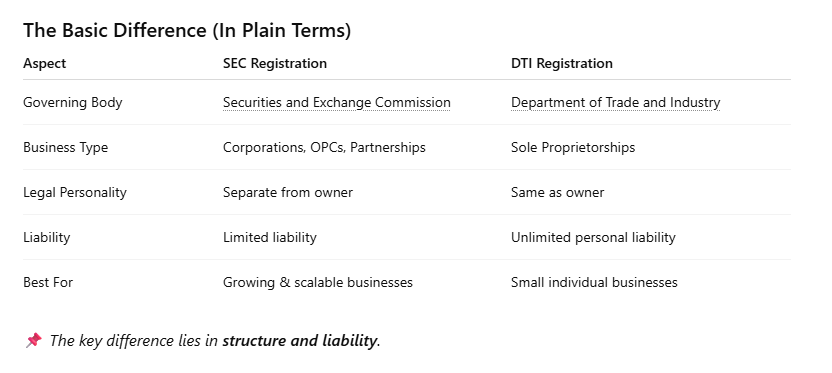
DTI registration is for sole proprietors—businesses owned and operated by one individual.
Characteristics of DTI-Registered Businesses:
Owner and business are legally the same
Simple and fast registration
Lower compliance requirements
Ideal for freelancers and micro businesses
Legal Reality:
❌ No separation between personal and business assets
❌ Owner is personally liable for debts and lawsuits
📌 If the business fails, personal assets may be at risk.
What Is SEC Registration?
SEC registration applies to businesses with a separate legal personality, such as:
Corporations
One Person Corporations (OPC)
Partnerships
Characteristics of SEC-Registered Businesses:
Business is legally separate from owners
Limited liability protection
Stronger credibility with banks and investors
Designed for growth and expansion
📌 SEC registration creates a legal “wall” between you and your business risks.
Liability: The Most Important Legal Difference
Under DTI:
You are personally liable
Lawsuits and debts can reach personal assets
Under SEC:
Liability is limited
Claims are generally against the company—not the owner
📌 From a legal standpoint, this is often the deciding factor.
Can a One-Person Business Register With the SEC?
Yes. This is where many entrepreneurs get confused.
A One Person Corporation (OPC) allows:
One owner
SEC registration
Limited liability protection
📌 OPC is often the better option for solo entrepreneurs who want protection and credibility.
Common Mistakes Entrepreneurs Make
🚫 Registering with DTI when SEC is required
🚫 Staying DTI-registered even after expansion
🚫 Assuming “small business” means “no risk”
🚫 Delaying conversion from DTI to SEC
📌 The law looks at structure and activity, not size.
When Should You Choose DTI?
✔ You are a solo entrepreneur
✔ Low-risk operations
✔ No immediate plans to scale
✔ Minimal contracts and liabilities
When Should You Choose SEC?
✔ You want asset protection
✔ You plan to grow or hire employees
✔ You want to attract partners or investors
✔ You need stronger business credibility
Can You Convert From DTI to SEC Later?
Yes—but conversion involves:
New registration
Possible tax adjustments
Updated permits and bank accounts
Additional costs
📌 It is usually cheaper to choose the right structure from the start.
Final Thoughts
📌 DTI registration is about simplicity. SEC registration is about protection and growth.
Both are legal—but they serve very different purposes. The right choice depends on your business goals, risk exposure, and long-term plans.
If you are unsure which registration fits your business, seek guidance early. In law and business, the right foundation saves time, money, and stress later on.
Navigating the business landscape in the Philippines can be both rewarding and intricate. Whether you’re embarking on a new venture or scaling up, ensuring that your corporate endeavors are in line with local regulations is paramount.
At CBOS Business Solutions Inc., we pride ourselves on simplifying these processes for our clients. As a seasoned professional services company, we offer comprehensive assistance with SEC Registration, Visa processing, and a myriad of other essential business requirements. Our team of experts is dedicated to ensuring that your business is compliant, well-established, and ready to thrive in the Philippine market.
Why venture into the complexities of business registration and compliance alone? Allow our team to guide you every step of the way. After all, your success is our commitment.
Get in touch today and let us be your partner in achieving your business goals in the Philippines.
Email Address: gerald.bernardo@cbos.com.ph
Mobile No.: +639270032851
You can also click this link to schedule a meeting.
Leave a Reply