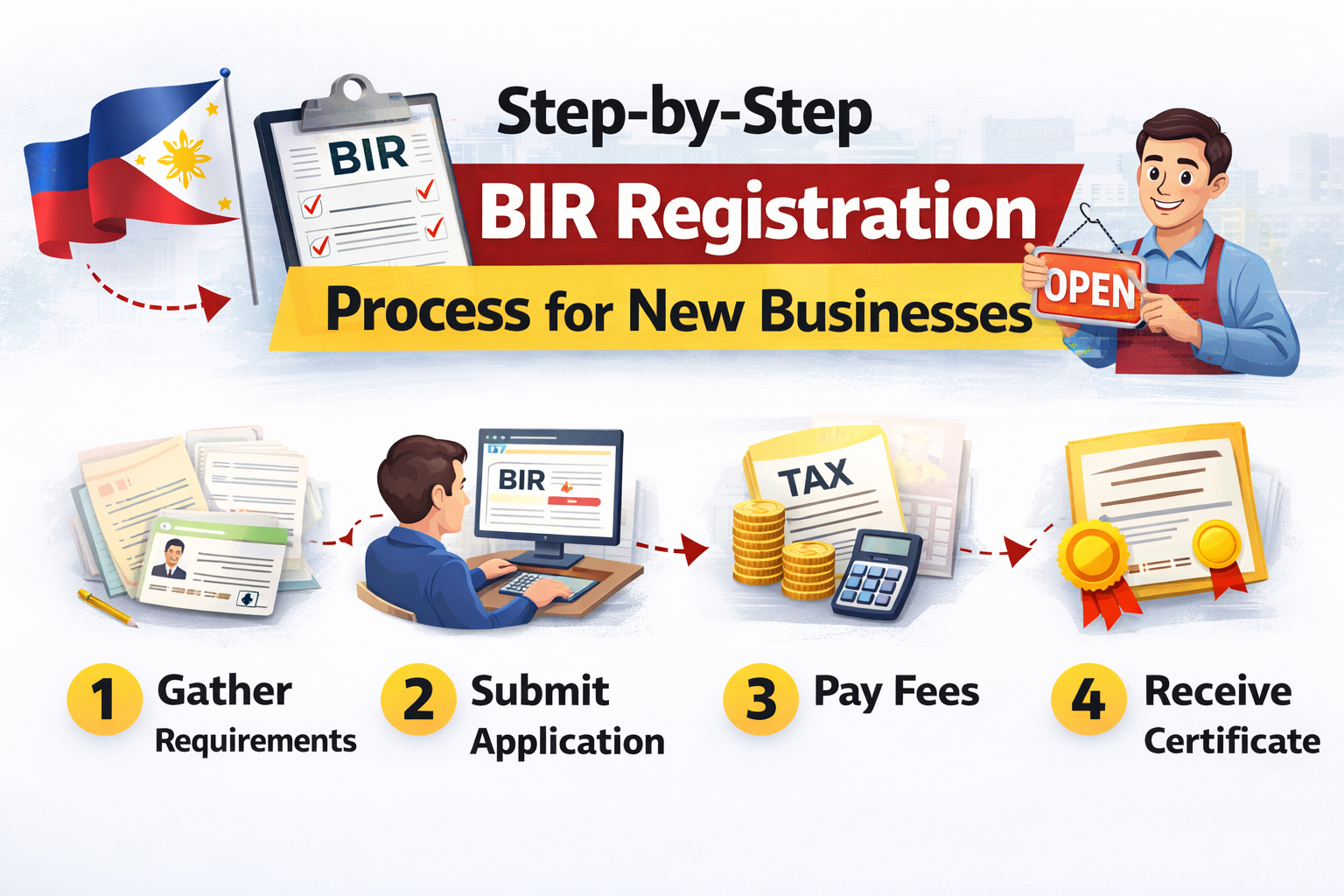
Starting a business in the Philippines requires more than registration with the appropriate agency—it also requires compliance with tax laws. One of the most critical steps is registering your business with the Bureau of Internal Revenue (BIR).
BIR registration ensures that your business is legally recognized for tax purposes, allowing you to issue official receipts, file taxes, and operate without risk of penalties.
This guide provides a clear, step-by-step overview of the BIR registration process for new businesses in the Philippines.
Who Needs to Register with BIR?
All businesses—whether sole proprietorships, partnerships, or corporations—must register with the BIR before commencing operations.
Typically:
Sole proprietors register after securing a business name from the Department of Trade and Industry
Corporations and partnerships register after incorporation with the Securities and Exchange Commission
Regardless of structure, BIR registration is mandatory for tax compliance.
Step 1: Secure Your Business Registration
Before proceeding with BIR registration, your business must already be registered with the appropriate agency:
DTI for sole proprietors
SEC for corporations and partnerships
You will need your Certificate of Registration as part of your BIR application.
Step 2: Prepare Required Documents
The BIR requires several documents depending on your business type. Common requirements include:
DTI or SEC Certificate
Valid government-issued ID
Proof of business address
Lease contract (if applicable)
Mayor’s Permit or application (if available)
Preparing complete and accurate documents will help prevent delays.
Step 3: Accomplish BIR Registration Forms
Applicants must complete the appropriate BIR registration form (commonly BIR Form 1901 or 1903, depending on the business structure).
These forms provide details about:
Business activities
Tax type and obligations
Owner or corporate information
Accuracy in completing these forms is essential for proper tax classification.
Step 4: Pay the Registration Fee
Businesses are required to pay an annual registration fee to the BIR.
Payment can be made through:
Authorized banks
Online payment channels
After payment, you will receive proof of registration fee payment, which is required for further processing.
Step 5: Register Books of Accounts
All businesses must register their books of accounts with the BIR.
These may include:
Journal
Ledger
Subsidiary books
These records will be used to track your financial transactions and are subject to inspection by tax authorities.
Step 6: Apply for Authority to Print (ATP) Receipts
Businesses must secure an Authority to Print (ATP) before issuing official receipts or invoices.
Alternatively, businesses may apply for:
Computerized accounting systems
Point-of-sale (POS) systems (subject to BIR approval)
Issuing receipts without BIR authorization is prohibited.
Step 7: Obtain Your BIR Certificate of Registration (COR)
Once all requirements are completed, the BIR will issue your Certificate of Registration (BIR Form 2303).
This certificate contains:
Your Tax Identification Number (TIN)
Registered business address
Applicable taxes you must file and pay
The COR must be displayed in your place of business.
Step 8: Understand Your Tax Obligations
After registration, business owners must comply with ongoing tax requirements, including:
Filing monthly, quarterly, and annual tax returns
Paying the correct taxes on time
Maintaining accurate financial records
Failure to comply may result in penalties, surcharges, and interest.
Common Mistakes to Avoid
Many new business owners encounter issues due to avoidable mistakes, such as:
Incomplete documentation
Incorrect tax type selection
Failure to register books of accounts
Issuing receipts without ATP approval
Missing tax filing deadlines
Understanding the process and requirements can help prevent these issues.
Final Thoughts
BIR registration is a crucial step in establishing a legally compliant business in the Philippines. It allows you to operate properly, issue official receipts, and meet your tax obligations.
While the process may seem complex, following a step-by-step approach can make it manageable and efficient.
For new business owners, completing BIR registration correctly from the start helps avoid penalties and lays the foundation for long-term success.
Navigating the business landscape in the Philippines can be both rewarding and intricate. Whether you’re embarking on a new venture or scaling up, ensuring that your corporate endeavors are in line with local regulations is paramount.
At CBOS Business Solutions Inc., we pride ourselves on simplifying these processes for our clients. As a seasoned professional services company, we offer comprehensive assistance with SEC Registration, Visa processing, and a myriad of other essential business requirements. Our team of experts is dedicated to ensuring that your business is compliant, well-established, and ready to thrive in the Philippine market.
Why venture into the complexities of business registration and compliance alone? Allow our team to guide you every step of the way. After all, your success is our commitment.
Get in touch today and let us be your partner in achieving your business goals in the Philippines.
Email Address: gerald.bernardo@cbos.com.ph
Mobile No.: +639270032851
You can also click this link to schedule a meeting.
Leave a Reply