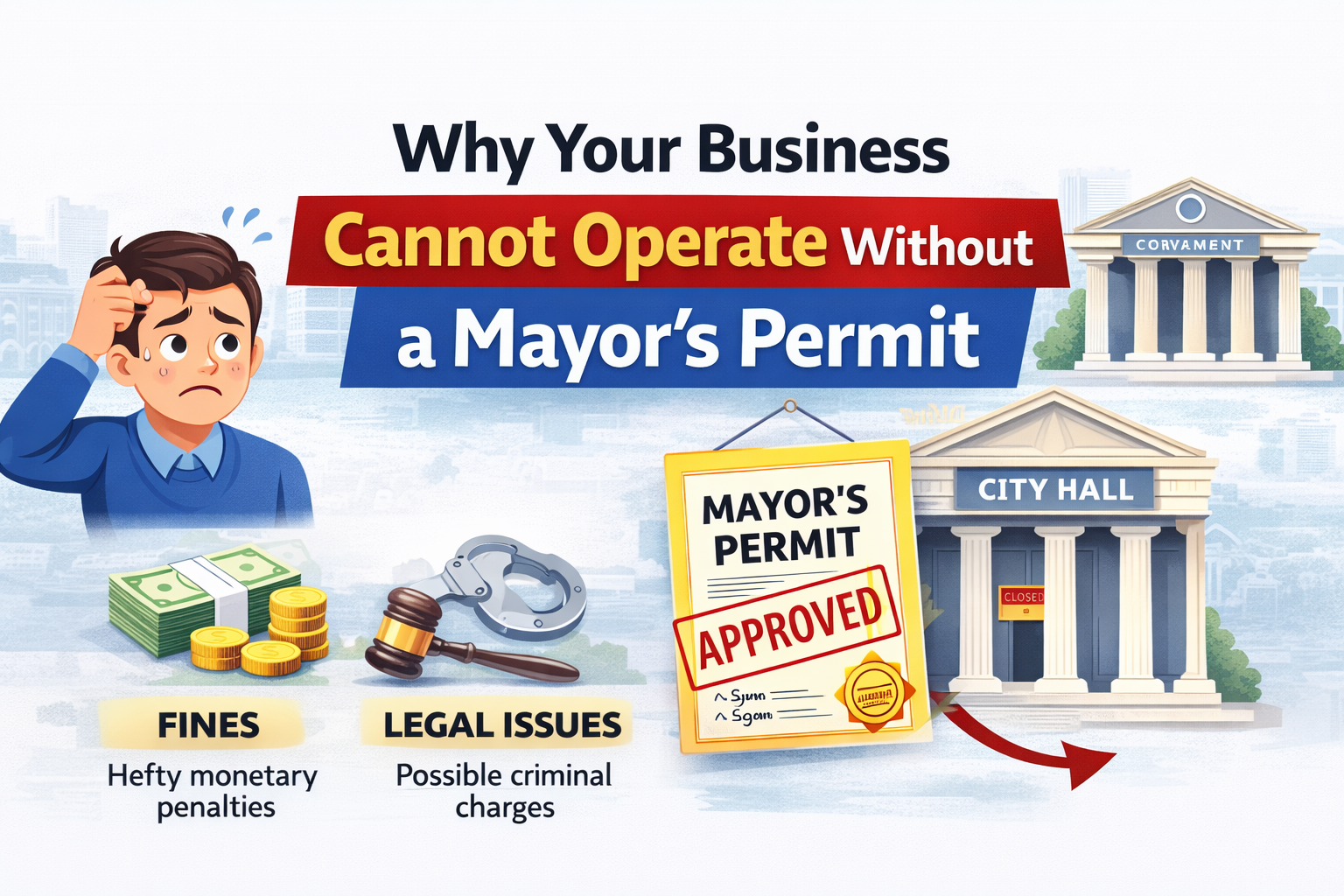
Starting a business in the Philippines requires more than registration with national agencies. Even after securing your business name and tax registration, you must obtain a Mayor’s Permit from your local government unit (LGU) before you can legally operate.
Many entrepreneurs overlook this requirement, assuming that registration with the Department of Trade and Industry or the Securities and Exchange Commission is sufficient. However, without a Mayor’s Permit, your business may be considered unauthorized at the local level.
This article explains why a Mayor’s Permit is essential and the legal consequences of operating without one.
What Is a Mayor’s Permit?
A Mayor’s Permit, also known as a Business Permit, is a license issued by the local government that authorizes a business to operate within a specific city or municipality.
It confirms that your business has complied with local requirements such as:
Zoning regulations
Safety standards
Sanitary requirements
Local taxes and fees
This permit ensures that your business operations are aligned with local laws and community standards.
1. It Is a Legal Requirement for Operation
No business can legally operate in a city or municipality without securing a Mayor’s Permit.
Even if your business is registered with national agencies such as the Bureau of Internal Revenue for tax purposes, local authorization is still required.
Operating without a permit may result in:
Notices of violation
Fines and penalties
Temporary or permanent closure
Compliance with local government regulations is mandatory for all businesses.
2. Required for Tax Registration and Compliance
A Mayor’s Permit is often required when completing your registration with the Bureau of Internal Revenue.
Without this permit:
Your BIR registration may be delayed
You may encounter issues in securing your Certificate of Registration (COR)
Your business may not be fully compliant with tax regulations
Local and national compliance requirements are interconnected, making the Mayor’s Permit an essential step.
3. Ensures Safety and Regulatory Compliance
Local governments require businesses to comply with safety and operational standards before issuing a permit.
These may include:
Fire safety inspection
Sanitary permits
Building and occupancy clearances
These requirements help protect:
Employees
Customers
The general public
Operating without meeting these standards can expose your business to legal risks.
4. Builds Trust and Business Credibility
A business with a valid Mayor’s Permit demonstrates that it is:
Legitimate
Compliant with local regulations
Safe for customers and clients
Displaying your permit in your place of business helps build trust and confidence among customers, suppliers, and partners.
5. Required for Business Transactions and Growth
Many business transactions require proof of a valid Mayor’s Permit, including:
Opening a business bank account
Applying for loans or financing
Entering into contracts with suppliers or corporate clients
Participating in government projects
Without a permit, your ability to grow and expand your business may be limited.
6. Annual Renewal Is Mandatory
A Mayor’s Permit is not a one-time requirement. Businesses must renew their permit annually with the local government.
Failure to renew on time may result in:
Penalties and surcharges
Suspension of business operations
Difficulty in renewing other registrations
Business owners must monitor renewal deadlines to maintain compliance.
Common Misconceptions
Some entrepreneurs believe they can delay obtaining a Mayor’s Permit, especially if:
The business is small or home-based
Operations are conducted online
The business is still in its early stages
However, any business engaged in commercial activity is generally required to comply with local government regulations.
Final Thoughts
A Mayor’s Permit is a fundamental requirement for operating a business in the Philippines. It provides legal authorization at the local level, ensures compliance with safety standards, and supports your overall business credibility.
Registering with national agencies is only part of the process—local compliance is equally important.
For business owners, securing and maintaining a valid Mayor’s Permit is not just about following the law—it is about protecting your business, building trust, and ensuring long-term success in your chosen market.
Navigating the business landscape in the Philippines can be both rewarding and intricate. Whether you’re embarking on a new venture or scaling up, ensuring that your corporate endeavors are in line with local regulations is paramount.
At CBOS Business Solutions Inc., we pride ourselves on simplifying these processes for our clients. As a seasoned professional services company, we offer comprehensive assistance with SEC Registration, Visa processing, and a myriad of other essential business requirements. Our team of experts is dedicated to ensuring that your business is compliant, well-established, and ready to thrive in the Philippine market.
Why venture into the complexities of business registration and compliance alone? Allow our team to guide you every step of the way. After all, your success is our commitment.
Get in touch today and let us be your partner in achieving your business goals in the Philippines.
Email Address: gerald.bernardo@cbos.com.ph
Mobile No.: +639270032851
You can also click this link to schedule a meeting.
Leave a Reply