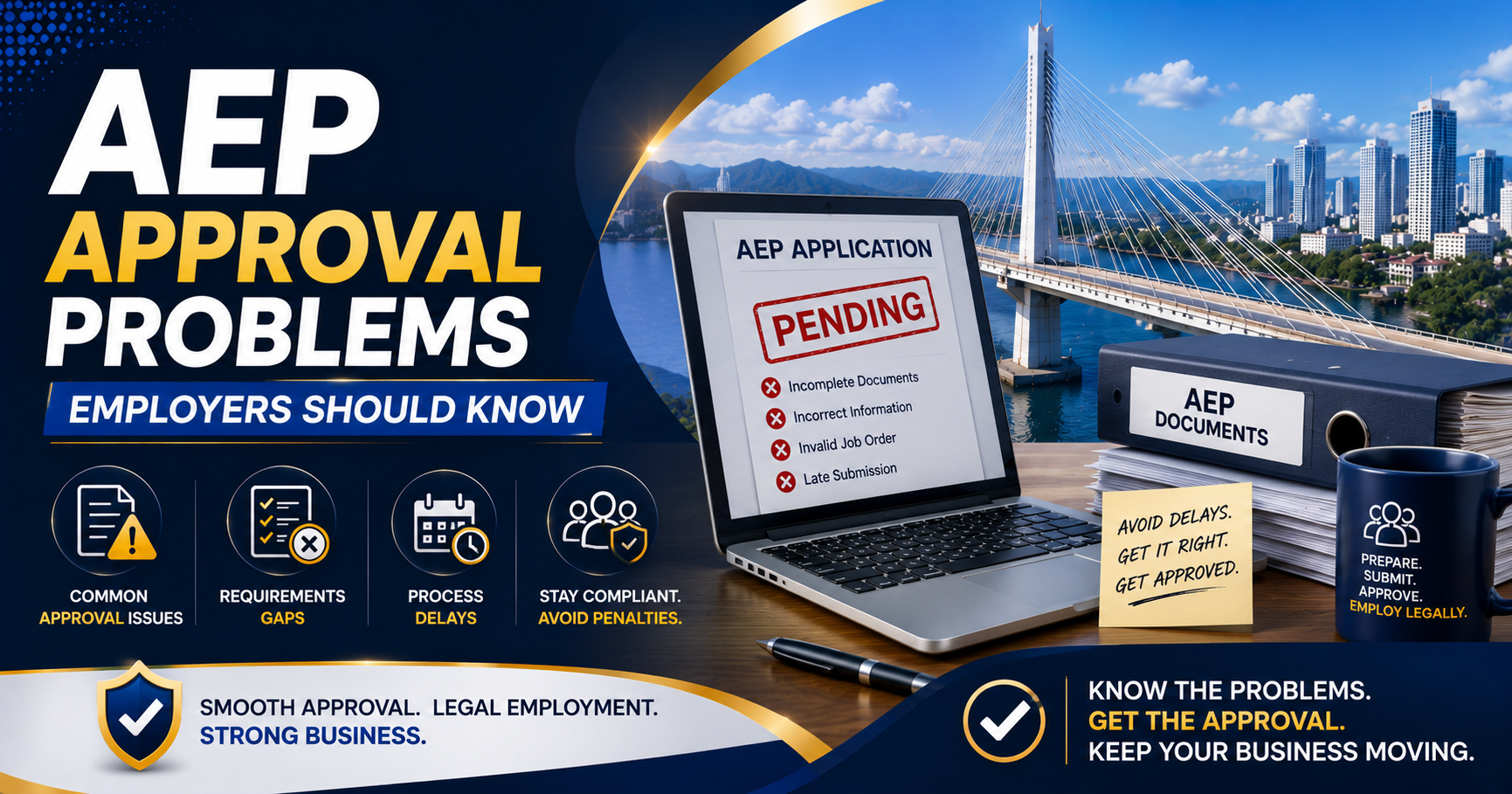
Hiring foreign nationals in the Philippines can help businesses access specialized skills, international expertise, and strategic leadership. However, employers must understand that employing foreign workers also creates important legal and compliance responsibilities.
One of the most critical requirements is the Alien Employment Permit (AEP) issued by the Department of Labor and Employment.
Unfortunately, many employers encounter delays, complications, or approval problems because they underestimate the compliance requirements involved.
This guide explains the most common AEP approval problems employers should know in 2026—and how to avoid them.
What Is an AEP?
An Alien Employment Permit (AEP) is generally required for foreign nationals who will work in the Philippines for a Philippine-based employer.
The AEP helps regulate foreign employment and ensures that labor and immigration rules are properly followed.
In many cases, AEP processing is connected with immigration procedures involving the Bureau of Immigration, especially when employment-based visas are involved.
Why Employers Must Take AEP Compliance Seriously
AEP problems can affect:
- Hiring timelines
- Work authorization
- Immigration processing
- Business operations
- Corporate compliance
Employers—not only foreign employees—may also face compliance consequences when requirements are mishandled.
1. Incomplete Employer Documents
One of the most common approval problems is incomplete corporate documentation.
Employers may be asked to provide:
- Business registration records
- Valid permits and licenses
- Tax compliance documents
- Corporate information
- Proof of legitimate operations
If records are incomplete, outdated, or inconsistent, processing may slow down significantly.
2. Expired or Invalid Local Permits
Employers sometimes overlook permit renewals while focusing on operations.
Problems may arise if:
- Mayor’s Permit is expired
- Barangay Clearance is outdated
- Local business permits are inconsistent with company records
Weak local compliance can affect credibility during review.
3. Inconsistent Corporate Information
Government agencies cross-check records carefully.
Delays often occur when:
- Company addresses do not match
- Officers listed are outdated
- Ownership information is inconsistent
- Business activities differ across registrations
Consistency across records is critical.
4. Unclear Job Position or Justification
Authorities may review whether the foreign national’s position is legitimate and properly supported.
Problems may arise when:
- Job descriptions are vague
- Duties are unclear
- Position titles are inconsistent
- The role appears unsupported by company operations
Employers should ensure employment documentation is well-prepared.
5. Weak Coordination Between Employer and Foreign Employee
Approval delays often happen because employers and applicants fail to coordinate properly.
Examples:
- Passport validity issues discovered late
- Inconsistent information across forms
- Missing signatures
- Delayed responses to requests for clarification
Strong coordination helps avoid avoidable delay.
6. Non-Compliance With Publication or Procedural Requirements
Certain procedural requirements may apply depending on the application type and current regulations.
Employers who rush filing without understanding procedural obligations may encounter setbacks.
7. Immigration and Labor Compliance Not Aligned
The AEP process often interacts with immigration requirements.
Problems may occur when:
- Visa status does not align with employment activity
- Immigration records are incomplete
- Work authorization assumptions are incorrect
Employment compliance and immigration compliance should support each other.
8. Applying Too Late
Some employers wait until:
- The foreign employee already starts working
- Existing status is close to expiration
- Operations already depend heavily on the foreign national
Late preparation increases pressure and risk.
9. Using Incorrect Business Structures or Arrangements
Poorly structured businesses may create additional review concerns.
Examples include:
- Unclear ownership structures
- Inconsistent operational records
- Weak corporate governance
- Informal employment arrangements
Strong corporate compliance improves application credibility.
Common Employer Misconceptions
Many employers believe:
- “The employee handles everything.”
- “The permit is only a formality.”
- “Business registration alone is enough.”
- “We can fix compliance later.”
In reality, employer compliance plays a major role in approval.
Best Practices to Improve AEP Approval
Keep Corporate Records Updated
Ensure:
- Permits are active
- Addresses match
- Corporate information is current
Prepare Clear Employment Documentation
Job roles and employment terms should be properly documented.
Coordinate Immigration and Labor Compliance Early
Do not treat AEP and immigration processing separately without planning.
Review Requirements Carefully Before Filing
Small inconsistencies create large delays.
Begin Processing Early
Avoid last-minute applications whenever possible.
Why Strong Compliance Helps Employers
Good compliance supports:
- Faster processing
- Lower legal risk
- Better workforce planning
- Stronger government credibility
- Easier future renewals and applications
Compliance is part of operational stability.
Final Thoughts
AEP approval problems are often caused not by one major issue—but by weak preparation, inconsistent records, or poor coordination.
Employers who maintain strong compliance systems usually experience smoother processing and fewer delays.
The practical lesson is simple:
Hiring foreign talent legally requires employer compliance—not just employee documents.
Because successful foreign employment begins with a business that is properly organized, documented, and prepared.
Navigating the business landscape in the Philippines can be both rewarding and intricate. Whether you’re embarking on a new venture or scaling up, ensuring that your corporate endeavors are in line with local regulations is paramount.
At CBOS Business Solutions Inc., we pride ourselves on simplifying these processes for our clients. As a seasoned professional services company, we offer comprehensive assistance with SEC Registration, Visa processing, and a myriad of other essential business requirements. Our team of experts is dedicated to ensuring that your business is compliant, well-established, and ready to thrive in the Philippine market.
Why venture into the complexities of business registration and compliance alone? Allow our team to guide you every step of the way. After all, your success is our commitment.
Get in touch today and let us be your partner in achieving your business goals in the Philippines.
Email Address: gerald.bernardo@cbos.com.ph
Mobile No.: +639270032851
You can also click this link to schedule a meeting.
Leave a Reply