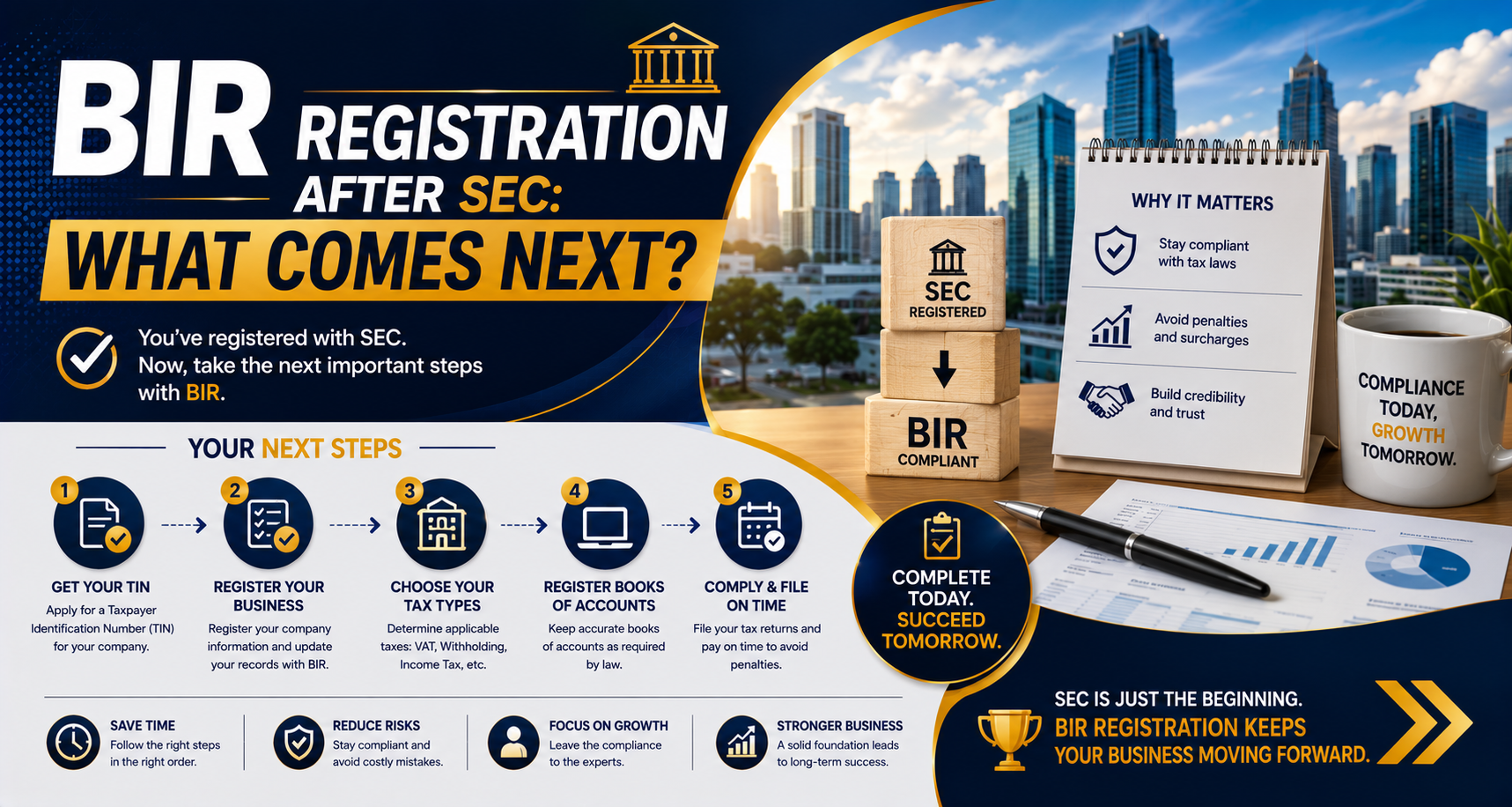
Many entrepreneurs feel a sense of relief after receiving approval from the Securities and Exchange Commission. After weeks of preparation, document review, and registration processing, the corporation finally becomes legally recognized.
But here is the reality many new business owners discover too late:
SEC approval is only the beginning.
A corporation cannot fully operate legally with SEC registration alone. After incorporation, one of the most critical next steps is proper registration with the Bureau of Internal Revenue (BIR).
Without BIR compliance, businesses may face delays in operations, invoicing problems, penalties, banking complications, and tax exposure.
This guide explains what usually comes after SEC registration and why BIR registration is essential for businesses in the Philippines in 2026.
Why SEC Registration Alone Is Not Enough
SEC registration creates the corporation’s legal personality.
However, businesses generally still need:
- Tax registration
- Authority to issue invoices or receipts
- Books of accounts
- Ongoing tax compliance
A corporation may legally exist after SEC approval—but it is not yet fully prepared for compliant operations.
What Is BIR Registration?
BIR registration is the process of registering the business for tax purposes with the Bureau of Internal Revenue.
This helps establish:
- The company’s tax obligations
- Filing responsibilities
- Invoicing authority
- Accounting and reporting requirements
This step is critical before normal business operations begin.
What Usually Comes After SEC Approval?
While requirements may vary depending on the business structure and activity, common next steps often include the following.
1. Secure the Tax Identification Number (TIN)
The corporation generally needs a Tax Identification Number (TIN) for tax-related transactions and compliance.
The TIN becomes important for:
- Tax filings
- Banking
- Contracts
- Government transactions
2. Obtain the Certificate of Registration (COR)
The Certificate of Registration identifies the business’s registered tax obligations.
This may include:
- Applicable tax types
- Filing schedules
- Registration details
Businesses should understand the obligations reflected in their registration.
3. Register Books of Accounts
Businesses are commonly required to maintain books of accounts for recording financial transactions.
Proper bookkeeping supports:
- Tax compliance
- Audit readiness
- Financial management
- Business reporting
Weak record keeping creates risk later.
4. Arrange Invoice or Receipt Compliance
Many businesses assume they can immediately issue invoices or receipts after SEC approval.
However, proper invoicing compliance is usually required before legally issuing official business documents.
This is one of the most commonly overlooked steps after incorporation.
5. Understand Tax Filing Obligations
Businesses may have recurring filing responsibilities such as:
- Monthly obligations
- Quarterly filings
- Annual filings
The exact obligations depend on the business’s registration and operations.
Ignoring filing deadlines can lead to:
- Penalties
- Interest
- Compliance notices
6. Coordinate Local Permit Requirements
Businesses operating physically may also require:
- Barangay Clearance
- Mayor’s Permit / Business Permit
- Industry-specific permits where applicable
Local compliance should be coordinated alongside tax registration.
7. Open a Corporate Bank Account
Banks often require:
- SEC registration documents
- BIR registration
- Corporate resolutions
- Permits and company records
Without BIR registration, account opening may become difficult or delayed.
Common Mistakes Businesses Make After SEC Registration
Many corporations encounter problems because they:
- Delay BIR registration
- Ignore tax filing deadlines
- Operate before invoicing compliance is complete
- Mix personal and business transactions
- Assume SEC approval means “fully operational”
- Ignore bookkeeping requirements
These mistakes often create preventable penalties.
Why Delays Become Expensive
Late or incomplete BIR compliance may affect:
- Tax filings
- Bank transactions
- Client invoicing
- Business credibility
- Audit readiness
Businesses that delay setup often spend more fixing issues later.
Best Practices After SEC Approval
To reduce risk:
✔ Complete BIR registration promptly
✔ Organize bookkeeping early
✔ Understand filing deadlines
✔ Maintain accurate records
✔ Coordinate permits and banking properly
✔ Separate personal and corporate finances
Strong systems should begin immediately after incorporation.
Why Proper Tax Setup Supports Growth
Businesses with clean tax compliance are often better positioned for:
- Loans and financing
- Investor confidence
- Large corporate clients
- Expansion opportunities
- Government transactions
Tax compliance is not just about avoiding penalties—it also supports business credibility.
Final Thoughts
SEC approval is a major milestone—but it is not the final step in building a compliant business.
The smartest corporations understand that:
- Incorporation creates the entity
- BIR registration prepares the business to operate legally
The practical lesson is simple:
After SEC approval, move quickly to complete your tax and compliance foundation.
Because businesses that establish proper compliance early are far easier to operate, scale, and protect long-term.
Navigating the business landscape in the Philippines can be both rewarding and intricate. Whether you’re embarking on a new venture or scaling up, ensuring that your corporate endeavors are in line with local regulations is paramount.
At CBOS Business Solutions Inc., we pride ourselves on simplifying these processes for our clients. As a seasoned professional services company, we offer comprehensive assistance with SEC Registration, Visa processing, and a myriad of other essential business requirements. Our team of experts is dedicated to ensuring that your business is compliant, well-established, and ready to thrive in the Philippine market.
Why venture into the complexities of business registration and compliance alone? Allow our team to guide you every step of the way. After all, your success is our commitment.
Get in touch today and let us be your partner in achieving your business goals in the Philippines.
Email Address: gerald.bernardo@cbos.com.ph
Mobile No.: +639270032851
You can also click this link to schedule a meeting.
Leave a Reply