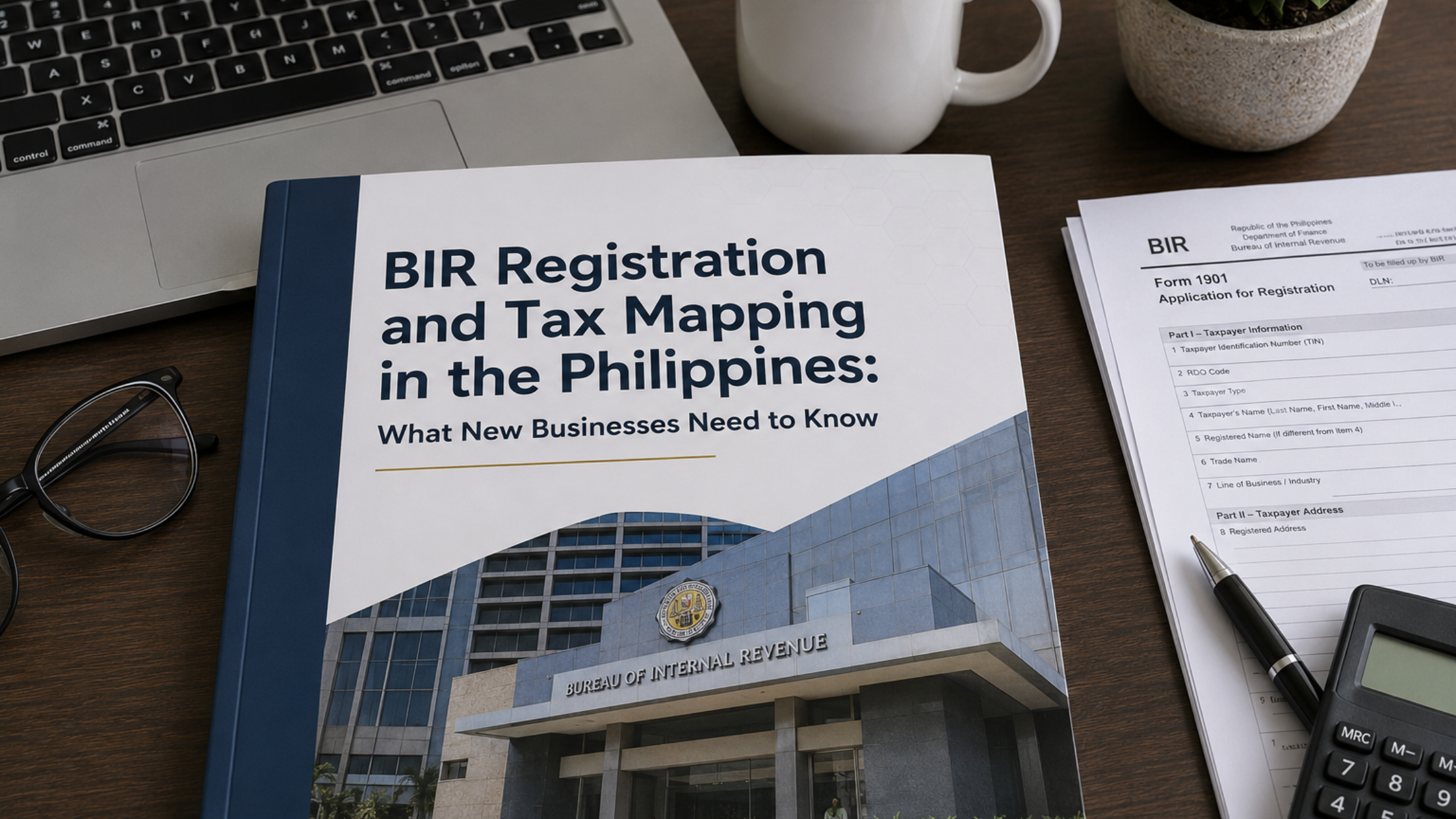
Registering a business with the SEC or DTI is only the beginning of regulatory compliance in the Philippines.
Every business also needs to address its obligations with the Bureau of Internal Revenue (BIR).
Proper BIR registration establishes the business within the Philippine tax system and determines important compliance responsibilities involving taxes, invoicing, accounting records, and tax filings.
For new business owners, three areas deserve particular attention: the Certificate of Registration, compliant invoicing, and books of accounts.
What Is BIR Registration?
BIR registration formally establishes a taxpayer’s business registration and applicable tax obligations.
Depending on the entity and circumstances, the registration process involves providing information concerning the business, its registered address, its activities, and its tax obligations.
Once registered, businesses must maintain ongoing compliance rather than treating BIR registration as a one-time administrative task.
BIR Form 2303: Certificate of Registration
One of the key documents associated with business tax registration is BIR Form 2303, Certificate of Registration (COR).
The Certificate of Registration identifies important taxpayer information and should be carefully reviewed when issued.
Business owners and their accounting teams should understand the tax types and filing obligations applicable to the business rather than simply storing the certificate in a compliance folder.
Missing a required return because the business misunderstood its registration can result in penalties even when there was little or no business activity during the period.
Setting Up Compliant Invoicing
Businesses also need to ensure that the invoices they issue comply with current BIR requirements.
This area deserves particular attention because Philippine invoicing rules have undergone significant changes in recent years.
Businesses should determine the current requirements applicable to their invoicing setup, including whether they will use:
Printed invoices
Computerized accounting or invoicing systems
Point-of-sale systems
Other BIR-compliant electronic solutions
The required registration, approval, notification, or documentation can differ depending on the system being used and current BIR regulations.
Existing businesses should also review older invoice templates rather than assuming that documents prepared under previous rules remain compliant indefinitely.
Books of Accounts
Businesses must maintain appropriate accounting records or books of accounts.
Depending on the taxpayer’s setup and applicable BIR rules, books may be maintained through permitted manual, loose-leaf, or computerized methods.
Accounting records commonly capture transactions involving:
Sales or revenue
Purchases
Cash receipts
Cash disbursements
General journal entries
General ledger accounts
The exact books and registration procedures depend on the taxpayer and accounting system.
Accurate books are not merely a registration requirement. They form the underlying evidence used to prepare tax returns and financial statements and to support the company’s position during a BIR examination.
What Is BIR Tax Mapping?
“Tax mapping” commonly refers to BIR compliance verification activities involving business establishments.
During a compliance visit, revenue officers may verify whether a business is properly registered and complying with applicable tax requirements.
The areas reviewed can depend on current BIR rules and the circumstances of the establishment.
Potential compliance concerns include whether the business has completed its required registration, uses compliant invoices, maintains properly registered books of accounts, and satisfies applicable posting, recordkeeping, and other regulatory requirements.
Why Tax Mapping Matters
A business may have excellent sales and operations but still face problems if its tax documentation is incomplete.
Tax mapping can expose gaps that were overlooked when the business initially registered.
Common risk areas include:
Incomplete BIR registration
Incorrect or outdated invoicing practices
Unregistered or improperly maintained books
Failure to update registration information
Missed tax filings
Inconsistencies between registered information and actual operations
These issues can potentially result in penalties or further BIR compliance action.
Keep Your Registered Information Updated
Businesses change over time.
You may move offices, add a branch, introduce a new line of business, change your registered contact information, or adopt a different accounting or invoicing system.
When these changes occur, determine whether the BIR requires an update to the taxpayer’s registration or additional documentation.
Your SEC, LGU, accounting, and BIR records should also be reviewed for consistency.
Conflicting addresses, business names, or registration information can create avoidable compliance problems.
Build a BIR Compliance Calendar
One of the most effective ways to manage tax compliance is to maintain a calendar covering all applicable filing and payment obligations.
Depending on the taxpayer, obligations can involve:
Income taxes
VAT or percentage tax
Withholding taxes
Payroll-related tax compliance
Information returns
Registration updates
Books and accounting requirements
Other applicable BIR submissions
Not every tax applies to every business. Your compliance calendar should therefore be based on the company’s actual registration and current tax obligations.
Be Tax-Mapping Ready Before an Inspection
Businesses should not wait for a compliance visit before checking their records.
Conduct periodic internal reviews.
Confirm that your Certificate of Registration and registered information are current. Review your invoices for compliance. Make sure your books are properly maintained and updated. Reconcile accounting records with filed tax returns. Keep relevant registration and supporting documents organized and accessible.
Being prepared makes compliance part of normal business operations rather than an emergency exercise when BIR personnel arrive.
Good Bookkeeping Is the Foundation of Tax Compliance
BIR registration gets your business into the tax system. Good bookkeeping helps keep it compliant.
When transactions are recorded accurately and on time, businesses are better positioned to prepare correct returns, substantiate expenses, monitor taxes payable, produce financial reports, and respond to regulatory reviews.
For a growing company, investing in a reliable bookkeeping process early can prevent small administrative problems from becoming expensive tax issues later.
Compliance note: Philippine tax regulations, BIR forms, invoicing rules, registration procedures, and tax-mapping requirements can change. Businesses should verify current requirements with the BIR and consult a qualified tax or accounting professional regarding requirements applicable to their specific circumstances.
Leave a Reply