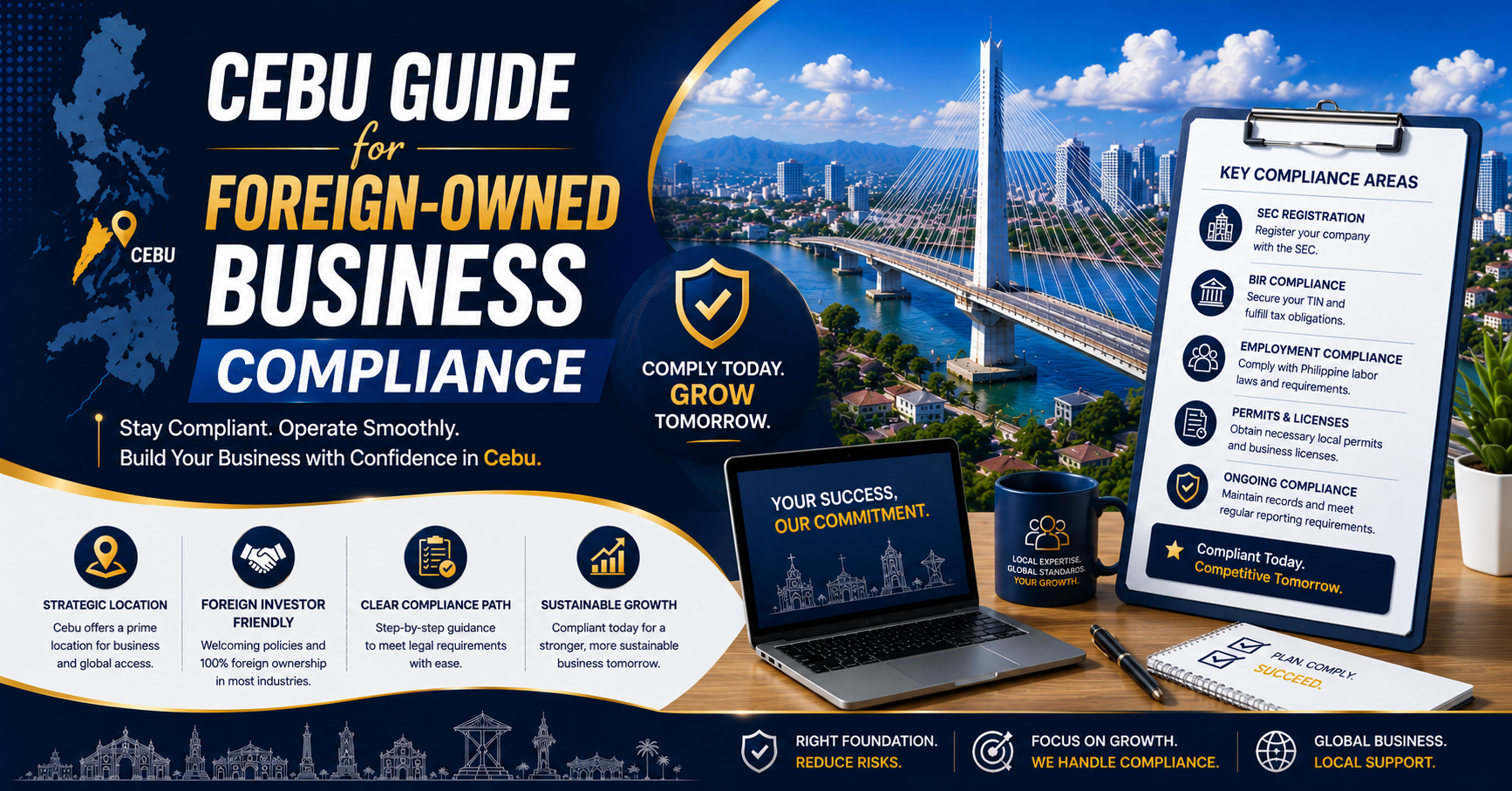
Cebu continues to attract foreign investors because of its strategic location, growing economy, tourism industry, expanding IT-BPO sector, and increasing business opportunities. From startups and restaurants to outsourcing firms and trading companies, many foreign-owned businesses are choosing Cebu as their operational base in the Philippines.
However, starting a business is only the first step.
For foreign-owned companies, long-term success depends heavily on ongoing legal and regulatory compliance. Many businesses operate smoothly during the early stages but later encounter penalties, permit problems, immigration issues, or banking complications because compliance obligations were overlooked.
This guide explains the key compliance areas foreign-owned businesses in Cebu should understand in 2026.
Why Compliance Matters for Foreign-Owned Businesses
Foreign-owned businesses are often subject to closer review because authorities may examine:
- Ownership structure
- Immigration compliance
- Corporate governance
- Tax obligations
- Labor and employment practices
- Investment legitimacy
Strong compliance helps businesses operate more smoothly, avoid disruption, and build credibility.
Step 1: Maintain Proper Corporate Registration
Foreign-owned corporations are commonly registered through the Securities and Exchange Commission.
Businesses should ensure that:
- Corporate records remain updated
- Ownership disclosures are accurate
- Directors and officers are current
- Amendments are filed when needed
- Corporate governance documents are maintained properly
Outdated records can create problems during audits, banking, renewals, or expansion.
Step 2: Understand Foreign Ownership Rules
One of the most important compliance issues involves ownership limitations.
Depending on the industry, businesses may face:
- Full foreign ownership eligibility
- Partial foreign ownership restrictions
- Filipino ownership minimums
Foreign-owned businesses should regularly review whether operations remain aligned with applicable ownership rules.
Step 3: Stay Compliant With BIR Requirements
Foreign-owned businesses must also comply with the Bureau of Internal Revenue.
Common obligations may include:
- Tax registration updates
- Timely tax filings
- Proper bookkeeping
- Invoice or receipt compliance
- Withholding tax obligations where applicable
Weak tax compliance can create penalties and operational risk.
Step 4: Maintain Valid Local Permits
Businesses operating in Cebu generally require local permits such as:
- Barangay Clearance
- Mayor’s Permit / Business Permit
- Industry-specific permits where applicable
Permit renewals should be monitored carefully because expired permits can affect operations and banking relationships.
Step 5: Coordinate Immigration and Employment Compliance
Foreign-owned businesses often employ foreign nationals or involve foreign directors and officers.
This may require coordination with:
- Bureau of Immigration
- Department of Labor and Employment
Businesses should ensure:
- Work authorization is valid
- Immigration status matches actual activities
- Employment documentation is accurate
Ownership does not automatically authorize operational work.
Step 6: Keep Accurate Bookkeeping and Records
Strong record keeping is essential.
Businesses should maintain:
- Accounting records
- Payroll documentation
- Contracts and agreements
- Corporate resolutions
- Tax records
- Ownership records
Good records support audit readiness and investor confidence.
Step 7: Separate Personal and Business Transactions
Foreign investors sometimes mix personal and corporate expenses during startup phases.
This creates issues involving:
- Tax reporting
- Audit explanations
- Corporate governance
- Banking reviews
Separate accounts and organized records are critical.
Step 8: Monitor Beneficial Ownership Transparency
Banks and regulators increasingly review:
- Ultimate beneficial owners
- Control structures
- Source of funds
- Ownership transparency
Clear and accurate ownership records reduce compliance risk.
Step 9: Review Contracts and Operational Agreements Carefully
Foreign-owned businesses often rely on:
- Lease agreements
- Supplier contracts
- Employment contracts
- Shareholder agreements
- Service agreements
Poorly drafted or unclear agreements can create long-term disputes.
Step 10: Prepare for Growth and Regulatory Review
As businesses expand, scrutiny may increase from:
- Banks
- Investors
- Government agencies
- Business partners
Companies with strong compliance systems are usually better positioned for expansion.
Common Compliance Mistakes Foreign-Owned Businesses Make
- Ignoring ownership restrictions
- Operating with outdated permits
- Weak bookkeeping
- Using nominee arrangements improperly
- Delaying immigration compliance
- Mixing personal and corporate funds
- Failing to update corporate records
Most problems begin with neglected details.
Why Compliance Helps Business Growth
Strong compliance supports:
- Easier banking transactions
- Investor confidence
- Faster renewals and approvals
- Better operational stability
- Reduced legal risk
- Long-term scalability
Compliance is not only protection—it is also a business advantage.
Best Practices for Foreign-Owned Businesses in Cebu
✔ Keep registrations and permits updated
✔ Maintain clean bookkeeping records
✔ Coordinate immigration and labor compliance properly
✔ Monitor ownership and governance structures
✔ Conduct regular compliance reviews
✔ Address issues early before they grow
Consistency matters.
Final Thoughts
Foreign-owned businesses can succeed strongly in Cebu—but success requires more than investment capital. It requires disciplined compliance and proper legal structure.
The businesses that grow sustainably are usually the ones that prioritize:
- Accurate records
- Transparent ownership
- Proper tax compliance
- Immigration coordination
- Corporate governance
The practical lesson is simple:
For foreign-owned businesses, compliance is not just a legal obligation—it is part of long-term business strategy.
Because businesses built on strong legal foundations are easier to protect, scale, and grow confidently in the Philippines.
Navigating the business landscape in the Philippines can be both rewarding and intricate. Whether you’re embarking on a new venture or scaling up, ensuring that your corporate endeavors are in line with local regulations is paramount.
At CBOS Business Solutions Inc., we pride ourselves on simplifying these processes for our clients. As a seasoned professional services company, we offer comprehensive assistance with SEC Registration, Visa processing, and a myriad of other essential business requirements. Our team of experts is dedicated to ensuring that your business is compliant, well-established, and ready to thrive in the Philippine market.
Why venture into the complexities of business registration and compliance alone? Allow our team to guide you every step of the way. After all, your success is our commitment.
Get in touch today and let us be your partner in achieving your business goals in the Philippines.
Email Address: gerald.bernardo@cbos.com.ph
Mobile No.: +639270032851
You can also click this link to schedule a meeting.
Leave a Reply