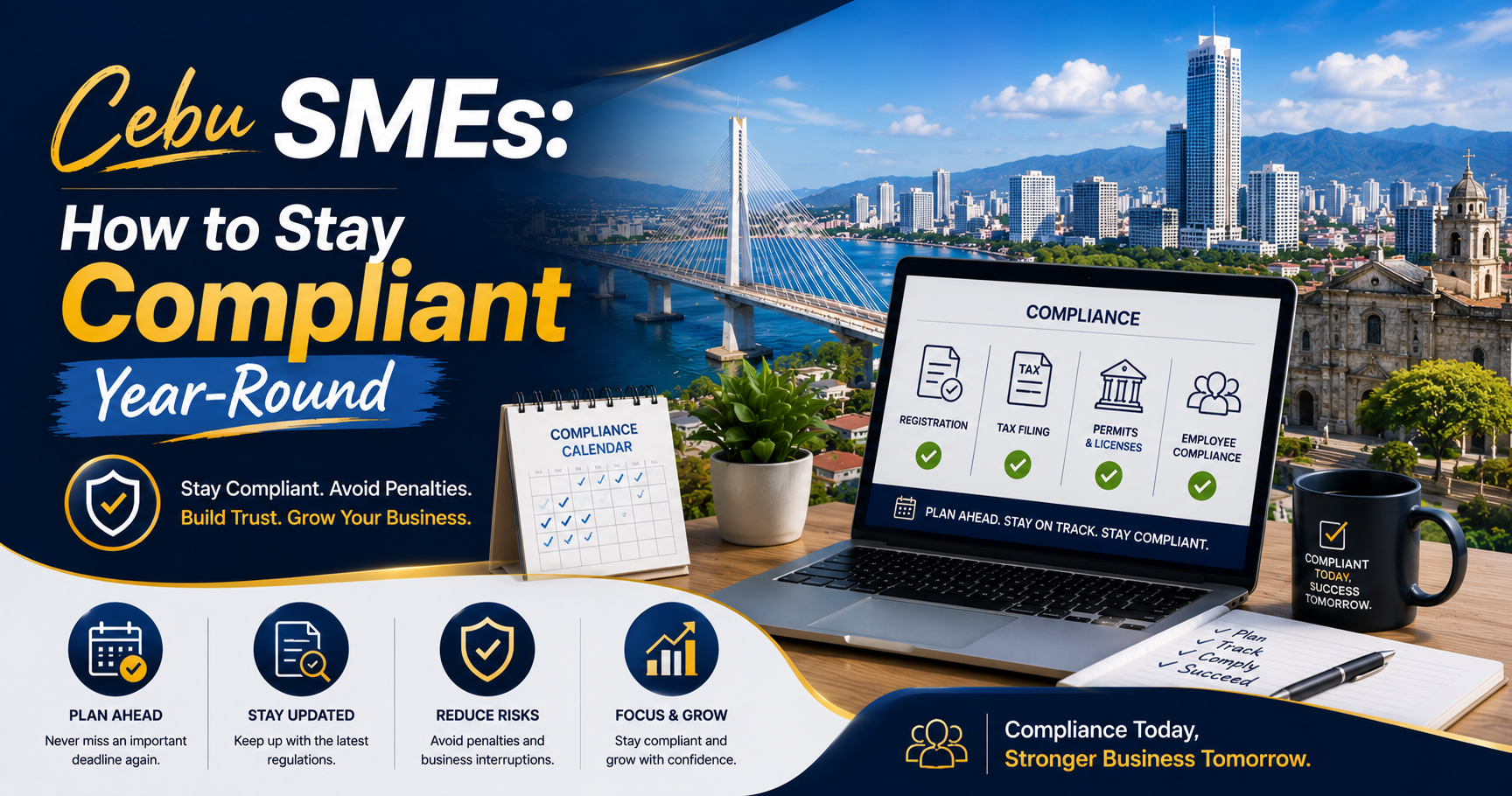
Small and medium-sized enterprises (SMEs) are a major driving force of Cebu’s economy. From retail shops and restaurants to online businesses, professional services, trading companies, and growing startups, SMEs create jobs and contribute significantly to local economic activity.
However, many Cebu business owners focus heavily on operations and sales while overlooking one critical responsibility:
Year-round compliance.
Compliance is not a one-time task completed after registration. It is an ongoing legal obligation involving taxes, permits, corporate records, bookkeeping, and reporting requirements.
Businesses that ignore compliance often face penalties, delayed permits, banking problems, or audit risks. On the other hand, SMEs with strong compliance systems usually grow more smoothly and gain greater credibility.
This guide explains how Cebu SMEs can stay compliant throughout the year in 2026.
What “Business Compliance” Really Means
Compliance generally refers to following legal and regulatory obligations required for operating a business in the Philippines.
Depending on the business type, this may involve:
- Business registration
- Tax filings
- Permit renewals
- Bookkeeping and records
- Payroll and employment obligations
- Corporate reportorial requirements
Key agencies commonly involved include the Bureau of Internal Revenue, Securities and Exchange Commission, and local government units in Cebu.
Why Cebu SMEs Commonly Struggle With Compliance
Many SMEs experience compliance problems because:
- Owners handle too many responsibilities personally
- Deadlines are tracked manually or forgotten
- Bookkeeping is delayed
- Growth happens faster than systems improve
- Compliance is treated only as a year-end concern
As businesses expand, compliance obligations also increase.
1. Maintain Updated Business Registration
The foundation of compliance begins with proper registration.
Depending on structure, businesses may be registered through the:
- Department of Trade and Industry
- Securities and Exchange Commission
SMEs should ensure records remain updated when changes occur involving:
- Address
- Ownership
- Officers
- Business activities
- Capital structure
Outdated records can create future legal and banking problems.
2. Stay Current With BIR Obligations
Tax compliance is one of the most important year-round responsibilities.
Businesses registered with the Bureau of Internal Revenue may need to manage:
- Monthly tax obligations
- Quarterly filings
- Annual filings
- Books of accounts
- Invoice or receipt compliance
Missed deadlines often lead to:
- Penalties
- Interest
- Compliance notices
A filing calendar is essential.
3. Renew Local Permits on Time
Cebu SMEs usually require local permits such as:
- Barangay Clearance
- Mayor’s Permit / Business Permit
- Industry-specific permits where applicable
Late renewals may lead to:
- Penalties
- Operational restrictions
- Delays in other transactions
Permit tracking should be part of annual planning.
4. Keep Accurate Bookkeeping Records
Good bookkeeping is one of the strongest compliance protections.
Maintain:
- Sales records
- Expense documentation
- Payroll records
- Bank reconciliations
- Inventory tracking where applicable
Weak records create tax and audit risk.
5. Separate Personal and Business Finances
One of the most common SME mistakes is mixing funds.
Best practice includes:
- Separate business bank accounts
- Clear owner withdrawals
- Proper reimbursement documentation
This improves accounting accuracy and audit readiness.
6. Monitor Corporate Compliance (For Corporations)
Corporations have additional obligations involving the Securities and Exchange Commission.
This may include:
- Reportorial filings
- Updates to directors and officers
- Governance records
- Shareholder documentation
Ignoring these duties can affect corporate good standing.
7. Prepare for Audits Before They Happen
Do not wait for a notice before organizing records.
SMEs should:
- Store documents properly
- Reconcile records regularly
- Review tax filings periodically
- Conduct internal compliance checks
Prepared businesses respond faster and with less stress.
8. Assign Responsibility for Compliance
Compliance without ownership often fails.
Whether internal or outsourced, someone should monitor:
- Filing deadlines
- Permit renewals
- Tax records
- Corporate updates
A clear system prevents missed obligations.
Common Compliance Mistakes Cebu SMEs Make
- Filing taxes late
- Ignoring bookkeeping until year-end
- Operating with expired permits
- Using personal accounts for business transactions
- Forgetting reportorial obligations
- Keeping incomplete records
These small issues often become expensive over time.
Why Compliance Helps Business Growth
Strong compliance supports:
- Easier bank transactions
- Better investor confidence
- Smoother loan applications
- Stronger customer trust
- Reduced legal risk
- More stable expansion opportunities
Compliance is not only protection—it is also a growth advantage.
Final Thoughts
For Cebu SMEs, compliance should not be viewed as a burden handled only during emergencies or tax season.
The strongest businesses treat compliance as part of daily operations.
The practical lesson is simple:
Stay compliant consistently—not just when deadlines or notices appear.
Because businesses that remain organized year-round usually avoid costly disruptions and grow with greater confidence.
Navigating the business landscape in the Philippines can be both rewarding and intricate. Whether you’re embarking on a new venture or scaling up, ensuring that your corporate endeavors are in line with local regulations is paramount.
At CBOS Business Solutions Inc., we pride ourselves on simplifying these processes for our clients. As a seasoned professional services company, we offer comprehensive assistance with SEC Registration, Visa processing, and a myriad of other essential business requirements. Our team of experts is dedicated to ensuring that your business is compliant, well-established, and ready to thrive in the Philippine market.
Why venture into the complexities of business registration and compliance alone? Allow our team to guide you every step of the way. After all, your success is our commitment.
Get in touch today and let us be your partner in achieving your business goals in the Philippines.
Email Address: gerald.bernardo@cbos.com.ph
Mobile No.: +639270032851
You can also click this link to schedule a meeting.
Leave a Reply