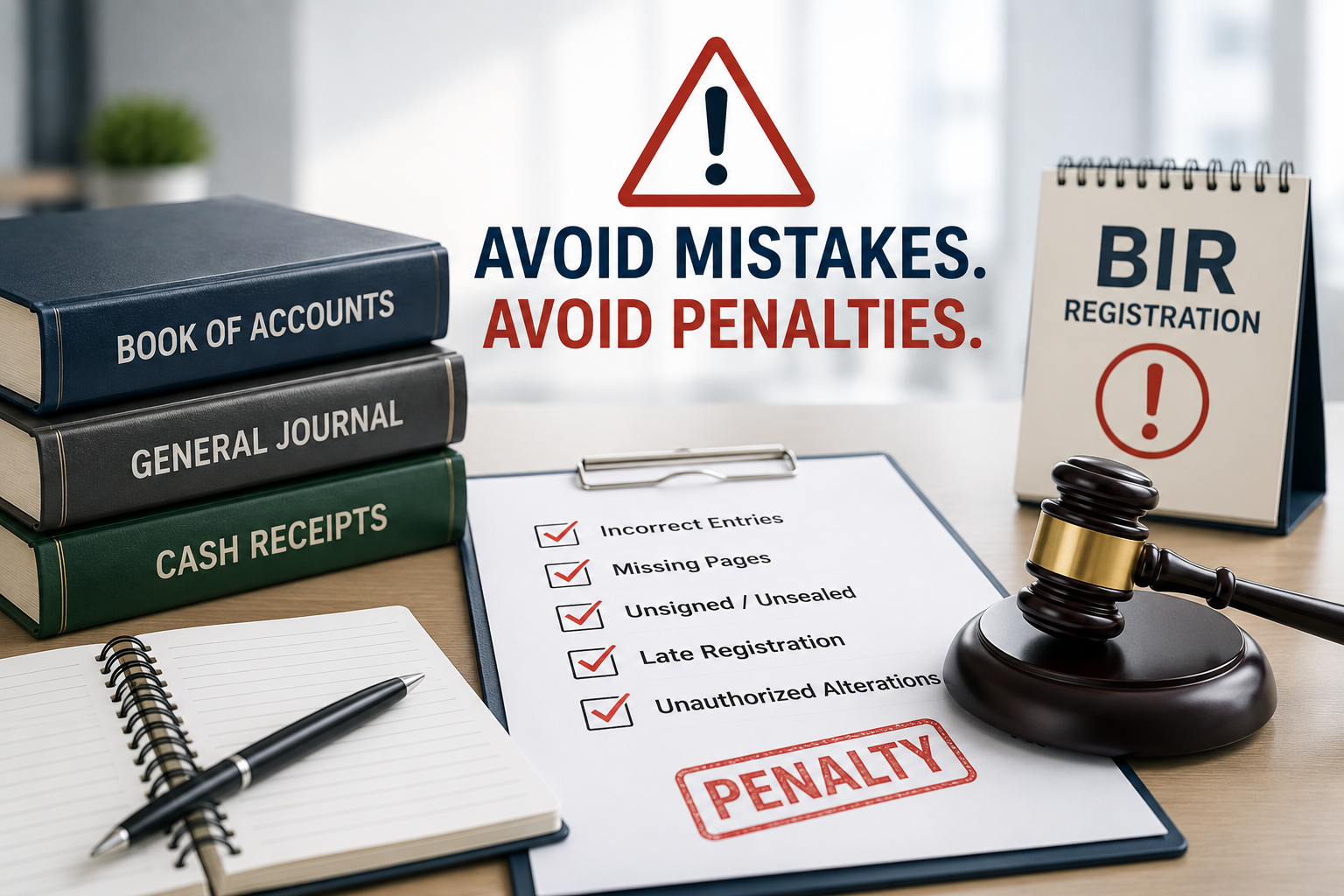
Registering your Books of Accounts with the Bureau of Internal Revenue (BIR) is one of the first tax compliance obligations after starting a business in the Philippines. While the process has become more convenient through the BIR’s Online Registration and Update System (ORUS), many taxpayers still make avoidable mistakes that can result in penalties, compliance issues, or difficulties during a tax audit.
Business owners often assume that simply purchasing accounting books or subscribing to accounting software is enough. In reality, the BIR requires taxpayers to properly register their Books of Accounts, observe prescribed deadlines, and maintain accurate accounting records throughout the life of the business.
This guide discusses the most common mistakes taxpayers make when registering Books of Accounts, the potential consequences of non-compliance, and practical tips for avoiding BIR penalties.
Why Registering Books of Accounts Matters
Books of Accounts are the official accounting records used to document a business’s financial transactions.
They form the basis for preparing:
- Annual Income Tax Returns
- Value-Added Tax (VAT) Returns
- Percentage Tax Returns
- Withholding Tax Returns
- Financial Statements
- Other regulatory reports
During a BIR audit, the Books of Accounts are among the first documents requested to verify the accuracy of a taxpayer’s reported income, expenses, and taxes.
Proper registration demonstrates compliance and strengthens the credibility of your accounting records.
Who Is Required to Register Books of Accounts?
Generally, all persons engaged in trade, business, or the practice of a profession are required to maintain and register Books of Accounts unless otherwise exempt under applicable laws or BIR regulations.
This generally includes:
- Sole proprietors
- Freelancers
- Professionals
- Online sellers
- Partnerships
- Domestic corporations
- One Person Corporations (OPCs)
- Resident foreign corporations
- Non-stock and non-profit organizations engaged in taxable activities
The specific books required depend on the taxpayer’s accounting system and business operations.
Registration Through ORUS
The Bureau of Internal Revenue now allows eligible taxpayers to register their Books of Accounts online through the Online Registration and Update System (ORUS).
Upon successful registration, taxpayers receive a QR Code that serves as proof of registration, replacing the traditional manual stamping process for covered registrations.
Although the registration process has become more efficient, taxpayers remain responsible for complying with all registration deadlines and recordkeeping requirements.
Common Mistakes That Lead to BIR Penalties
1. Missing the Registration Deadline
One of the most common mistakes is failing to register the Books of Accounts within the period prescribed by the BIR.
For newly registered businesses, the Books of Accounts should generally be registered within thirty (30) calendar days from the date of business registration, unless a different period is provided under current BIR regulations.
Many business owners focus on obtaining permits and opening operations while overlooking this important deadline.
Late registration may expose the taxpayer to administrative penalties.
2. Starting Business Operations Before Registering Books
Some businesses begin issuing invoices, recording sales, and accepting customers before registering their Books of Accounts.
Doing so creates accounting records that may not be properly supported by registered books.
Businesses should complete the required registration before maintaining official accounting records.
3. Registering the Wrong Type of Books
The BIR recognizes different bookkeeping systems, including:
- Manual Books of Accounts
- Loose-Leaf Books of Accounts
- Computerized Books of Accounts
Some taxpayers register manual books but actually maintain computerized accounting records, while others use accounting software without complying with the applicable registration or notification requirements.
The bookkeeping system used in practice should be consistent with the system registered with the BIR.
4. Failure to Register Additional or Replacement Books
Businesses eventually consume all pages of their registered books or transition to a different bookkeeping system.
Some taxpayers continue using new books without registering them.
Whenever additional or replacement Books of Accounts are required, taxpayers should comply with the applicable BIR registration procedures before use.
5. Assuming ORUS Eliminates Recordkeeping Responsibilities
The availability of online registration has led some taxpayers to believe that physical or properly maintained accounting records are no longer necessary.
This is incorrect.
ORUS simplifies the registration process, but taxpayers must still:
- maintain complete Books of Accounts;
- record transactions accurately;
- preserve accounting records;
- make records available during a BIR audit.
Registration does not replace proper bookkeeping.
6. Incomplete Accounting Entries
Some businesses maintain registered books but fail to update them regularly.
Examples include:
- delayed recording of sales;
- missing expense entries;
- incomplete journal entries;
- unreconciled ledgers.
Books of Accounts should reflect the business’s actual financial transactions and be updated in accordance with applicable accounting and tax requirements.
7. Poor Record Retention
Registration is only one aspect of compliance.
Businesses must also preserve supporting documents such as:
- Sales invoices
- Official receipts, where applicable
- Purchase invoices
- Delivery receipts
- Contracts
- Payroll records
- Bank statements
- Inventory records
- Tax returns
Without supporting documentation, accounting entries may be difficult to substantiate during a tax examination.
8. Failure to Reconcile Books with Tax Returns
Books of Accounts should reconcile with:
- Annual Income Tax Returns
- VAT Returns
- Percentage Tax Returns
- Withholding Tax Returns
- Financial Statements
Differences between accounting records and tax filings frequently become issues during BIR audits.
Regular reconciliation helps identify discrepancies before tax returns are filed.
9. Ignoring Changes in Business Operations
Businesses often undergo changes such as:
- change of business address;
- expansion of operations;
- adoption of new accounting software;
- conversion from manual to computerized bookkeeping.
These changes may affect the taxpayer’s registration and bookkeeping obligations.
Businesses should review whether updates to their BIR registration are required whenever significant operational changes occur.
10. Not Keeping the ORUS QR Registration Confirmation
After successfully registering Books of Accounts through ORUS, taxpayers receive a QR Code confirming the registration.
Some businesses fail to:
- download the confirmation;
- print the QR Code;
- keep electronic backup copies.
The QR registration confirmation should be preserved together with the company’s tax records.
Potential Consequences of Non-Compliance
Failure to properly register and maintain Books of Accounts may expose businesses to:
- Administrative penalties
- Surcharges and interest, where applicable
- Difficulty substantiating deductible expenses
- Questions regarding reported revenues and expenses
- Delays during BIR tax audits
- Additional compliance requirements
- Challenges in preparing accurate financial statements
Strong bookkeeping practices reduce these risks and support overall tax compliance.
Best Practices to Avoid BIR Penalties
Register Books Promptly
Complete the registration process within the applicable deadline after business registration or before using new or replacement books.
Choose the Appropriate Bookkeeping System
Select a bookkeeping method that matches your business operations:
- Manual
- Loose-leaf
- Computerized
Consult your CPA before changing accounting systems.
Record Transactions Regularly
Maintain current accounting records instead of waiting until tax filing deadlines.
Timely bookkeeping improves accuracy and simplifies compliance.
Perform Monthly Reconciliations
Reconcile your Books of Accounts with:
- Bank statements
- Sales records
- Purchase records
- Tax returns
- General ledger
Regular reconciliation helps detect errors early.
Retain Supporting Documents
Organize accounting documents by taxable year and maintain both physical and electronic copies whenever possible.
Proper documentation strengthens your position during a BIR audit.
Monitor BIR Issuances
The BIR regularly updates procedures relating to:
- ORUS
- Books of Accounts
- Record retention
- Electronic filing
- Accounting systems
Businesses should stay informed of new Revenue Regulations, Revenue Memorandum Circulars, and other issuances.
Work with a Qualified CPA
Professional guidance helps ensure:
- timely registration;
- proper bookkeeping;
- accurate tax reporting;
- compliance with evolving BIR requirements.
Preventive compliance is often less costly than correcting mistakes after an audit.
Year-End Compliance Checklist
Before closing your books for the year, confirm that:
- Books of Accounts are properly registered.
- The correct bookkeeping system is being used.
- All accounting entries are updated.
- Books reconcile with financial statements.
- Books reconcile with tax returns.
- Supporting documents are complete.
- ORUS registration confirmations and QR Codes are securely retained.
- Any new or replacement books have been registered, if applicable.
A proactive review helps minimize compliance risks before the BIR conducts an examination.
Final Thoughts
Registering Books of Accounts is more than a one-time administrative requirement—it is the foundation of sound tax compliance and financial reporting. While the BIR’s ORUS platform has simplified the registration process, taxpayers remain responsible for maintaining accurate books, observing registration deadlines, and preserving complete accounting records.
Many BIR penalties arise not from intentional violations but from simple oversights such as late registration, incomplete bookkeeping, or poor record retention. By understanding the common mistakes discussed in this guide and implementing strong internal controls, businesses can significantly reduce audit risks and maintain compliance with Philippine tax laws.
Investing in proper bookkeeping practices from the beginning not only helps avoid penalties but also provides business owners with reliable financial information for making informed decisions and supporting long-term growth.
Leave a Reply