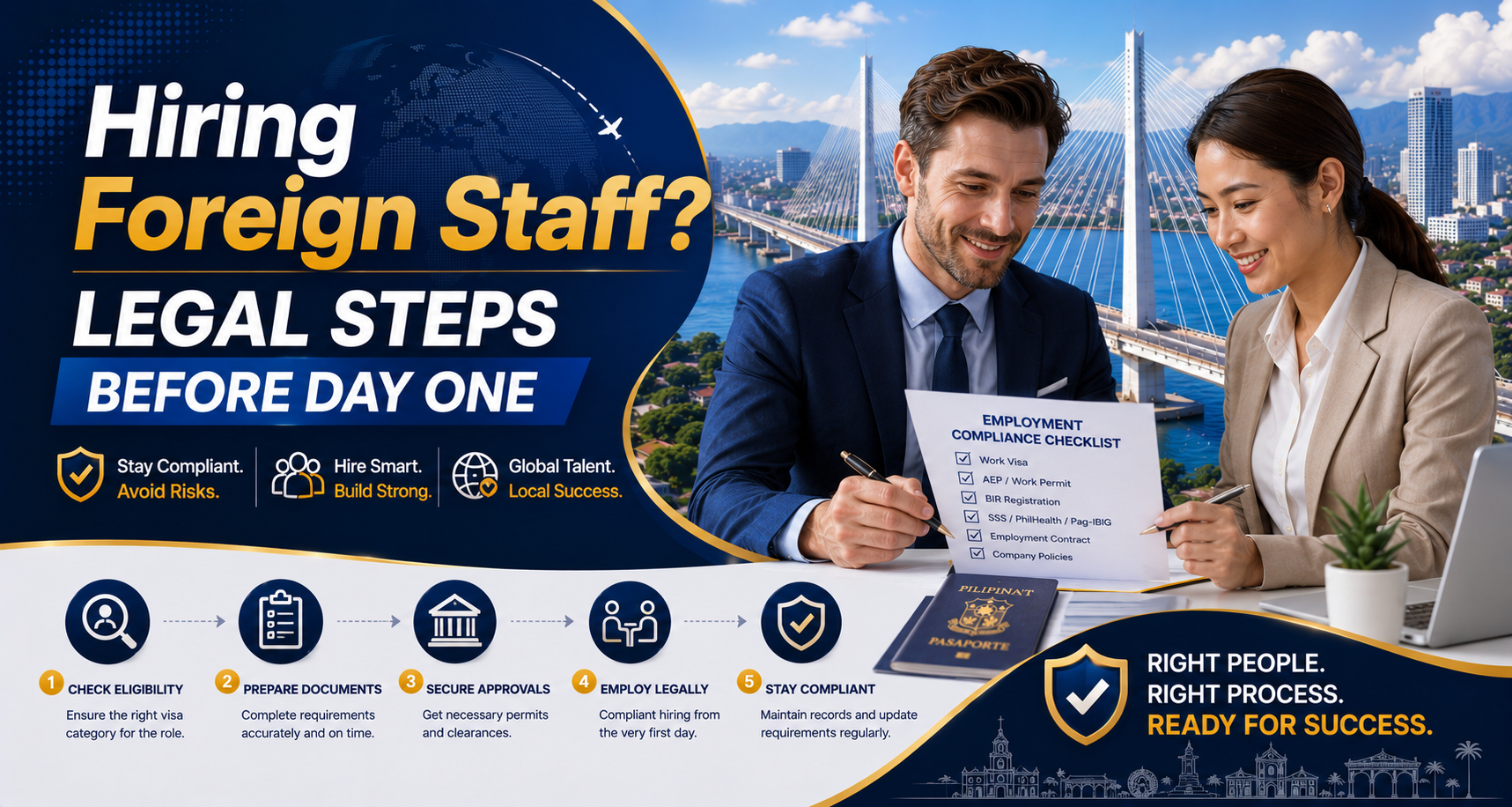
Hiring foreign employees can bring valuable expertise, international experience, and specialized skills to your business. In Cebu and across the Philippines, many companies rely on foreign professionals for leadership roles, technical support, training, consulting, hospitality, and specialized operations.
However, employing foreign nationals is not simply a hiring decision—it is also a legal and compliance process.
One of the biggest mistakes employers make is allowing a foreign employee to begin work before all legal requirements are properly addressed. Doing so can create immigration, labor, tax, and corporate compliance risks for both the employer and the employee.
This guide explains the important legal steps businesses should complete before a foreign employee’s first day of work in the Philippines.
Why Compliance Matters Before Employment Begins
Foreign employment is closely monitored by Philippine authorities to ensure that:
- Businesses are legitimate and compliant
- Employment arrangements are lawful
- Immigration rules are followed
- Labor requirements are satisfied
Employers that fail to prepare properly may face:
- Delays in work authorization
- Immigration complications
- Penalties or compliance issues
- Operational disruptions
Preparation before hiring is critical.
Step 1: Ensure the Business Is Properly Registered
Before hiring foreign staff, the company itself should already be legally compliant.
Depending on the structure, the business may need proper registration with the:
- Securities and Exchange Commission
- Department of Trade and Industry
Businesses should also maintain:
- Active local permits
- Updated corporate records
- Proper tax registration with the Bureau of Internal Revenue
Weak corporate compliance can affect employment processing.
Step 2: Confirm the Position Is Properly Defined
Authorities may review whether the foreign national’s role is legitimate and clearly documented.
Employers should prepare:
- Clear job descriptions
- Defined duties and responsibilities
- Employment terms
- Compensation details
Unclear or inconsistent roles may create approval delays.
Step 3: Understand Work Authorization Requirements
Foreign nationals generally cannot simply begin working immediately upon arrival or hiring.
Depending on the circumstances, employers may need to coordinate with agencies such as the:
- Department of Labor and Employment
- Bureau of Immigration
Employment authorization and immigration status must align properly.
Step 4: Process the Alien Employment Permit (AEP)
Many foreign employees working in the Philippines may require an Alien Employment Permit (AEP).
The AEP process commonly involves review of:
- Employer legitimacy
- Position details
- Employment relationship
- Corporate records
- Supporting documentation
Delays often happen when records are incomplete or inconsistent.
Step 5: Coordinate Immigration Status Properly
Work authorization and immigration status are separate legal matters.
Employers should ensure:
- Visa classification matches actual activities
- Immigration records are current
- Employment activities are properly supported
Allowing work without proper status can create serious compliance issues.
Step 6: Verify Passport and Personal Documents Early
Before processing begins, confirm that the employee has:
- Valid passport
- Updated identification documents
- Accurate personal information
- Supporting employment records where required
Small inconsistencies can delay applications significantly.
Step 7: Review Tax and Payroll Compliance
Employers should also prepare for:
- Payroll setup
- Compensation reporting
- Tax withholding obligations where applicable
- Proper record keeping
Foreign employment often requires coordination between HR, accounting, and legal compliance.
Step 8: Maintain Updated Corporate Records
Government agencies may cross-check employer information.
Ensure that:
- Company address is updated
- Officers and directors are current
- Permits are active
- Business activities are accurately recorded
Corporate inconsistencies may affect approvals.
Common Mistakes Employers Make
- Allowing work before approvals are complete
- Ignoring immigration status requirements
- Using incomplete employment documentation
- Delaying permit processing
- Operating with outdated corporate records
- Treating foreign employment like ordinary local hiring
These mistakes can create avoidable legal risk.
Why Proper Preparation Protects Employers
Strong compliance helps businesses:
- Avoid delays and penalties
- Build credibility with regulators
- Support smoother visa processing
- Reduce operational disruption
- Plan workforce needs more effectively
Compliance is part of responsible workforce management.
Best Practices Before Day One
Before the employee officially begins work:
✔ Verify company compliance
✔ Prepare employment documentation
✔ Coordinate labor and immigration requirements
✔ Begin applications early
✔ Review permits and corporate records
✔ Align HR, accounting, and legal compliance systems
Preparation reduces risk.
Final Thoughts
Hiring foreign staff can strengthen a business—but only when the legal process is handled properly.
The smartest employers understand that foreign hiring is not only about recruitment. It is also about:
- Corporate compliance
- Immigration coordination
- Labor law awareness
- Proper documentation
- Long-term operational planning
The practical lesson is simple:
Before a foreign employee’s first day of work, make sure your compliance process is already working.
Because businesses that prepare early experience smoother hiring, fewer delays, and stronger long-term stability.
Navigating the business landscape in the Philippines can be both rewarding and intricate. Whether you’re embarking on a new venture or scaling up, ensuring that your corporate endeavors are in line with local regulations is paramount.
At CBOS Business Solutions Inc., we pride ourselves on simplifying these processes for our clients. As a seasoned professional services company, we offer comprehensive assistance with SEC Registration, Visa processing, and a myriad of other essential business requirements. Our team of experts is dedicated to ensuring that your business is compliant, well-established, and ready to thrive in the Philippine market.
Why venture into the complexities of business registration and compliance alone? Allow our team to guide you every step of the way. After all, your success is our commitment.
Get in touch today and let us be your partner in achieving your business goals in the Philippines.
Email Address: gerald.bernardo@cbos.com.ph
Mobile No.: +639270032851
You can also click this link to schedule a meeting.
Leave a Reply