Understand the Reporting Obligations Based on Your Business Structure
Choosing the right business structure is one of the most important decisions an entrepreneur makes. Whether you operate as a sole proprietor, partnership, or corporation, your legal structure affects not only ownership and liability but also your accounting responsibilities, tax obligations, and annual reportorial requirements. While all registered businesses in the Philippines are expected to comply with the National Internal Revenue Code (NIRC) and applicable Bureau of Internal Revenue (BIR) regulations, the scope and complexity of annual tax reporting vary significantly depending on the type of business organization.
Many business owners assume that all taxpayers follow the same filing procedures. In reality, each business structure has its own set of tax forms, financial reporting requirements, and regulatory obligations. Understanding these differences helps business owners remain compliant, avoid unnecessary penalties, and prepare accurate tax returns.
This guide explains how annual tax reporting differs for sole proprietors, partnerships, and corporations, and outlines the key compliance responsibilities associated with each business structure.
Important Note: Tax reporting requirements depend not only on the type of business organization but also on the taxpayer’s tax registration, industry, accounting method, applicable tax incentives, and prevailing BIR regulations. Businesses should always consult the latest BIR issuances and seek professional advice to determine their specific compliance obligations.
Why Your Business Structure Matters
Your business structure determines several aspects of tax compliance, including:
- The type of Annual Income Tax Return (AITR) to be filed
- Financial reporting obligations
- Documentary requirements
- Reportorial obligations with the BIR and other government agencies
- Recordkeeping requirements
- Applicable tax rates and tax rules
- Corporate governance and regulatory compliance
Selecting the appropriate structure should involve both legal and tax considerations.
Overview of the Three Common Business Structures
Sole Proprietorship
A sole proprietorship is owned by one individual.
The owner and the business are generally treated as one legal and tax-paying entity for income tax purposes.
Characteristics include:
- Single owner
- Simpler organizational structure
- Direct management by the owner
- Business income generally reported through the owner’s applicable income tax return
Partnership
A partnership is formed by two or more persons who agree to contribute money, property, or industry to a common enterprise.
Depending on the type of partnership and applicable tax laws, tax obligations may vary.
Partnerships maintain separate accounting records and are generally subject to specific tax reporting requirements under the NIRC.
Corporation
A corporation is a separate juridical entity distinct from its shareholders.
Corporations generally have more comprehensive reporting obligations because they are subject to corporate governance rules, financial reporting standards, and additional regulatory requirements.
Annual Tax Reporting for Sole Proprietors
Sole proprietors are required to comply with annual tax reporting based on their registration with the BIR.
Their annual compliance generally includes:
- Annual Income Tax Return
- Financial records supporting reported income
- Books of Accounts
- Other applicable tax returns filed during the taxable year
Depending on the taxpayer’s registration and applicable tax rules, sole proprietors may also have obligations relating to:
- VAT or Percentage Tax
- Withholding taxes
- Payroll reporting (if employees are hired)
Accounting Requirements
Sole proprietors should maintain:
- Books of Accounts
- Sales records
- Expense documentation
- Bank records
- Inventory records, where applicable
Proper bookkeeping remains essential regardless of business size.
Financial Statements
Depending on applicable laws and regulatory requirements, certain sole proprietorships may be required to prepare Financial Statements, and in some cases, have them audited by an independent Certified Public Accountant (CPA).
Businesses should determine whether audit requirements apply based on current laws and regulations.
Annual Tax Reporting for Partnerships
Partnerships generally have broader accounting and reporting responsibilities because they maintain financial records separate from the personal finances of the partners.
Annual reporting typically includes:
- Annual Income Tax Return
- Financial Statements
- Books of Accounts
- Supporting schedules
- Other applicable annual information returns
The partnership itself maintains accounting records even though the partners may have separate tax obligations arising from partnership distributions or other income.
Additional Recordkeeping
Partnerships should maintain documentation covering:
- Capital contributions
- Profit-sharing arrangements
- Partnership agreements
- Partner withdrawals
- Financial Statements
- Accounting records
Proper documentation helps support reported transactions.
Annual Tax Reporting for Corporations
Corporations generally have the most extensive annual reporting obligations among the three business structures.
In addition to BIR requirements, corporations may also have reportorial obligations with other regulatory agencies such as the Securities and Exchange Commission (SEC), depending on applicable laws.
Annual reporting commonly includes:
- Annual Income Tax Return
- Financial Statements
- Books of Accounts
- Annual Information Returns
- Supporting schedules
- Corporate records
Corporate taxpayers often require more comprehensive documentation because of their governance structure.
Financial Reporting
Corporations generally prepare complete Financial Statements, including:
- Statement of Financial Position
- Statement of Comprehensive Income
- Statement of Changes in Equity
- Statement of Cash Flows
- Notes to the Financial Statements
Where required by law, these Financial Statements may need to be audited by an independent CPA.
Corporate Records
Corporations should also maintain:
- Articles of Incorporation
- By-Laws
- General Information Sheet (GIS)
- Board resolutions
- Stockholder records
- Minutes of meetings
These documents support both corporate governance and regulatory compliance.
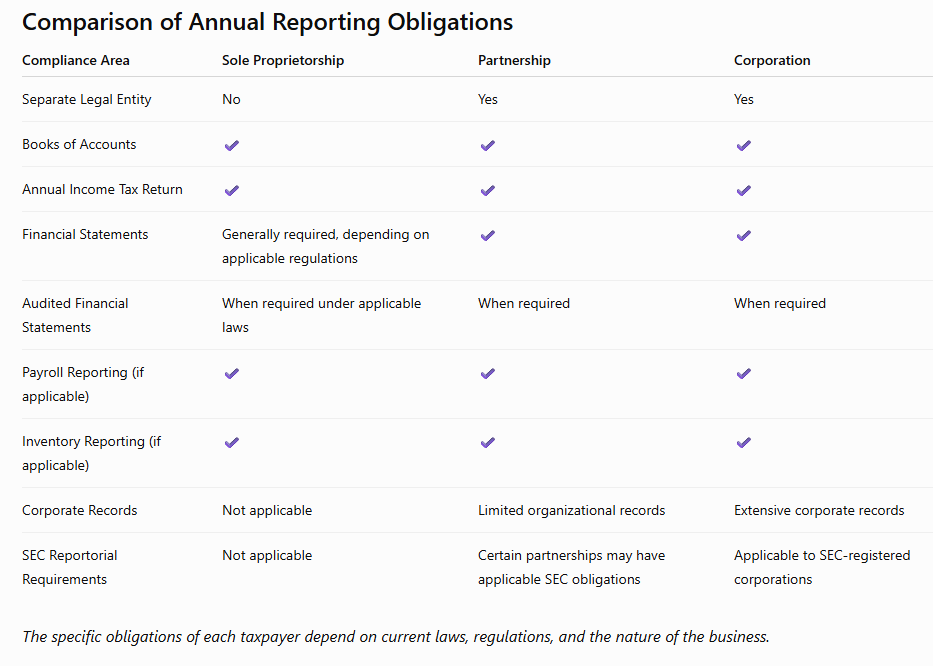
Tax Forms May Differ
The type of Annual Income Tax Return filed depends on the taxpayer’s classification and applicable BIR rules.
For example:
- Individual taxpayers operating sole proprietorships generally file the annual income tax return applicable to individual taxpayers.
- Partnerships and corporations generally file the annual income tax return applicable to juridical entities.
Businesses should always verify the correct BIR form based on their registration and current regulations.
Common Reporting Requirements Shared by All Businesses
Regardless of business structure, every taxpayer should maintain:
Accurate Books of Accounts
Accounting records should be complete and updated throughout the year.
Proper Supporting Documents
Maintain copies of:
- Sales invoices
- Official receipts, where applicable
- Purchase invoices
- Payroll records
- Bank statements
- Contracts
- Inventory records
Timely Tax Filing
Businesses should comply with applicable filing deadlines for:
- Income Tax
- VAT or Percentage Tax
- Withholding Taxes
- Annual Information Returns
Proper Record Retention
Tax records should be retained for the period required under applicable laws and regulations.
Organized records make future audits easier to manage.
Common Compliance Mistakes
Regardless of business structure, businesses often encounter similar reporting problems.
Mixing Personal and Business Transactions
This frequently affects sole proprietors and partnerships.
Separate bank accounts and proper bookkeeping reduce confusion.
Incomplete Accounting Records
Missing journal entries, invoices, or expense documentation may affect tax reporting.
Maintain updated accounting records throughout the year.
Filing the Wrong Tax Return
Using an incorrect Annual Income Tax Return may delay compliance and require amendments.
Always verify the appropriate BIR form before filing.
Ignoring Regulatory Updates
Tax laws and BIR regulations continue to evolve.
Businesses should monitor new Revenue Regulations (RRs), Revenue Memorandum Circulars (RMCs), and other official issuances.
Waiting Until Year-End
Preparing accounting records only during filing season increases the likelihood of reporting errors.
Regular monthly bookkeeping simplifies annual compliance.
Best Practices for Every Business Structure
Whether you operate as a sole proprietor, partnership, or corporation, the following practices help strengthen tax compliance.
Maintain Accurate Bookkeeping
Record all business transactions promptly.
Reconcile Financial Records Regularly
Perform monthly reconciliations of:
- Bank accounts
- Sales
- Expenses
- Payroll
- Inventory
- Tax accounts
Maintain Organized Documentation
Create filing systems for:
- Tax returns
- Financial Statements
- Tax certificates
- Contracts
- Accounting records
Conduct Annual Compliance Reviews
Before filing your Annual Income Tax Return:
- Review Financial Statements.
- Verify tax credits.
- Reconcile accounting records.
- Confirm payroll information.
- Validate inventory balances.
Consult Qualified Professionals
A Certified Public Accountant (CPA) or tax lawyer can help:
- Identify reporting obligations
- Review Financial Statements
- Ensure proper tax compliance
- Prepare annual tax returns
- Provide audit support
Professional advice helps reduce costly compliance errors.
Annual Tax Reporting Checklist
Before filing annual reports, every business should confirm that:
✔ Books of Accounts are updated.
✔ Financial records have been reconciled.
✔ Financial Statements are complete.
✔ Applicable tax returns have been reviewed.
✔ Supporting documents are organized.
✔ Tax credits are properly documented.
✔ Payroll records are accurate.
✔ Inventory records reconcile with accounting records.
✔ Regulatory reporting obligations have been completed.
✔ Filing deadlines have been observed.
Final Thoughts
Annual tax reporting requirements are not identical for all businesses. While sole proprietors generally benefit from simpler reporting obligations, partnerships and corporations often face more comprehensive accounting, financial reporting, and regulatory compliance requirements. Understanding how your business structure affects your annual tax responsibilities is essential to maintaining compliance and avoiding unnecessary penalties or audit issues.
Regardless of whether you operate as a sole proprietor, partnership, or corporation, the key to successful annual tax reporting remains the same: maintain accurate Books of Accounts, prepare reliable Financial Statements, organize supporting documentation, and reconcile accounting records before filing your Annual Income Tax Return.
By investing in sound accounting practices and seeking professional guidance when needed, businesses can strengthen compliance, improve financial decision-making, and build a solid foundation for sustainable growth.
Leave a Reply