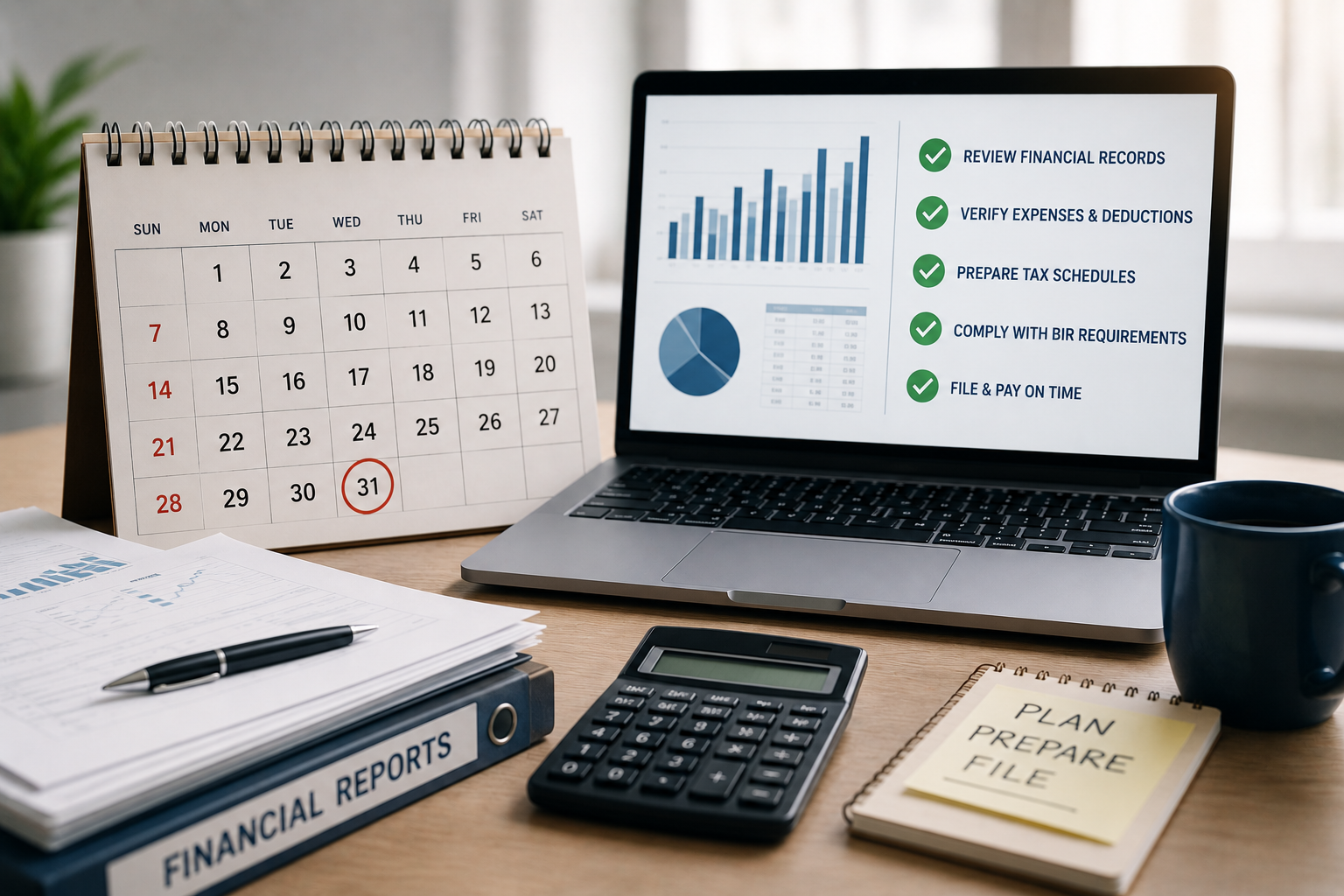
For many businesses in the Philippines, year-end tax reporting is one of the most stressful periods of the year. Accountants scramble to reconcile books, payroll teams rush to correct employee records, management searches for missing receipts, and business owners worry about meeting Bureau of Internal Revenue (BIR) deadlines. Unfortunately, this last-minute approach often leads to filing errors, penalties, missed tax-saving opportunities, and increased audit risks.
The good news is that year-end tax reporting doesn’t have to be overwhelming. With proper planning, regular bookkeeping, and proactive tax management, businesses can complete their annual compliance obligations accurately and on time.
This guide outlines the essential steps businesses should take throughout the year—and especially during the final quarter—to prepare for year-end tax reporting without the unnecessary pressure of last-minute deadlines.
Why Early Preparation Matters
Year-end tax reporting involves much more than filing an Annual Income Tax Return. Businesses must ensure that their financial records, payroll, tax returns, inventory, and supporting documents are complete and consistent.
Preparing early allows businesses to:
- Reduce filing errors
- Avoid penalties and interest
- Improve financial reporting accuracy
- Maximize legitimate tax deductions and credits
- Minimize the risk of BIR audits
- Make informed business decisions before year-end
A proactive approach also gives business owners time to address issues before they become costly compliance problems.
Step 1: Keep Your Books of Accounts Updated
Accurate bookkeeping is the foundation of successful year-end tax reporting.
Many businesses delay recording transactions until filing season, resulting in incomplete financial records and rushed reconciliations.
Throughout the year, ensure that:
- Sales are recorded promptly.
- Purchases are properly documented.
- Business expenses are supported by valid invoices and receipts.
- Bank transactions are reconciled regularly.
- Journal entries and ledger accounts are updated.
Whether you use manual, loose-leaf, or computerized Books of Accounts, consistency is essential.
Step 2: Reconcile Payroll Records Early
Payroll errors are among the most common causes of tax reporting issues.
Before year-end, employers should reconcile:
- Payroll registers
- Employee earnings
- Taxable and non-taxable compensation
- Withholding taxes on compensation
- Government contributions
- Employee master records
Verify that each employee’s:
- Full legal name
- Taxpayer Identification Number (TIN)
- Compensation
- Taxes withheld
are accurate.
This preparation simplifies the issuance of BIR Form 2316, the preparation of the Annual Alphalist of Employees, and the filing of BIR Form 1604-C.
Step 3: Review Withholding Tax Compliance
Businesses acting as withholding agents should reconcile all withholding tax transactions before year-end.
Review:
- Expanded Withholding Tax (EWT)
- Final Withholding Tax (FWT)
- Compensation Withholding Tax
Ensure consistency between:
- Monthly withholding tax returns
- Accounting records
- BIR Forms 2307
- BIR Forms 2306
- Payroll records
Any discrepancies should be resolved before preparing annual information returns.
Step 4: Prepare Your Financial Statements
Do not wait until tax filing season to prepare your financial statements.
Begin reviewing:
- Trial Balance
- General Ledger
- Bank reconciliations
- Accounts Receivable
- Accounts Payable
- Fixed Assets
- Depreciation schedules
- Loan balances
If your business requires an external audit, coordinate with your independent Certified Public Accountant (CPA) well before the filing deadline.
Early preparation allows sufficient time for audit adjustments and financial statement review.
Step 5: Conduct an Inventory Count
For businesses maintaining inventories, a physical inventory count is an essential year-end procedure.
Verify:
- Merchandise inventory
- Raw materials
- Work-in-process
- Finished goods
- Damaged or obsolete inventory
Inventory records should reconcile with:
- Warehouse records
- Inventory subsidiary ledgers
- General ledger
- Financial statements
Accurate inventory valuation is critical because inventory directly affects the computation of Cost of Goods Sold and taxable income.
Step 6: Reconcile Financial Statements with Tax Returns
One of the most common audit triggers is inconsistency between financial statements and tax filings.
Before filing annual reports, reconcile:
- Revenue per books with VAT returns
- Sales reported in quarterly and annual tax returns
- Cost of Goods Sold
- Operating expenses
- Payroll expenses
- Withholding taxes
- Inventory balances
Businesses should also review temporary and permanent differences between accounting income under Philippine Financial Reporting Standards (PFRS) and taxable income under the National Internal Revenue Code (NIRC).
Proper reconciliation strengthens both financial reporting and tax compliance.
Step 7: Review Available Tax Credits and Tax Assets
Year-end is the ideal time to identify tax benefits that may reduce your tax liability.
Review available tax assets such as:
- Creditable Withholding Taxes (BIR Form 2307)
- Minimum Corporate Income Tax (MCIT)
- Net Operating Loss Carry-Over (NOLCO)
- Excess Input VAT
- Foreign Tax Credits
- Deferred Tax Assets
Ensure that all claims are supported by complete documentation and comply with applicable tax laws.
Missing legitimate tax credits may result in paying more tax than necessary.
Step 8: Verify Books of Accounts Registration
Confirm that your Books of Accounts are properly registered with the BIR.
Businesses using the Online Registration and Update System (ORUS) should verify that:
- Registration records are complete.
- QR registration confirmations have been retained.
- Any additional or replacement books have been properly registered.
Proper registration is an important component of audit readiness.
Step 9: Organize Supporting Documents
A well-organized filing system simplifies year-end reporting and future tax examinations.
Maintain complete records of:
- Sales invoices
- Official receipts, where applicable
- Purchase invoices
- Delivery receipts
- Payroll records
- Bank statements
- Contracts
- Inventory reports
- Tax returns
- Financial statements
- Tax certificates (BIR Forms 2307, 2306, and 2316)
Both physical and electronic copies should be securely maintained in accordance with record retention requirements.
Step 10: Conduct Year-End Tax Planning
Tax planning should occur before the taxable year ends—not after tax returns are due.
Review:
- Projected taxable income
- Estimated income tax liability
- Business expenses
- Capital expenditures
- Available deductions
- Tax incentives
- Timing of significant transactions
Lawful tax planning helps businesses optimize cash flow while remaining fully compliant with Philippine tax laws.
Common Year-End Mistakes to Avoid
Many businesses create unnecessary compliance issues because of avoidable errors.
Waiting Until the Filing Deadline
Leaving bookkeeping, reconciliations, and financial statement preparation until the last minute often results in rushed work and preventable mistakes.
Incomplete Documentation
Missing invoices, contracts, payroll records, or tax certificates can delay reporting and weaken support for deductions or tax credits during a BIR audit.
Failure to Reconcile Records
Differences between accounting records, tax returns, payroll reports, and financial statements are common audit triggers.
Monthly reconciliations reduce these risks.
Ignoring Regulatory Updates
The BIR regularly issues new Revenue Regulations, Revenue Memorandum Circulars (RMCs), and other issuances that may affect filing requirements and deadlines.
Businesses should stay informed of these changes throughout the year.
Overlooking Tax-Saving Opportunities
Many taxpayers fail to review available tax credits, incentives, or deductible expenses before year-end, resulting in higher tax liabilities than necessary.
Early planning allows businesses to maximize legitimate tax benefits.
Year-End Tax Reporting Checklist
Before the filing season begins, confirm that:
- Books of Accounts are updated and properly registered.
- Bank accounts have been reconciled.
- Payroll records are complete and accurate.
- Employee TINs and payroll data have been verified.
- Inventory counts have been completed.
- Financial Statements are substantially prepared.
- Revenue and expenses reconcile with tax returns.
- Tax credits are properly documented.
- Supporting documents are organized.
- Annual filing deadlines have been scheduled.
- Internal reviews have been completed.
- A CPA or tax adviser has reviewed significant tax issues.
Completing this checklist before filing season can dramatically reduce year-end stress.
The Value of Working with a CPA and Tax Adviser
Preparing for year-end tax reporting requires coordination across several departments, including Accounting, Payroll, Human Resources, Operations, and Management.
A qualified CPA or tax lawyer can assist with:
- Reviewing tax compliance
- Preparing financial statements
- Reconciling accounting records
- Identifying tax-saving opportunities
- Evaluating tax risks
- Ensuring compliance with current BIR regulations
Professional guidance often helps businesses avoid costly mistakes before returns are filed.
Final Thoughts
Year-end tax reporting should never be treated as a last-minute project. Businesses that maintain accurate bookkeeping, reconcile records regularly, monitor payroll and withholding taxes, conduct timely inventory counts, and review financial statements throughout the year are far better positioned to meet their compliance obligations with confidence.
Beyond avoiding penalties, early preparation provides valuable opportunities to identify legitimate tax savings, strengthen internal controls, and improve the overall quality of financial reporting. It also allows business owners and management to focus on strategic planning instead of scrambling to meet filing deadlines.
By adopting a proactive approach and working closely with qualified accounting and tax professionals, Philippine businesses can transform year-end tax reporting from a stressful compliance exercise into an organized and efficient process that supports long-term business success.
Disclaimer
This article is intended for general informational purposes only and should not be construed as legal, accounting, or tax advice. Tax reporting requirements, filing deadlines, documentary requirements, and available tax benefits depend on the taxpayer’s specific circumstances, business structure, accounting period, and applicable provisions of the National Internal Revenue Code, BIR regulations, SEC issuances, and other relevant laws. Businesses should consult a qualified Certified Public Accountant (CPA) or tax lawyer and review the latest official issuances to ensure full compliance with current Philippine tax laws and regulations.
Leave a Reply