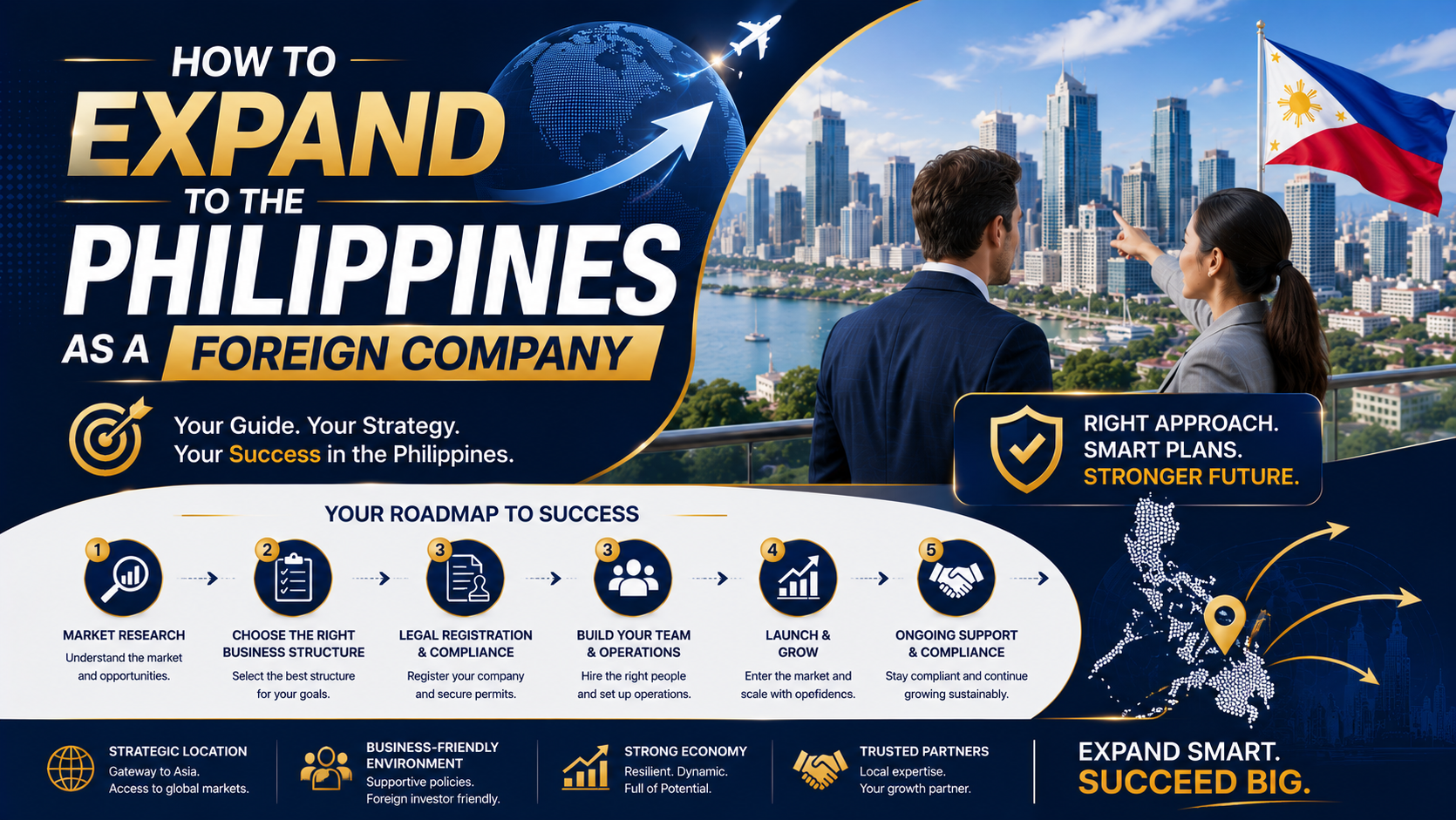
The Philippines continues to attract international businesses because of its growing economy, skilled workforce, strategic location in Southeast Asia, and expanding consumer market. For many foreign companies, expansion into the Philippines is not only an opportunity for growth—it is also a strategic move for long-term regional presence.
Cities such as Cebu, Manila, and other major commercial centers offer strong opportunities in industries including outsourcing, tourism, technology, logistics, consulting, retail support, and export-related operations.
However, successful expansion into the Philippines requires more than market interest. It requires careful legal planning, proper registration, tax compliance, and immigration coordination.
This guide explains how foreign companies can legally expand into the Philippines in 2026.
Why Foreign Companies Expand to the Philippines
International businesses are often attracted by:
- Access to a large and growing consumer market
- Competitive operational costs
- Strong English-speaking workforce
- Expanding digital and BPO sectors
- Strategic location for regional operations
- Growing tourism and hospitality industries
The Philippines offers opportunities for both operational expansion and long-term investment.
Step 1: Determine the Expansion Strategy
Before registering, foreign companies should determine their business objectives in the Philippines.
Common goals include:
- Opening a local operating business
- Establishing regional support operations
- Hiring local employees
- Expanding customer reach
- Supporting import/export activities
- Creating a representative presence
The expansion strategy affects the legal structure that should be used.
Step 2: Choose the Proper Legal Structure
Foreign companies commonly expand using structures such as:
Philippine Corporation
A separate Philippine entity registered through the Securities and Exchange Commission.
Advantages:
- Separate legal personality
- Stronger operational flexibility
- Better local market integration
- Easier long-term expansion
Branch Office
Often used when the foreign parent company directly extends operations into the Philippines.
Representative Office
Usually intended for limited activities such as liaison or market representation without direct income-generating operations.
Other Lawful Structures
Depending on the business model, other compliant arrangements may also be considered.
The ideal structure depends on:
- Industry
- Ownership goals
- Operational scope
- Tax considerations
- Long-term plans
Step 3: Understand Foreign Ownership Rules
Not all industries allow the same level of foreign participation.
Depending on the sector, businesses may face:
- Full foreign ownership eligibility
- Partial foreign ownership limitations
- Minimum Filipino ownership requirements
Ownership analysis should happen before registration—not after investment is committed.
Step 4: Register the Entity Properly
Once the structure is selected, registration commonly involves:
- Name reservation
- Submission of corporate documents
- Ownership disclosures
- Corporate address setup
- Capital structure preparation
Most foreign corporate structures require coordination with the Securities and Exchange Commission.
Step 5: Complete Tax Registration
After registration, the company generally needs compliance with the Bureau of Internal Revenue.
This may include:
- Tax Identification Number (TIN)
- Certificate of Registration (COR)
- Books of accounts
- Invoice or receipt compliance
- Applicable tax registrations
Tax setup is essential before operations begin.
Step 6: Secure Local Permits
Businesses operating physically in the Philippines usually require local permits such as:
- Barangay Clearance
- Mayor’s Permit / Business Permit
- Industry-specific permits where applicable
Requirements vary by city or municipality.
For companies expanding into Cebu, local compliance planning should be part of early preparation.
Step 7: Coordinate Immigration and Employment Compliance
If foreign nationals will:
- Manage operations
- Work locally
- Serve operational functions
then immigration and labor compliance become important.
This may involve coordination with the:
- Bureau of Immigration
- Department of Labor and Employment
Ownership and operational work authorization are separate legal issues.
Step 8: Open Corporate Banking Facilities
Banks often require:
- Corporate registration documents
- Tax registration
- Corporate resolutions
- Ownership disclosures
- Permits and identification records
Strong compliance improves banking relationships.
Step 9: Evaluate Incentive Opportunities
Some industries may qualify for incentives through agencies such as:
- Board of Investments
- Philippine Economic Zone Authority
Depending on eligibility, incentives may include tax or operational benefits.
Common Mistakes Foreign Companies Make
- Ignoring ownership restrictions
- Choosing the wrong structure
- Delaying tax registration
- Operating before permits are complete
- Ignoring immigration compliance
- Using unclear ownership arrangements
- Underestimating local compliance obligations
These mistakes often delay expansion and increase costs.
Why Proper Structuring Matters
Strong legal structuring helps protect:
- Investment security
- Tax efficiency
- Corporate governance
- Operational flexibility
- Long-term scalability
Expansion is smoother when compliance is planned from the beginning.
Best Industries for Foreign Expansion in the Philippines
Depending on legal eligibility and business strategy, opportunities may include:
- IT and outsourcing
- Tourism and hospitality
- Export support operations
- Logistics and trading
- Professional services
- Technology and digital businesses
Industry-specific review remains essential.
Final Thoughts
Expanding into the Philippines can offer major business opportunities—but successful expansion requires more than market entry. It requires legal preparation, proper registration, tax compliance, and strategic planning.
The businesses that expand successfully are usually the ones that:
- Choose the correct structure
- Understand ownership rules
- Coordinate immigration and tax compliance early
- Build organized governance systems from the start
The practical lesson is simple:
Expand strategically—not just operationally.
Because foreign companies that enter the Philippines with strong legal foundations are far better positioned for long-term growth and stability.
Navigating the business landscape in the Philippines can be both rewarding and intricate. Whether you’re embarking on a new venture or scaling up, ensuring that your corporate endeavors are in line with local regulations is paramount.
At CBOS Business Solutions Inc., we pride ourselves on simplifying these processes for our clients. As a seasoned professional services company, we offer comprehensive assistance with SEC Registration, Visa processing, and a myriad of other essential business requirements. Our team of experts is dedicated to ensuring that your business is compliant, well-established, and ready to thrive in the Philippine market.
Why venture into the complexities of business registration and compliance alone? Allow our team to guide you every step of the way. After all, your success is our commitment.
Get in touch today and let us be your partner in achieving your business goals in the Philippines.
Email Address: gerald.bernardo@cbos.com.ph
Mobile No.: +639270032851
You can also click this link to schedule a meeting.
Leave a Reply