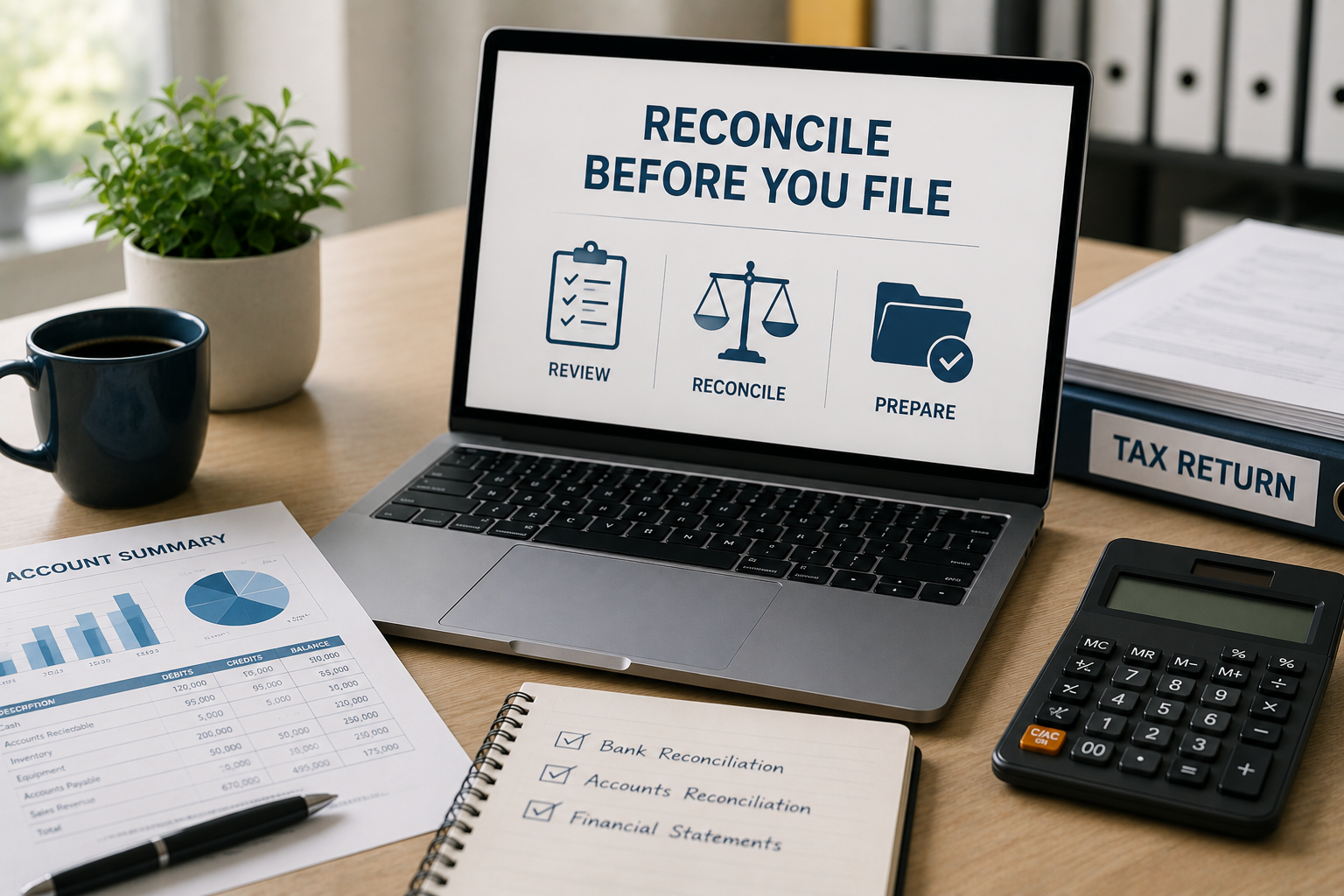
Best Practices for Ensuring Your Books, Financial Statements, and Tax Returns Are Consistent
Preparing your Annual Income Tax Return (AITR) is one of the most significant tax compliance responsibilities for every business in the Philippines. However, filing your return is not simply a matter of transferring figures from your accounting software into BIR forms. Before submitting your tax return, your accounting records, financial statements, and tax filings should be carefully reconciled to ensure they are accurate, complete, and consistent.
One of the most common reasons businesses receive inquiries from the Bureau of Internal Revenue (BIR) is because of discrepancies between accounting records and tax returns. Differences in reported sales, expenses, inventory, or withholding taxes may prompt the BIR to request explanations or supporting documents during a tax audit.
Proper reconciliation helps identify these issues before filing, reducing the risk of penalties, amended returns, and unnecessary tax investigations.
This guide explains how businesses can effectively reconcile their accounting records before filing their Annual Income Tax Return and outlines best practices for maintaining accurate financial and tax records.
Important Note: Reconciliation procedures may vary depending on the nature of the business, accounting system, applicable accounting standards, and tax regulations. Businesses should consult a qualified Certified Public Accountant (CPA) or tax adviser for guidance specific to their circumstances.
What Is Accounting Reconciliation?
Accounting reconciliation is the process of comparing financial records from different sources to confirm that they are complete, accurate, and consistent.
Before filing the Annual Income Tax Return, businesses should reconcile:
- Books of Accounts
- General Ledger
- Trial Balance
- Financial Statements
- Income Tax Returns
- VAT Returns
- Withholding Tax Returns
- Payroll Records
- Bank Statements
- Inventory Records
The objective is to identify and resolve discrepancies before they become compliance issues.
Why Reconciliation Is Important
Proper reconciliation helps businesses:
- Ensure accurate tax reporting
- Reduce the risk of BIR audits
- Detect accounting errors early
- Prevent duplicate or missing transactions
- Support tax deductions and tax credits
- Improve financial reporting accuracy
- Strengthen internal controls
Accurate records also make it easier to respond to future tax examinations or financial audits.
Step 1: Update Your Books of Accounts
Reconciliation begins with complete and updated accounting records.
Before preparing your Annual Income Tax Return, confirm that all transactions have been recorded.
Review:
- Sales
- Purchases
- Cash receipts
- Cash disbursements
- Journal entries
- Adjusting entries
- Closing entries
Businesses should ensure that their Books of Accounts accurately reflect all transactions for the taxable year.
Step 2: Reconcile Bank Accounts
Bank reconciliation is one of the most important year-end procedures.
Compare:
- Cash book balances
- Bank statements
- Outstanding checks
- Deposits in transit
- Bank charges
- Interest income
Investigate any unexplained differences before preparing financial statements.
Accurate cash balances strengthen both accounting and tax reporting.
Step 3: Verify Revenue and Sales Records
Sales reported in your accounting records should reconcile with:
- VAT Returns
- Sales journals
- Sales invoices
- Financial Statements
- Annual Income Tax Return
Common discrepancies include:
- Duplicate sales entries
- Missing invoices
- Incorrect revenue recognition
- Timing differences
Businesses should investigate any inconsistencies before filing.
Step 4: Review Business Expenses
Expenses claimed as deductions should be supported by proper documentation.
Verify:
- Purchase invoices
- Official receipts, where applicable
- Payroll records
- Contracts
- Proof of payment
- Bank records
Expenses should also satisfy the deductibility requirements under the National Internal Revenue Code (NIRC) and applicable BIR regulations.
Unsupported expenses may be disallowed during a tax audit.
Step 5: Reconcile Payroll Records
Businesses with employees should reconcile payroll before year-end.
Review:
- Employee compensation
- Payroll registers
- Taxes withheld
- Government contributions
- Employee TINs
Payroll records should agree with:
- BIR Form 2316
- Annual Alphalist of Employees
- BIR Form 1604-C
- Accounting records
Accurate payroll reporting helps avoid withholding tax issues.
Step 6: Review Withholding Taxes
Businesses acting as withholding agents should reconcile all withholding tax records.
Compare:
- Accounting records
- Monthly withholding tax returns
- BIR Forms 2307
- BIR Forms 2306
- Annual information returns
Verify that all taxes withheld have been properly remitted and recorded.
Step 7: Reconcile Inventory Records
For businesses maintaining inventories, inventory reconciliation is critical.
Review:
- Physical inventory count
- Inventory subsidiary ledger
- Warehouse records
- General Ledger
- Financial Statements
Confirm that inventory balances are consistent across all records.
Inventory discrepancies directly affect Cost of Goods Sold (COGS) and taxable income.
Step 8: Review Fixed Assets
Fixed asset schedules should be reviewed before preparing annual reports.
Verify:
- Asset acquisitions
- Asset disposals
- Depreciation expense
- Accumulated depreciation
- Remaining useful lives
Ensure that accounting records accurately reflect all year-end adjustments.
Step 9: Verify Tax Credits
Before filing the Annual Income Tax Return, review all available tax credits.
These may include:
- Creditable Withholding Taxes (BIR Form 2307)
- Minimum Corporate Income Tax (MCIT)
- Net Operating Loss Carry-Over (NOLCO)
- Excess Input VAT
- Foreign Tax Credits, where applicable
Tax credit claims should be supported by complete documentation and reconciled with accounting records.
Step 10: Compare the Trial Balance with the Financial Statements
The Trial Balance serves as the foundation for preparing Financial Statements.
Review whether account balances agree with:
- Statement of Financial Position
- Statement of Comprehensive Income
- Statement of Changes in Equity
- Statement of Cash Flows
Investigate unusual fluctuations before preparing the Annual Income Tax Return.
Step 11: Reconcile Financial Statements with the Annual Income Tax Return
One of the final reconciliation procedures involves comparing Financial Statements with the Annual Income Tax Return.
Review:
- Gross sales
- Cost of Goods Sold
- Gross profit
- Operating expenses
- Other income
- Taxable income
- Income tax expense
Businesses should also identify any book-to-tax differences arising from accounting standards and tax regulations.
Proper reconciliation reduces inconsistencies that may attract BIR attention.
Common Reconciliation Errors
Many businesses experience tax reporting issues because of avoidable mistakes.
Waiting Until Filing Season
Delaying reconciliation until the filing deadline often results in rushed reviews and overlooked discrepancies.
Reconciliation should be performed regularly throughout the year.
Missing Supporting Documents
Transactions without adequate documentation may be questioned during a tax audit.
Maintain complete records for every material transaction.
Ignoring Small Differences
Minor discrepancies may accumulate into significant reporting errors.
Investigate unexplained differences promptly.
Failing to Review Adjusting Entries
Year-end adjustments affect both Financial Statements and taxable income.
Review all adjusting journal entries before preparing tax returns.
Poor Communication Between Departments
Accounting, Payroll, Finance, Inventory, and Operations should coordinate throughout the reconciliation process.
Incomplete communication often results in inconsistent records.
Best Practices for Successful Reconciliation
Businesses can improve reconciliation by following these best practices.
Perform Monthly Reconciliations
Review bank accounts, receivables, payables, payroll, inventory, and tax accounts every month.
Maintain Updated Books of Accounts
Record transactions promptly rather than waiting until year-end.
Organize Supporting Documents
Maintain complete files of:
- Sales invoices
- Official receipts, where applicable
- Purchase invoices
- Contracts
- Payroll records
- Bank statements
- Tax certificates
Good documentation supports every reconciliation.
Conduct Internal Reviews
Before filing annual reports:
- Review Financial Statements.
- Verify tax returns.
- Reconcile accounting records.
- Confirm inventory balances.
- Validate payroll reports.
Internal reviews reduce filing errors.
Work with Qualified Professionals
A Certified Public Accountant (CPA) or tax lawyer can assist with:
- Financial statement preparation
- Tax reconciliation
- Audit readiness
- Tax planning
- Compliance reviews
Professional guidance strengthens both accounting accuracy and tax compliance.
Pre-Filing Reconciliation Checklist
Before filing your Annual Income Tax Return, confirm that:
- Books of Accounts are updated.
- Bank accounts have been reconciled.
- Sales agree with VAT returns and accounting records.
- Expenses are properly documented.
- Payroll records reconcile with withholding tax reports.
- Inventory balances match Financial Statements.
- Fixed asset schedules are updated.
- Tax credits are supported.
- Financial Statements reconcile with accounting records.
- Annual Income Tax Return agrees with the Financial Statements.
- Supporting documents are complete and organized.
Completing this checklist before filing helps minimize reporting errors.
Final Thoughts
Reconciling your accounting records before filing your Annual Income Tax Return is one of the most effective ways to strengthen tax compliance and reduce the likelihood of BIR inquiries or audits. Accurate reconciliation ensures that your Books of Accounts, Financial Statements, and tax returns present a consistent and reliable picture of your business’s financial performance.
Rather than treating reconciliation as a year-end exercise, businesses should incorporate it into their regular accounting processes through monthly reviews, organized recordkeeping, and timely financial reporting. This proactive approach not only improves compliance but also provides management with more reliable financial information for strategic decision-making.
By maintaining disciplined accounting practices and seeking professional advice when necessary, businesses can approach annual tax filing with greater confidence, reduce compliance risks, and build a stronger foundation for long-term growth.
Leave a Reply