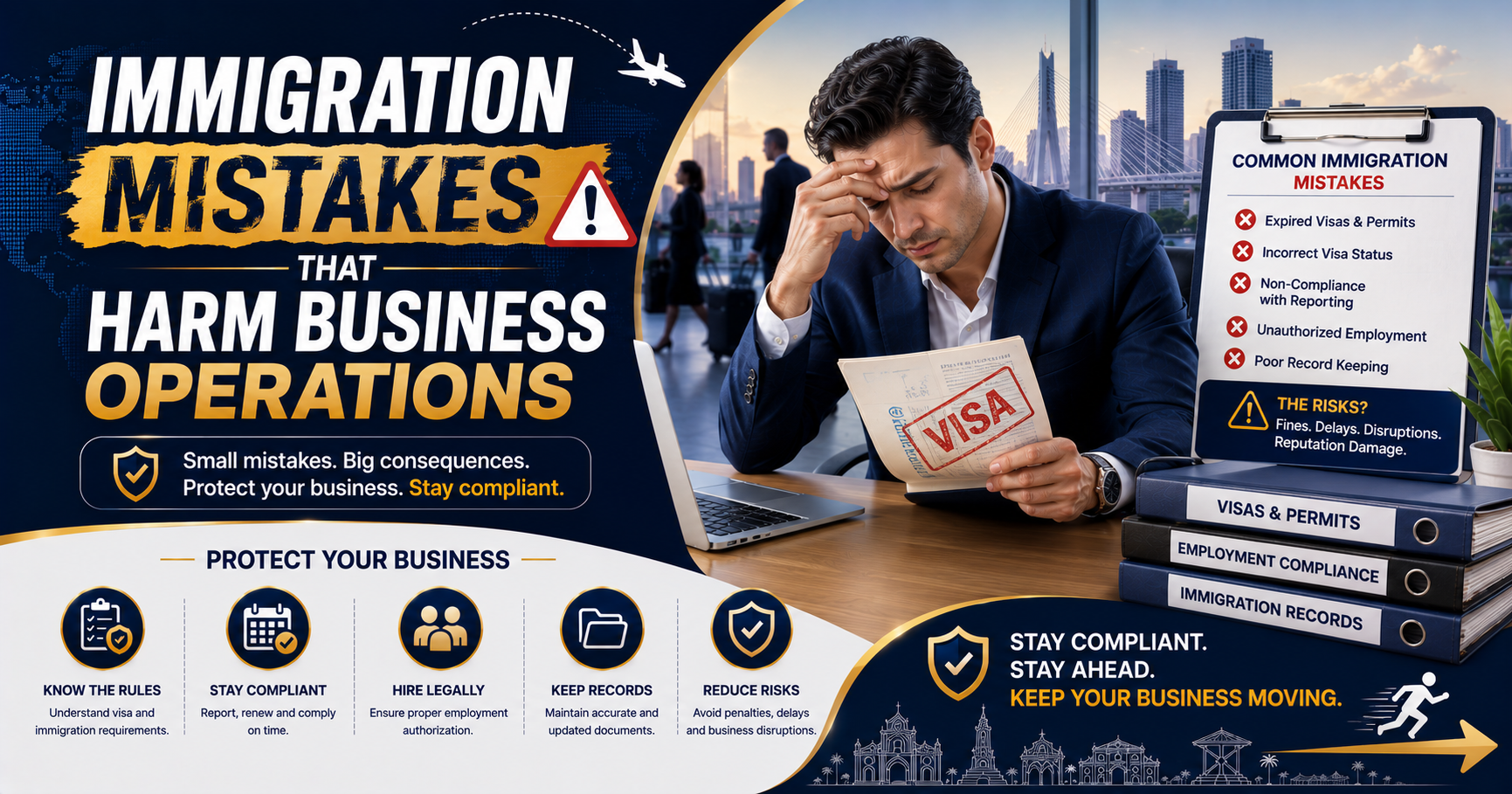
For many businesses in the Philippines, foreign investors, directors, consultants, and employees play an important role in daily operations and long-term growth. However, one area many companies underestimate is immigration compliance.
A single immigration issue can affect not only the foreign national involved—but also the business itself. Delays, penalties, operational interruptions, banking concerns, and reputational problems often begin with avoidable immigration mistakes.
For companies operating in Cebu and throughout the Philippines, immigration compliance should be treated as a core part of business risk management.
This guide explains the common immigration mistakes that can harm business operations in 2026—and how businesses can avoid them.
Why Immigration Compliance Matters to Businesses
Immigration issues are not separate from business operations.
They can affect:
- Work authorization
- Hiring timelines
- Corporate compliance
- Investor confidence
- Permit processing
- Operational continuity
Businesses that rely on foreign nationals must coordinate immigration compliance carefully.
Key agencies often involved include the Bureau of Immigration and the Department of Labor and Employment.
1. Allowing Foreign Nationals to Work Without Proper Authorization
One of the most serious mistakes is assuming that:
- Tourist status automatically allows work
- Ownership automatically permits employment
- Informal arrangements are acceptable
Foreign nationals performing operational work may require proper authorization depending on their activities.
Unauthorized work can create risk for both the individual and the employer.
2. Delaying AEP or Visa Processing
Many companies wait too long before processing employment-related requirements.
Examples include delays involving:
- Alien Employment Permit (AEP) applications
- Employment-related visa processing
- Immigration status coordination
Late filing creates unnecessary pressure and operational uncertainty.
3. Using the Wrong Visa Classification
Different immigration categories exist for different purposes.
Problems arise when businesses use a visa status inconsistent with the actual activity being performed.
This may create issues involving:
- Work authorization
- Compliance reviews
- Future renewals
- Immigration records
The correct classification matters.
4. Ignoring Employer Compliance Problems
Immigration applications often depend heavily on the employer’s compliance status.
Problems may arise when the company has:
- Expired permits
- Outdated corporate records
- Weak tax compliance with the Bureau of Internal Revenue
- Inconsistent business records
Weak business compliance can delay immigration processing.
5. Poor Coordination Between HR, Legal, and Management
Immigration compliance often fails because departments work separately.
Examples:
- HR hires too quickly
- Legal review happens too late
- Accounting records are inconsistent
- Management assumes someone else is handling compliance
Coordination is critical.
6. Allowing Status Expiration
Businesses sometimes lose track of:
- Visa validity dates
- Permit expiration
- Renewal timelines
Expired status can create operational and legal complications quickly.
A compliance calendar is essential.
7. Using Informal or Improper Employment Arrangements
Some companies attempt shortcuts such as:
- Unclear consulting arrangements
- Informal compensation structures
- Improper nominee or operational setups
These arrangements often create bigger long-term risks.
8. Failing to Update Corporate Information
Immigration and labor agencies may review company information closely.
Problems occur when:
- Company address changed but records were not updated
- Officers are outdated
- Ownership records are inconsistent
- Business activities no longer match filings
Consistency across agencies matters.
9. Weak Documentation and Record Keeping
Immigration processing depends heavily on documentation.
Businesses should maintain:
- Employment records
- Corporate records
- Payroll documentation
- Immigration records
- Tax compliance documents
Missing records can delay approvals and renewals.
10. Assuming Immigration Problems Affect Only the Employee
This is a dangerous misconception.
Immigration issues can affect the business by creating:
- Operational delays
- Regulatory scrutiny
- Hiring disruptions
- Investor concerns
- Banking and compliance questions
Strong immigration compliance protects the entire company.
Common Warning Signs of Immigration Risk
- Foreign employees working before approvals are complete
- Expired visas or permits
- Unclear employment roles
- Inconsistent company records
- Missing immigration documents
- Delayed renewals
These issues should be addressed immediately.
Best Practices for Businesses
To reduce immigration-related operational risk:
✔ Start applications early
✔ Coordinate HR, legal, and accounting properly
✔ Monitor visa and permit expiration dates
✔ Maintain updated corporate records
✔ Keep tax and permit compliance current
✔ Document employment relationships clearly
✔ Conduct periodic compliance reviews
Preparation prevents disruption.
Why Strong Immigration Compliance Supports Growth
Businesses with organized immigration systems often benefit from:
- Smoother hiring
- Faster renewals
- Better investor confidence
- Reduced legal exposure
- Improved operational stability
Compliance strengthens long-term business planning.
Final Thoughts
Immigration mistakes often begin as “small issues” but later create major operational and legal problems for businesses.
The companies that avoid disruption are usually the ones that:
- Plan early
- Maintain strong records
- Coordinate compliance properly
- Treat immigration compliance as part of business management—not just paperwork
The practical lesson is simple:
If your business depends on foreign talent or foreign ownership, immigration compliance is business compliance.
Because protecting your workforce also protects your operations, reputation, and future growth.
Navigating the business landscape in the Philippines can be both rewarding and intricate. Whether you’re embarking on a new venture or scaling up, ensuring that your corporate endeavors are in line with local regulations is paramount.
At CBOS Business Solutions Inc., we pride ourselves on simplifying these processes for our clients. As a seasoned professional services company, we offer comprehensive assistance with SEC Registration, Visa processing, and a myriad of other essential business requirements. Our team of experts is dedicated to ensuring that your business is compliant, well-established, and ready to thrive in the Philippine market.
Why venture into the complexities of business registration and compliance alone? Allow our team to guide you every step of the way. After all, your success is our commitment.
Get in touch today and let us be your partner in achieving your business goals in the Philippines.
Email Address: gerald.bernardo@cbos.com.ph
Mobile No.: +639270032851
You can also click this link to schedule a meeting.
Leave a Reply