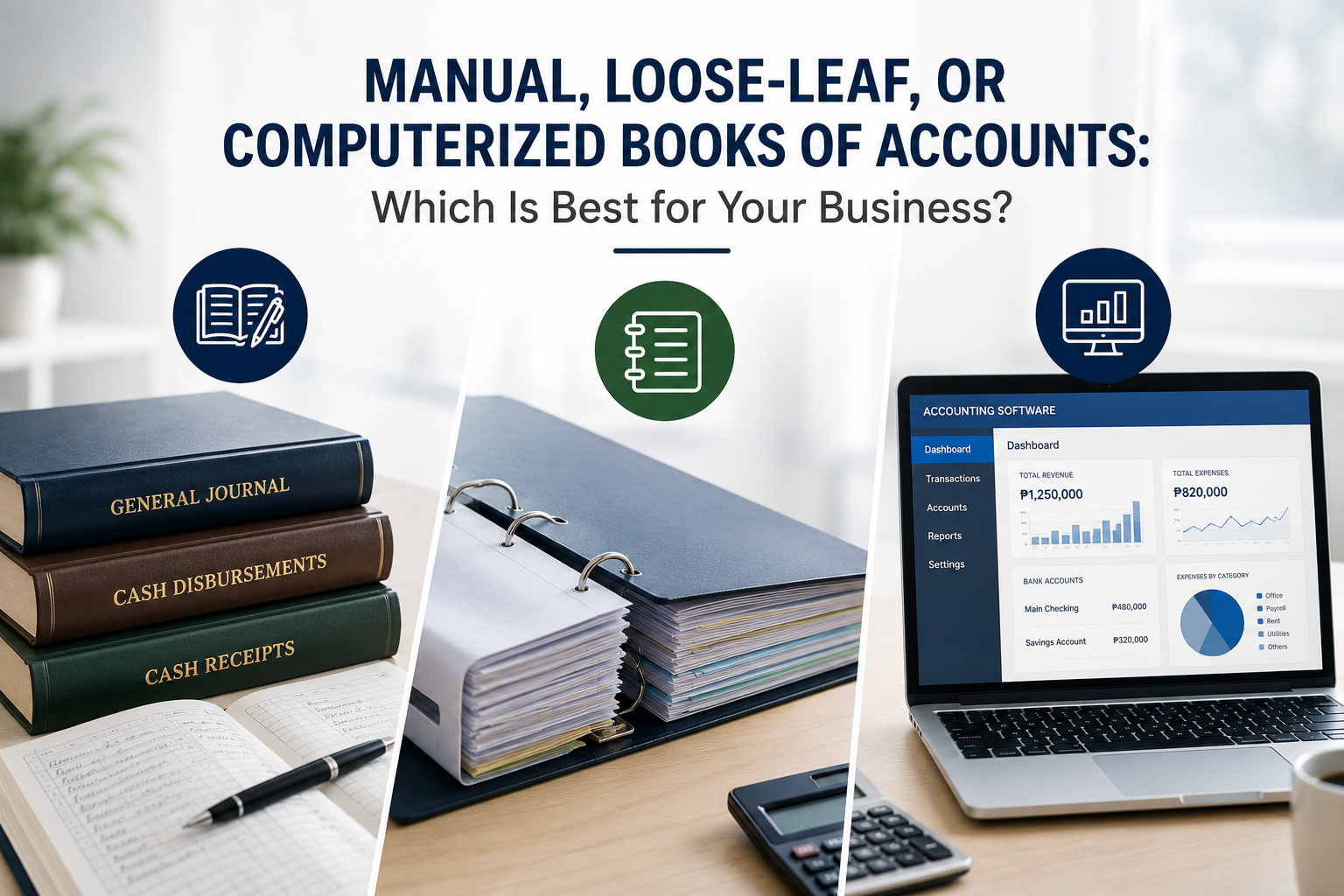
Every business in the Philippines, regardless of size, is required to maintain Books of Accounts. Whether you are a sole proprietor, freelancer, corporation, or partnership, your accounting records serve as the foundation for preparing tax returns, financial statements, and supporting documents during a Bureau of Internal Revenue (BIR) audit.
One of the first decisions every business owner must make is which bookkeeping method to use. Should you maintain traditional manual books, adopt a loose-leaf accounting system, or invest in a computerized accounting system?
Each option has its own advantages, limitations, and compliance requirements. Choosing the right system can improve efficiency, strengthen internal controls, and ensure compliance with Philippine tax regulations.
This guide compares Manual, Loose-Leaf, and Computerized Books of Accounts, explains their BIR compliance requirements, and provides practical guidance on selecting the best option for your business.
What Are Books of Accounts?
Books of Accounts are the official accounting records used to record a business’s financial transactions.
They provide the basis for preparing:
- Annual Financial Statements
- Income Tax Returns
- VAT Returns
- Percentage Tax Returns
- Withholding Tax Returns
- Other regulatory reports
The National Internal Revenue Code (NIRC) requires taxpayers engaged in business or the practice of a profession to maintain Books of Accounts in accordance with BIR rules.
These records are also among the first documents examined during a BIR tax audit.
Why Choosing the Right Bookkeeping System Matters
Your bookkeeping system affects more than daily accounting.
It influences:
- tax compliance;
- financial reporting;
- audit readiness;
- operational efficiency;
- management decision-making.
A bookkeeping method that works well for a small startup may become inefficient as the business grows.
Selecting the appropriate system early can save considerable time and compliance costs in the future.
Manual Books of Accounts
What Are Manual Books?
Manual Books of Accounts are traditional bound books in which accounting entries are recorded by hand.
Common manual books include:
- General Journal
- General Ledger
- Cash Receipts Book
- Cash Disbursements Book
These books are registered with the BIR before use.
Advantages
Manual books offer several benefits for smaller businesses.
Low Initial Cost
Businesses need only purchase registered bound books.
No accounting software or computer system is required.
Simple to Maintain
For businesses with relatively few transactions, manual bookkeeping is often sufficient.
Examples include:
- Small retail stores
- Home-based businesses
- Freelancers
- Independent professionals
Minimal Technology Requirements
Manual books do not depend on:
- computers;
- internet access;
- accounting software.
Disadvantages
As businesses grow, manual bookkeeping becomes more challenging.
Common disadvantages include:
- time-consuming recordkeeping;
- increased risk of mathematical errors;
- duplicate manual work;
- difficulty generating financial reports;
- limited scalability.
Businesses processing hundreds of transactions each month often outgrow manual systems quickly.
Loose-Leaf Books of Accounts
What Are Loose-Leaf Books?
Loose-leaf Books of Accounts are accounting records generated using accounting software and printed periodically in loose-leaf format.
Instead of handwriting transactions, businesses encode data electronically and print the required books for registration and retention.
Loose-leaf books remain subject to BIR registration and reporting requirements.
Advantages
Faster Recordkeeping
Transactions are recorded electronically, reducing manual work.
Better Reporting
Most accounting software can generate:
- ledgers;
- journals;
- financial statements;
- trial balances.
This significantly improves efficiency.
Easier Corrections
Accounting adjustments can be made within the software before printing.
Suitable for Growing Businesses
Loose-leaf systems work well for businesses experiencing increasing transaction volumes.
Disadvantages
Businesses must still comply with BIR requirements regarding:
- registration;
- printing schedules;
- record retention.
Failure to print and maintain required accounting records may create compliance issues.
Computerized Books of Accounts
What Are Computerized Books?
Computerized Books of Accounts are maintained using an approved Computerized Accounting System (CAS) or other BIR-recognized computerized bookkeeping solution.
Transactions are recorded, processed, and stored electronically.
Depending on the applicable BIR rules, businesses using computerized accounting systems may be required to comply with registration or notification requirements and maintain electronic records in the prescribed format.
Advantages
Highest Efficiency
Computerized systems automate:
- journal entries;
- ledgers;
- financial statements;
- tax reports;
- inventory;
- payroll.
Improved Accuracy
Automation reduces:
- posting errors;
- mathematical errors;
- duplicate entries.
Real-Time Financial Information
Business owners can immediately view:
- sales;
- expenses;
- cash flow;
- receivables;
- profitability.
This improves decision-making.
Better Internal Controls
Most accounting software includes:
- user access controls;
- audit trails;
- automated backups;
- approval workflows.
These features strengthen financial controls.
Integration
Modern accounting systems often integrate with:
- inventory management;
- payroll;
- invoicing;
- banking;
- tax reporting.
Disadvantages
Computerized systems typically require:
- software investment;
- staff training;
- ongoing maintenance;
- reliable data backups.
Businesses should also ensure compliance with applicable BIR regulations governing computerized accounting systems.
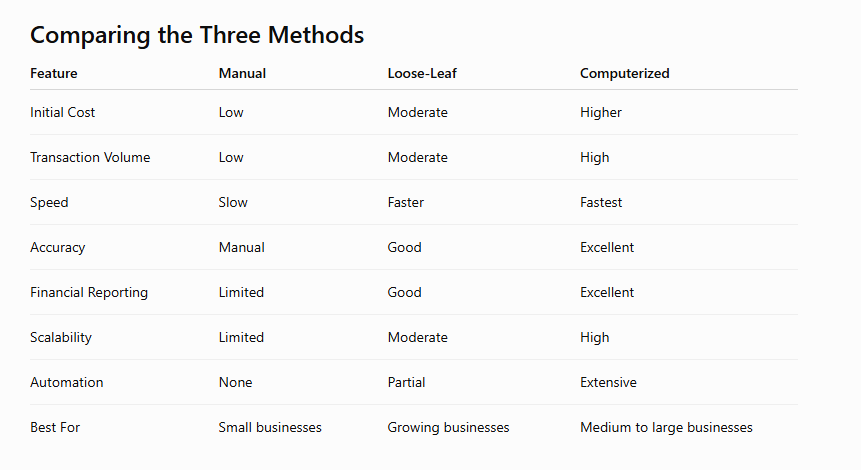
Which Businesses Should Use Each Method?
Manual Books
Generally suitable for:
- Small sole proprietorships
- Freelancers
- Independent professionals
- Businesses with few monthly transactions
Loose-Leaf Books
Ideal for:
- Growing small businesses
- Retail stores
- Service providers
- Businesses using accounting software but not requiring a fully computerized accounting environment
Computerized Books
Best suited for:
- Medium-sized businesses
- Large corporations
- Manufacturers
- Importers
- Companies with multiple branches
- Businesses with high transaction volumes
BIR Compliance Requirements
Regardless of the bookkeeping method chosen, taxpayers must comply with applicable BIR regulations.
These generally include:
- Registration of Books of Accounts
- Maintenance of complete accounting records
- Proper retention of accounting documents
- Availability of records during tax audits
- Timely updating of accounting entries
Businesses should also comply with current BIR rules relating to the Online Registration and Update System (ORUS), electronic registration of Books of Accounts, and any requirements applicable to computerized accounting systems.
Because BIR procedures continue to evolve through new issuances, taxpayers should regularly review the latest regulations.
Common Mistakes Businesses Make
Choosing a System That Cannot Handle Growth
Some businesses continue using manual books despite processing thousands of monthly transactions.
This often leads to delays and accounting errors.
Poor Recordkeeping
Regardless of the bookkeeping method, incomplete records remain one of the leading causes of BIR audit issues.
Businesses should maintain:
- invoices;
- receipts;
- contracts;
- ledgers;
- journals;
- supporting schedules.
Failure to Register Books Properly
Businesses should ensure that their Books of Accounts are registered in accordance with applicable BIR requirements before use.
Inadequate Data Backup
Businesses using computerized systems should maintain secure backups to prevent data loss caused by hardware failure, cyber incidents, or natural disasters.
Delayed Recording of Transactions
Accounting records should be updated regularly.
Waiting until tax filing deadlines often results in inaccurate financial reporting and compliance issues.
Best Practices for Effective Bookkeeping
Regardless of the bookkeeping system selected, businesses should:
- Maintain accurate and complete accounting records.
- Reconcile bank accounts regularly.
- Update books promptly.
- Retain supporting documents.
- Review financial statements monthly.
- Reconcile accounting records with tax returns.
- Perform periodic internal audits.
- Consult a CPA regarding compliance requirements.
These practices improve both operational efficiency and tax compliance.
How to Choose the Right System
When selecting a bookkeeping method, consider:
Business Size
Larger businesses generally benefit from computerized accounting systems.
Transaction Volume
The greater the number of transactions, the greater the need for automation.
Budget
Small businesses may initially choose manual or loose-leaf systems before upgrading as operations expand.
Reporting Needs
Businesses requiring detailed financial analysis should consider computerized accounting software.
Growth Plans
Choose a bookkeeping system that can support future expansion.
Changing systems frequently may increase costs and disrupt operations.
Final Thoughts
Choosing between Manual, Loose-Leaf, and Computerized Books of Accounts is an important business decision that affects both day-to-day operations and long-term compliance. While manual books remain practical for businesses with minimal transactions, growing enterprises often benefit from the efficiency of loose-leaf systems, and larger organizations generally require the automation and scalability of computerized accounting.
Regardless of the method selected, every business must maintain accurate Books of Accounts, comply with BIR registration requirements, preserve supporting documents, and ensure that accounting records are consistent with tax returns and financial statements.
As businesses grow, their bookkeeping systems should evolve as well. Investing in the right accounting system today can improve financial management, strengthen internal controls, simplify tax compliance, and prepare the business for sustainable growth.
Disclaimer: This article is intended for general informational purposes only and should not be construed as legal, accounting, or tax advice. Requirements relating to Books of Accounts, ORUS registration, loose-leaf accounting records, computerized accounting systems, and record retention are governed by the National Internal Revenue Code, applicable BIR regulations, revenue issuances, and administrative guidelines, which may be amended from time to time. Businesses should consult a qualified Certified Public Accountant (CPA) or tax lawyer and review the latest BIR issuances to determine the bookkeeping method most appropriate for their operations and ensure full compliance with Philippine tax laws.
Leave a Reply