You check your sales. You check your bank balance. You check whether customers have paid.
But when was the last time you checked the tax health of your business?
Many accounting and tax problems do not appear overnight. They build gradually.
One unreconciled bank transaction becomes ten. One missing document becomes an entire folder of unsupported expenses. One overlooked tax issue carries into the next reporting period.
A monthly tax health check can help stop that cycle.
- Confirm That the Books Are Updated
Start by asking whether all material transactions for the period have been recorded.
Review sales, purchases, collections, payments, payroll-related entries, adjustments, and other significant transactions.
If bookkeeping is incomplete, tax preparation is already starting from unreliable information.
- Reconcile the Bank Accounts
Compare the accounting cash balances with the corresponding bank records.
Identify outstanding items and investigate unusual differences.
Do not simply carry unexplained reconciling items forward every month.
- Review Sales
Check sales records against supporting documents and other relevant reports.
Look for missing invoice sequences where applicable, unusual adjustments, duplicate entries, or significant differences requiring investigation.
Then determine whether the accounting information appropriately supports the amounts being used for applicable tax reporting.
- Review Purchases and Expenses
Look at significant and unusual expenses.
Make sure they are properly classified and supported.
Pay particular attention to transactions involving owners or related parties, large one-time purchases, professional services, advances, and expenses with incomplete documentation.
- Review Withholding Taxes
Identify transactions that may have withholding implications and check whether they were treated appropriately.
Review the related accounting accounts, tax schedules, certificates, and other documentation as applicable.
Investigate old balances rather than allowing them to accumulate.
- Review Tax Accounts
Look at the tax-related accounts in the general ledger.
Do the balances make sense? Are there old outstanding amounts? Do the movements correspond with returns, payments, certificates, and other records?
Any material difference should either be reconciled or placed on an exception list for investigation.
- Check Receivables and Payables
Review aging schedules.
Long-outstanding receivables and payables may require follow-up, accounting analysis, or additional documentation.
They can also reveal transactions that have not been properly cleared from the books.
- Identify Missing Documents
Do not wait until year-end.
Prepare a missing-document list every month and send it to the responsible person.
- Missing invoices
- Missing contracts
- Missing bank records
- Missing proof of payment
- Missing withholding certificates
- Incomplete supplier information
- Unexplained transactions
Assign an owner and target completion date to important items.
- Review Upcoming Compliance Requirements
Before closing the month, look ahead.
Identify applicable returns, payments, information returns, attachments, registrations, renewals, or other compliance obligations that may be approaching.
Do not rely solely on memory.
Maintain a compliance calendar appropriate to the taxpayer’s registration and circumstances, and verify current deadlines against official BIR requirements.
- Create an Exception Report
Not every issue needs to stop the entire accounting close.
Instead, maintain a short exception report.
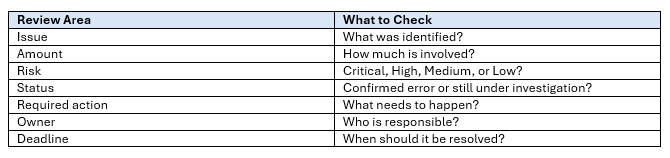
This gives management visibility without treating every unexplained difference as a confirmed mistake.
Don’t Just Close the Books—Understand Them
A strong month-end process should answer more than: “Are we finished?”
It should answer: Are the books complete? Do the important balances reconcile? Are tax-related accounts supported? Are there unresolved exceptions? Are we ready for the next filing period?
That is what turns bookkeeping into financial control.
Make Tax Compliance a Monthly Habit
The easiest tax problem to manage is often the one identified early.
Regular accounting review gives your business more time to investigate discrepancies, obtain missing documents, correct genuine errors, and seek professional advice when the proper treatment is unclear.
You do not need to wait for year-end—or for a BIR inquiry—to find out whether your records are in order.
Make a tax health check part of your monthly accounting routine.
Need a professional review of your accounting records and BIR compliance? CBOS Business Solutions Inc. can assist with bookkeeping supervision, tax reconciliation, compliance review, and Philippine tax advisory.
Disclaimer: This checklist is general in nature. Actual BIR filing, payment, documentation, and reporting requirements depend on the taxpayer’s registration, transactions, tax types, and current regulations. Verify applicable requirements against the latest official BIR issuances before finalizing compliance actions.
Leave a Reply