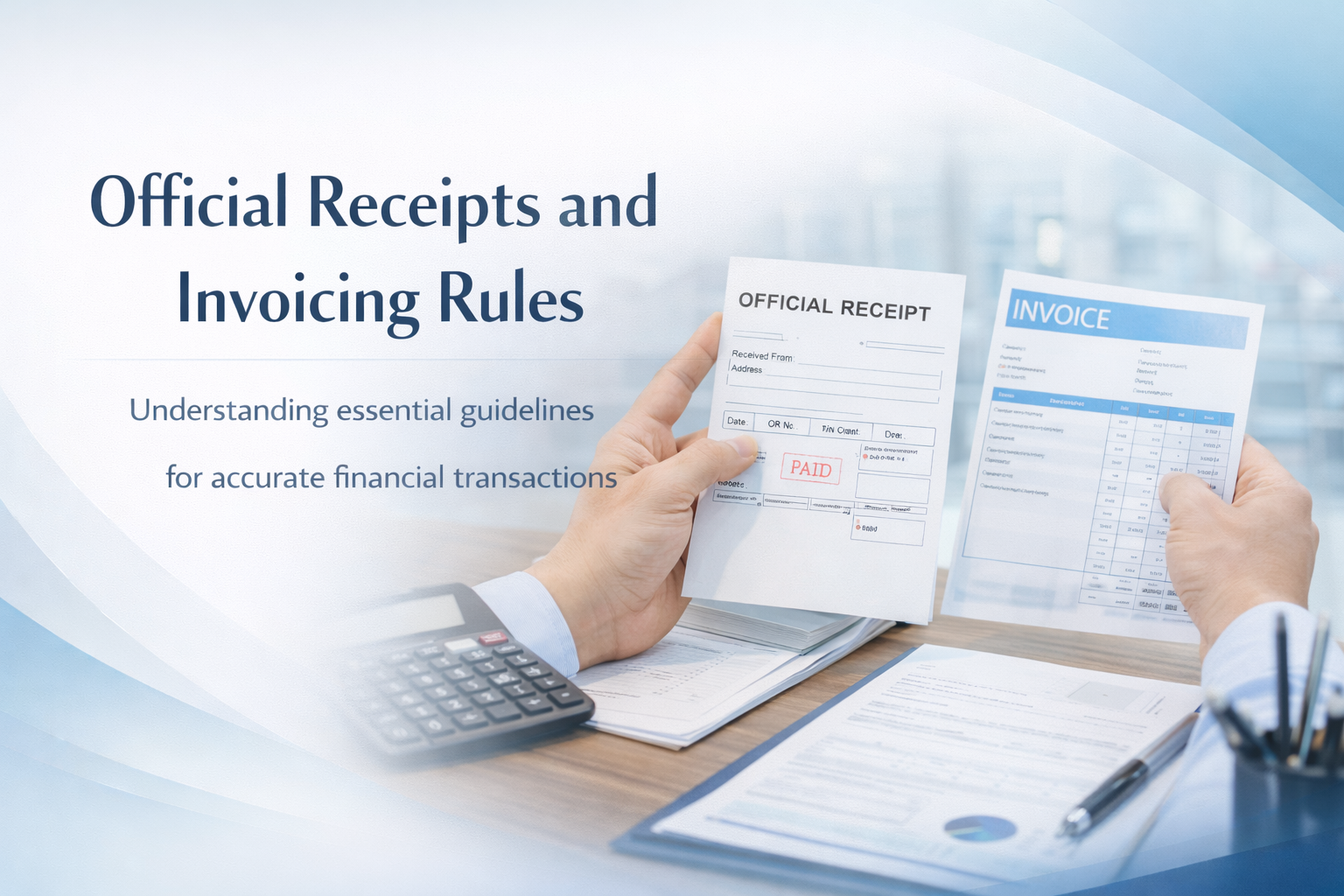
Issuing official receipts and invoices is a fundamental requirement for any business operating in the Philippines. Beyond being a routine transaction, it is a legal obligation under Philippine tax laws. Failure to comply with invoicing rules can result in penalties, disallowance of expenses, and potential audits.
As regulations continue to evolve, business owners must understand the updated rules enforced by the Bureau of Internal Revenue (BIR) in 2026.
This guide explains the key requirements, compliance standards, and best practices for official receipts and invoicing.
Why Official Receipts and Invoices Matter
Official receipts (ORs) and sales invoices are not merely proof of payment—they serve as:
- Evidence of business transactions
- Basis for tax reporting and compliance
- Documentation for customers’ expense claims
Businesses that fail to issue proper receipts risk violating tax regulations and losing credibility with clients.
Official Receipts vs. Sales Invoices
Understanding the distinction is important:
- Official Receipts (ORs) – issued for services
- Sales Invoices – issued for sale of goods
Each document must be issued depending on the nature of the transaction.
1. Requirement to Issue Receipts and Invoices
All registered businesses are required to issue official receipts or invoices for every sale or service rendered.
This applies to:
- Corporations
- Sole proprietors
- Freelancers and self-employed individuals
Issuing receipts is mandatory regardless of transaction size.
2. Authority to Print (ATP) or System Registration
Before issuing receipts, businesses must secure approval from the BIR.
This includes:
- Authority to Print (ATP) for manual receipts
- Registration of Computerized Accounting Systems (CAS) or POS systems
Using unregistered receipts is strictly prohibited.
3. Required Information on Receipts and Invoices
Official receipts and invoices must contain specific details, including:
- Registered business name
- Business address
- Tax Identification Number (TIN)
- Date of transaction
- Description of goods or services
- Amount and applicable taxes
- Serial number
Incomplete or incorrect details may render the document invalid for tax purposes.
4. Transition to Digital and Electronic Invoicing
In recent years, the BIR has encouraged the use of electronic invoicing systems.
Businesses may adopt:
- Electronic receipts (e-receipts)
- Online invoicing systems
- POS-integrated systems
However, these systems must still be registered and approved by the BIR.
5. Record-Keeping and Retention Requirements
Businesses are required to maintain copies of issued receipts and invoices.
Key requirements include:
- Proper storage of records
- Retention for the required number of years
- Availability for inspection during audits
Accurate record-keeping supports compliance and protects the business during tax examinations.
6. Penalties for Non-Compliance
Failure to follow invoicing rules may result in:
- Monetary penalties
- Disallowance of expenses for tax purposes
- Suspension of business operations
- Closure in severe cases
Non-compliance is treated seriously by tax authorities.
7. Alignment with Business Registration
Proper invoicing is closely tied to business registration and compliance.
Businesses must ensure:
- Registration with the Securities and Exchange Commission or Department of Trade and Industry
- Valid BIR registration and Certificate of Registration (COR)
- Updated tax types and obligations
Without proper registration, issuing receipts is not legally allowed.
Common Mistakes to Avoid
Many businesses encounter compliance issues due to:
- Using unregistered receipts
- Issuing incomplete or incorrect invoices
- Failing to apply for ATP
- Not updating invoicing systems
- Poor record-keeping practices
Avoiding these mistakes is essential to maintaining compliance.
Final Thoughts
Official receipts and invoicing are critical components of business compliance in the Philippines. They are not optional—they are legal requirements that support transparency, taxation, and business credibility.
As regulations evolve in 2026, businesses must stay informed, adopt proper systems, and ensure that all invoicing practices align with BIR requirements.
For business owners, compliance with invoicing rules is more than a legal obligation—it is a foundation for trust, accountability, and sustainable growth.
Navigating the business landscape in the Philippines can be both rewarding and intricate. Whether you’re embarking on a new venture or scaling up, ensuring that your corporate endeavors are in line with local regulations is paramount.
At CBOS Business Solutions Inc., we pride ourselves on simplifying these processes for our clients. As a seasoned professional services company, we offer comprehensive assistance with SEC Registration, Visa processing, and a myriad of other essential business requirements. Our team of experts is dedicated to ensuring that your business is compliant, well-established, and ready to thrive in the Philippine market.
Why venture into the complexities of business registration and compliance alone? Allow our team to guide you every step of the way. After all, your success is our commitment.
Get in touch today and let us be your partner in achieving your business goals in the Philippines.
Email Address: gerald.bernardo@cbos.com.ph
Mobile No.: +639270032851
You can also click this link to schedule a meeting.
Leave a Reply