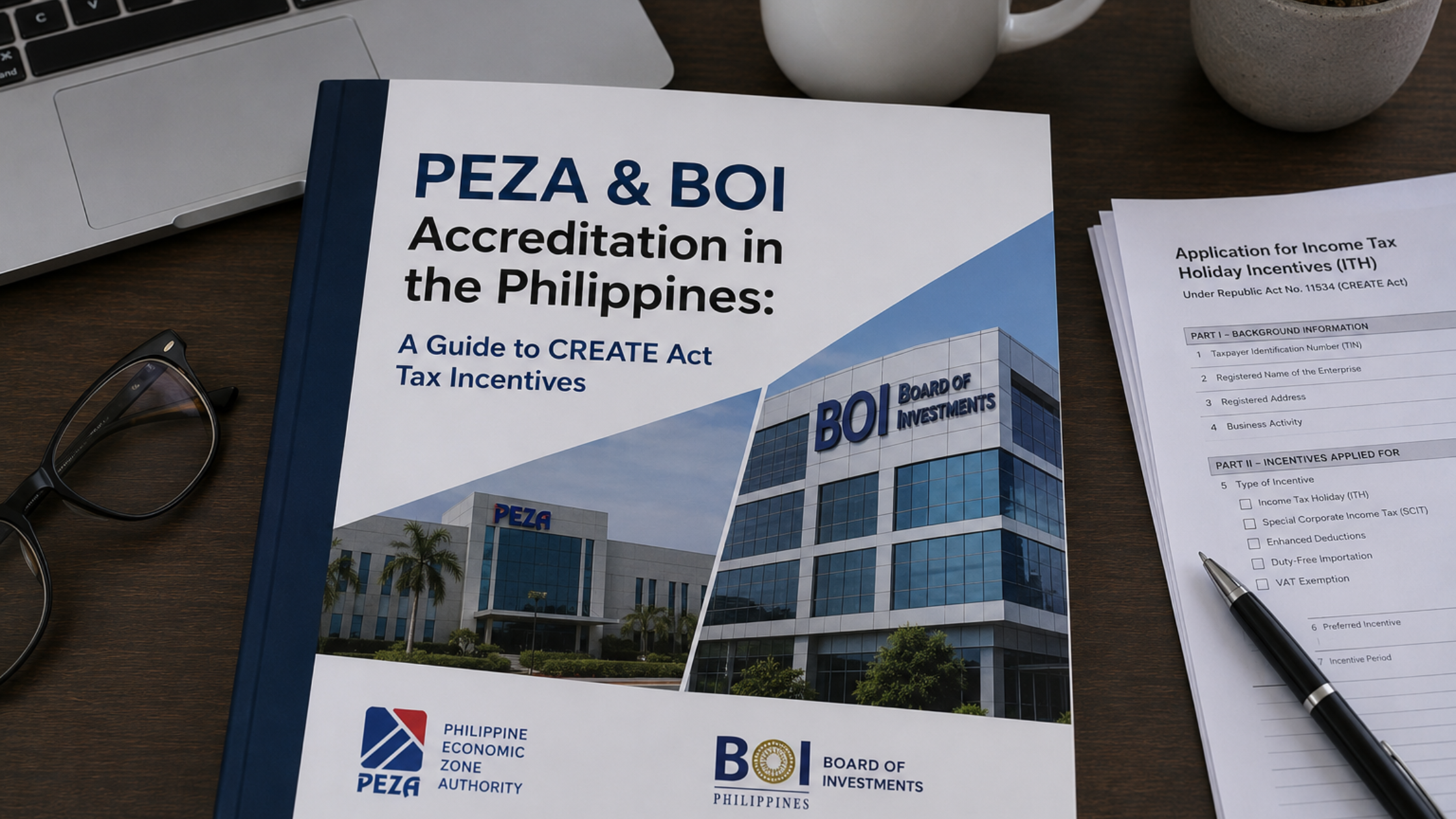
Businesses investing or expanding in the Philippines may be able to reduce their tax burden through government investment incentives.
Two of the primary Investment Promotion Agencies (IPAs) are the Philippine Economic Zone Authority (PEZA) and the Board of Investments (BOI). Qualified projects registered with these agencies may access fiscal and non-fiscal incentives under the Philippines’ investment incentive framework, including the Corporate Recovery and Tax Incentives for Enterprises (CREATE) Act, as subsequently amended.
Depending on the project’s qualifications and applicable rules, incentives can include an Income Tax Holiday (ITH), preferential taxation or enhanced deductions after the ITH period, and exemptions on certain importations.
However, these benefits are not automatically available simply because a company registers with the SEC or operates in an economic zone. The project or activity must qualify and be properly registered, and the enterprise must continue satisfying the conditions attached to its incentives.
What Are PEZA and BOI?
Although both agencies promote investment in the Philippines, PEZA and BOI serve different types of projects and operating structures.
Philippine Economic Zone Authority (PEZA)
PEZA promotes and administers designated economic zones throughout the Philippines.
PEZA registration is commonly associated with businesses operating in proclaimed economic zones, including qualified enterprises engaged in activities such as:
Export manufacturing
Information technology and business process activities
Logistics and related services
Economic zone development and operation
Other eligible activities conducted within PEZA-administered economic zones
Eligibility depends on the proposed activity, location, investment structure, market orientation, and applicable PEZA and investment-priority rules.
Board of Investments (BOI)
The BOI, an agency attached to the Department of Trade and Industry, administers investment incentives for qualified projects that fall within the government’s investment priorities.
Unlike the typical PEZA model, BOI registration does not necessarily require the enterprise to locate inside a PEZA economic zone.
A BOI applicant generally needs to demonstrate that its proposed project or activity qualifies under the applicable Strategic Investment Priority Plan (SIPP) and relevant investment laws and regulations.
Understanding the CREATE Act
The Corporate Recovery and Tax Incentives for Enterprises Act, or CREATE, substantially reformed the Philippine corporate income tax and fiscal incentive system.
For investors, one of CREATE’s most important changes was the establishment of a more standardized framework for granting incentives to qualified Registered Business Enterprises (RBEs).
The CREATE framework has subsequently been amended, including through the CREATE MORE Act, so businesses considering an incentive application should use the current rules rather than relying on older descriptions of PEZA or BOI tax incentives.
Under the current incentive framework, the benefits available to a particular project can depend on factors such as:
Type of business activity
Industry classification
Investment location
Export or domestic-market orientation
Investment amount
Strategic importance of the project
Applicable SIPP classification
Registration date
Length and type of approved incentive package
This means two companies operating in the same broad industry may not necessarily receive identical incentives.
What Is the Strategic Investment Priority Plan?
The Strategic Investment Priority Plan (SIPP) identifies activities and projects that the Philippine government considers priorities for investment incentives.
Before applying for BOI or PEZA registration, an investor should determine whether the proposed activity falls within the current SIPP or another applicable category authorized to receive incentives.
Priority activities can evolve as government policy changes.
Depending on the current SIPP, priority areas may involve advanced manufacturing, innovation, research and development, digital technologies, infrastructure, agriculture, energy, healthcare, export activities, and other strategically important sectors.
A business should therefore evaluate incentive eligibility before making major investment commitments whenever possible.
Income Tax Holiday
One of the most attractive incentives available to qualified registered projects is the Income Tax Holiday (ITH).
During an approved ITH period, qualifying income from the registered project or activity may receive an income-tax exemption, subject to the conditions of the enterprise’s registration and applicable law.
The length of the ITH is not necessarily the same for every business.
The applicable period can depend on the project’s classification and other factors established under the current incentive framework.
Businesses should also distinguish between:
Registered activities — activities specifically covered by the approved registration.
Non-registered activities — other activities conducted by the same company that may not qualify for the same incentives.
Proper accounting is particularly important when a company earns income from both registered and non-registered activities.
Incentives After the Income Tax Holiday
Depending on the enterprise’s qualifications and applicable rules, additional incentives may be available after the ITH period.
These can potentially include a preferential tax regime or an Enhanced Deductions Regime (EDR).
Enhanced deductions can provide qualified businesses with additional deductions for certain eligible expenses, subject to statutory conditions and limitations.
The appropriate regime depends on the enterprise’s classification, registration, and current tax rules.
Businesses should model the financial impact of each available incentive structure rather than evaluating an investment solely on the headline ITH period.
Duty-Free Importation and Import Incentives
Qualified registered enterprises may also receive incentives relating to the importation of capital equipment, raw materials, spare parts, accessories, and other eligible goods used directly in the registered activity.
Depending on the applicable law and registration, these benefits can include exemptions from customs duties and potentially other tax treatment available for qualified importations.
However, duty-free treatment is not a blanket exemption for everything the company imports.
The enterprise generally needs to establish that the imported goods meet the applicable requirements and are connected to the registered project or activity.
Import documentation and asset controls are therefore important parts of PEZA and BOI compliance.
Businesses should maintain clear records identifying imported equipment and materials and demonstrating how they are used in registered operations.
PEZA Registration Process
The exact process depends on the type of enterprise and project, but a PEZA application generally involves several stages.
1. Determine PEZA Eligibility
First, determine whether the proposed activity qualifies for PEZA registration and whether the business will operate in an appropriate PEZA location or under an eligible PEZA registration category.
2. Prepare the Investment Project
The applicant should clearly define:
Business activity
Products or services
Target customers and markets
Proposed investment
Equipment requirements
Employment projections
Operating location
Export projections, when applicable
Project implementation schedule
3. Prepare the Application and Supporting Documents
Depending on the project, PEZA may require corporate records, financial information, project studies, location documents, investment schedules, and other supporting materials.
4. PEZA Evaluation
PEZA reviews the application to determine whether the project qualifies and satisfies applicable requirements.
Additional information or clarification may be requested during evaluation.
5. Approval and Registration
If approved, the enterprise completes the applicable registration requirements and receives documentation establishing its status and registered activities.
The company must then operate within the scope and conditions of its approved registration.
BOI Registration Process
BOI applications similarly require careful project planning.
1. Check the Current SIPP
Determine whether the proposed activity is eligible under the current Strategic Investment Priority Plan or another applicable investment-incentive provision.
2. Define the Registered Project
Identify the specific project or activity for which incentives are being requested.
This distinction matters because BOI incentives attach to the registered project or activity, rather than automatically applying to every transaction conducted by the corporation.
3. Prepare the Application
Businesses may need to provide information concerning:
Company ownership
Business activities
Project costs
Capital expenditures
Financing
Employment
Production capacity
Technology
Products or services
Target markets
Implementation timetable
Additional requirements may apply depending on the industry.
4. Project Evaluation
The BOI evaluates whether the project satisfies the applicable eligibility criteria and investment priorities.
5. Registration and Compliance
Once approved, the enterprise must comply with the conditions of its BOI registration to maintain access to its incentives.
PEZA vs. BOI: Which One Should You Choose?
Neither registration is automatically “better.” The appropriate Investment Promotion Agency depends on the business model and proposed project.
PEZA may be appropriate when:
The business intends to operate within an eligible economic zone and its activities fit PEZA’s registration framework.
BOI may be appropriate when:
The project qualifies under the applicable SIPP and the investor requires a structure that does not depend on operating within a PEZA economic zone.
Location, export orientation, investment size, industry, customers, supply chain, import requirements, and long-term expansion plans should all be considered.
Businesses should assess the available incentives before choosing a site or finalizing the investment structure, because these decisions can affect eligibility.
Registration Does Not Eliminate Normal Business Compliance
PEZA or BOI registration does not replace the company’s other regulatory obligations.
Depending on the enterprise, it may still need to maintain compliance involving:
SEC registration and corporate filings
BIR registration
Local government requirements
Employment regulations
Customs documentation
VAT and withholding-tax requirements
Accounting and bookkeeping
Audited financial statements
Industry-specific permits
Reporting requirements imposed by the relevant IPA
An incentivized business therefore needs both ordinary corporate compliance and specialized incentive compliance.
Accounting for PEZA and BOI Registered Enterprises
Accounting becomes particularly important when a business receives tax incentives.
Companies should be able to identify and substantiate transactions associated with their registered project or activity.
This may require careful tracking of:
Registered and non-registered revenue
Direct and indirect expenses
Imported equipment
Raw materials
Fixed assets
Tax-exempt transactions
VAT treatment
Incentive periods
Payroll and employment commitments
Capital expenditures
If the company operates both registered and non-registered activities, accurate allocation of revenue and expenses becomes especially important.
Poor accounting can make it difficult to demonstrate that income or expenses qualify for incentive treatment.
Common PEZA and BOI Registration Mistakes
Businesses can encounter problems when they apply for incentives too late or assume that incentives apply automatically.
Common mistakes include:
Making significant investments before determining eligibility
Choosing a business location before evaluating PEZA or BOI requirements
Assuming SEC registration automatically provides investment incentives
Applying under an activity that does not match the actual business model
Failing to distinguish registered from non-registered activities
Assuming all imported goods are automatically duty-free
Failing to maintain documentation supporting incentive claims
Missing periodic reporting or compliance requirements
Using outdated CREATE incentive information
Incentive planning should therefore be incorporated into the investment decision itself rather than addressed only after operations have begun.
Plan Your Investment Before You Register
PEZA and BOI incentives can significantly affect the economics of establishing or expanding a business in the Philippines.
For qualifying enterprises, an Income Tax Holiday, subsequent tax incentives, and exemptions associated with eligible importations can reduce operating and investment costs.
But obtaining approval is only the first step.
Businesses must structure their projects correctly, maintain appropriate accounting records, comply with the conditions of registration, and monitor changes to the Philippine investment-incentive framework.
A well-planned PEZA or BOI registration should therefore combine investment planning, tax planning, regulatory compliance, and reliable bookkeeping from the beginning.
Compliance note: The Philippine fiscal-incentive framework has changed significantly under CREATE and subsequent legislation, including CREATE MORE. Eligibility, incentive periods, tax rates, import privileges, SIPP classifications, approval authority, and PEZA/BOI procedures can change. Businesses should verify the latest rules directly with PEZA, BOI, FIRB, BIR, Bureau of Customs, and other relevant government agencies and obtain professional tax or legal advice before relying on a particular incentive.
Leave a Reply