Corporate compliance problems are rarely dramatic at the beginning. A company does not usually wake up one morning with ten years of disorganized records.
It starts with one missed filing. One resolution that nobody prepared. One outdated officer. One address that was changed with one agency but not another. One permit that was assumed to be someone else’s responsibility.
Small gaps accumulate quietly. Then a bank, investor, buyer, regulator, or auditor asks for documents. That is when the problem becomes visible.
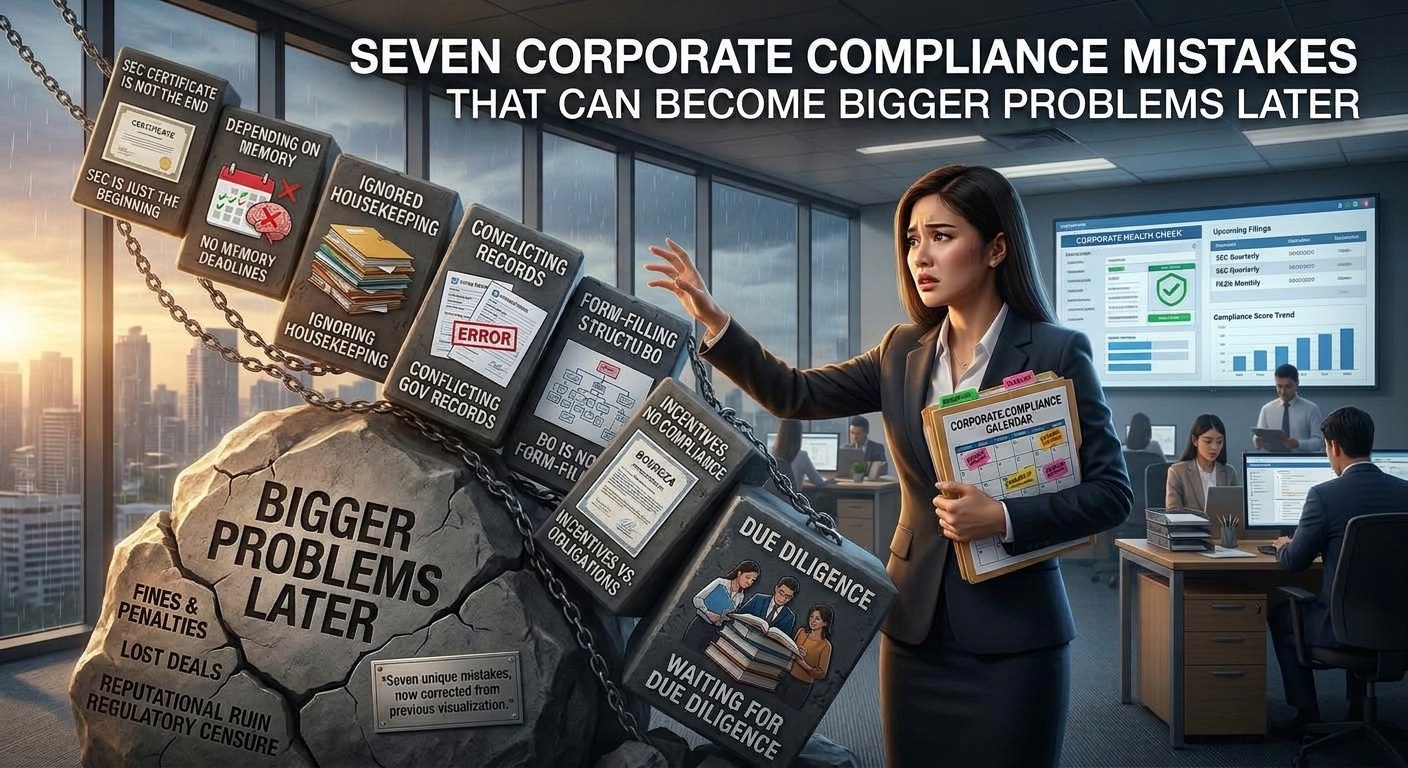
1. Treating the SEC Certificate as the End of Compliance
Incorporation is the beginning of the corporation’s legal life. It is not the end of its regulatory responsibilities. Depending on the business, continuing obligations may involve the SEC, BIR, LGU, employer-related agencies, investment authorities, and industry regulators. The company should identify these responsibilities from the start.
2. Depending on Memory for Filing Deadlines
Someone in the office “usually remembers” the filing. Until that person resigns, goes on leave, changes roles, or simply forgets. A corporation should have a compliance calendar that belongs to the organization, not to one person’s memory.
- A responsible person
- A target preparation date
- A filing deadline
- Required supporting documents
- Proof of submission
- A backup person
Good compliance systems anticipate human error.
3. Ignoring Corporate Housekeeping
A Board decision is made informally. An officer signs a contract. Shares change hands. A new authorized representative is appointed. But the documents are never properly organized. Months or years later, somebody has to reconstruct the corporate history from emails and old files. That is avoidable. Important corporate actions should be documented when they happen.
4. Allowing Government Records to Tell Different Stories
Imagine that the SEC records show one principal office. The business permit shows another. The bank has an old officer. Another government registration still reflects a former address. Each record may have had a reasonable explanation at the time, but together they create inconsistency.
Whenever corporate information changes, management should identify every record that may also need updating.
5. Treating Beneficial Ownership as a Form-Filling Exercise
Beneficial ownership is not merely another box to complete. The company should understand who ultimately owns or controls the corporation and ensure that required disclosures accurately reflect the ownership and control structure. The more complex the structure, the more important this becomes.
6. Enjoying Incentives but Forgetting the Compliance That Comes With Them
A BOI or PEZA registration can be valuable. But registration does not end when the certificate is issued. Registered enterprises may have reporting requirements, operational commitments, documentary obligations, and incentive-administration rules to follow.
PEZA issuances can address matters involving FIRMS reporting, incentive administration, work-from-home arrangements, exporter and importer processes, and digital enterprise systems. The compliance cost should be understood together with the benefit.
7. Waiting for Due Diligence Before Cleaning Everything Up
This is one of the most expensive habits a corporation can develop. An investor expresses interest. A bank wants to finance the company. The shareholders want to sell. A major customer asks for compliance documents. Only then does management discover missing resolutions, inconsistent records, or old filings.
Corporate housekeeping is much easier when it is done gradually than when everything has to be corrected during a time-sensitive transaction.
Build a Simple Corporate Compliance System
- Requirement – What needs to be filed, renewed, approved, or maintained?
- Agency – Which regulator or government body is involved?
- Responsible Person – Who owns the task?
- Deadline – When must it be completed?
- Documents – What needs to be prepared?
- Status – Is it pending, submitted, approved, or for follow-up?
- Evidence – Where is the receipt, acknowledgement, permit, certificate, or proof of filing?
Conduct a Periodic Corporate Health Check
- SEC information
- Directors and officers
- Shareholders
- Beneficial ownership
- Board and stockholder approvals
- Corporate records
- Permits
- Regulatory registrations
- Investment registrations
- Outstanding reportorial obligations
Compliance Is Part of Running the Business
Compliance is sometimes viewed purely as a cost. But organized corporate records also make the company easier to manage. They help when dealing with investors, financing, due diligence, government agencies, and internal decision-making. Good corporate housekeeping is therefore not only about avoiding penalties. It is part of good corporate governance.
How CBOS Can Help
CBOS Business Solutions Inc. assists Philippine corporations and foreign investors with corporate registration, corporate housekeeping, SEC-related requirements, BOI and PEZA matters, business permits, and regulatory documentation.
Disclaimer: This article is for general informational purposes only and does not constitute legal advice. Corporate obligations vary according to the entity, transaction, business activity, location, and current government regulations. Specific requirements should be verified with the appropriate authority.
Leave a Reply