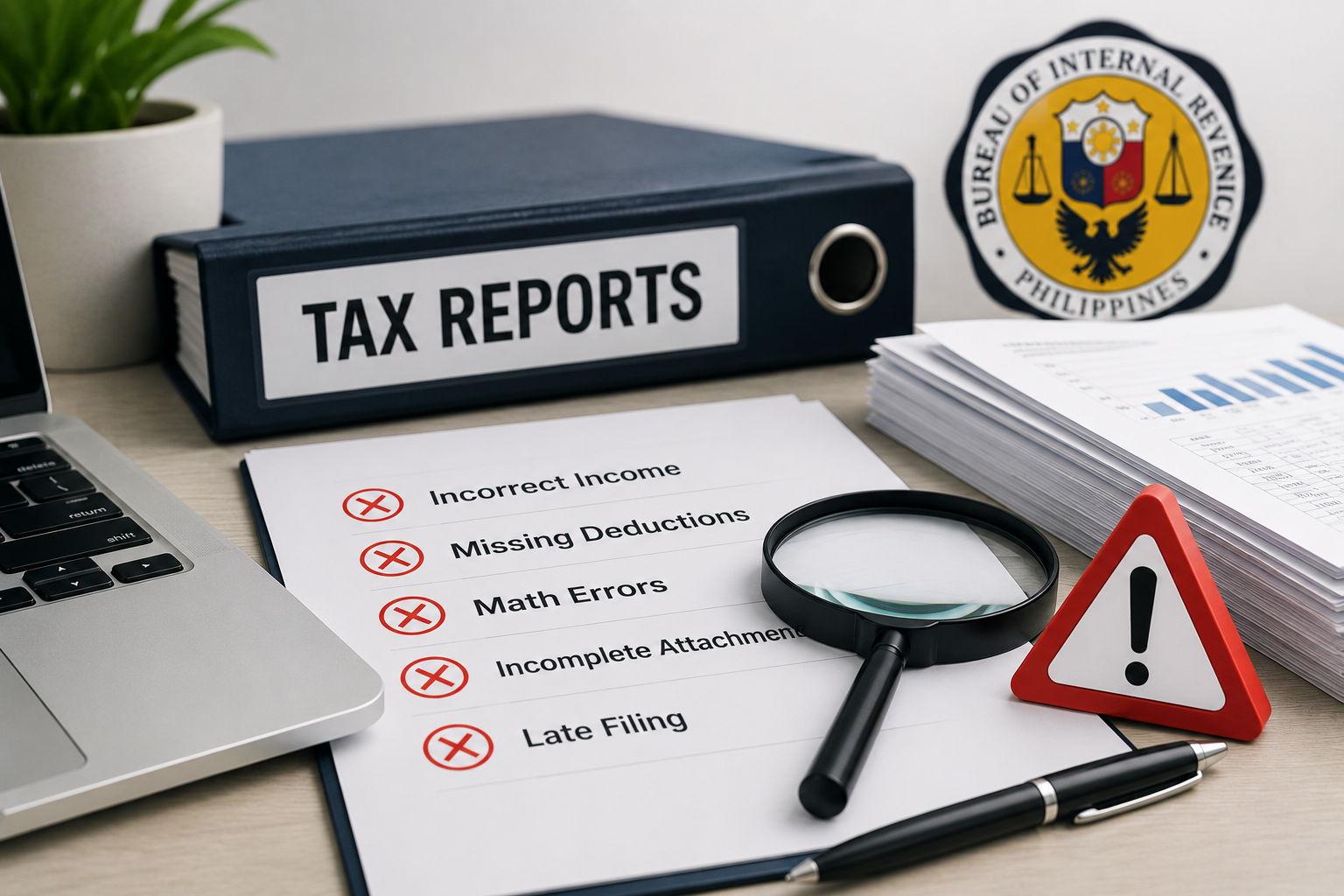
Every year, thousands of Philippine businesses file their annual tax returns believing they have fully complied with Bureau of Internal Revenue (BIR) requirements. Unfortunately, many taxpayers unknowingly commit filing errors that can attract unwanted attention during a tax audit. In many cases, these issues are not caused by tax evasion but by incomplete documentation, incorrect tax forms, inconsistent financial records, or missed filing deadlines.
The BIR uses risk-based audit procedures and data matching to compare tax returns, financial statements, withholding tax reports, VAT declarations, and other regulatory filings. Even minor discrepancies may prompt requests for clarification or further examination.
This article discusses the most common annual tax reporting mistakes that can trigger BIR audits and provides practical guidance on how businesses can strengthen their tax compliance.
Why Accurate Annual Tax Reporting Matters
Annual tax reporting is more than simply submitting tax returns before the deadline.
Businesses are expected to ensure that:
- tax returns are accurate;
- supporting documents are complete;
- financial statements reconcile with tax returns;
- tax credits are properly supported;
- all required attachments are submitted.
Proper compliance reduces the likelihood of BIR assessments, penalties, and prolonged tax examinations.
How the BIR Identifies Potential Audit Issues
The BIR does not evaluate tax returns in isolation.
It compares information from multiple sources, including:
- Annual Income Tax Returns
- Quarterly Income Tax Returns
- VAT Returns
- Percentage Tax Returns
- Withholding Tax Returns
- Annual Information Returns
- Audited Financial Statements
- Books of Accounts
- Alphalists
- Inventory Lists
- Third-party information reports
When inconsistencies appear among these documents, the taxpayer may be selected for further review.
Mistake #1: Filing the Wrong Tax Return
One of the most common errors is using the incorrect BIR form.
Examples include:
- An individual filing BIR Form 1701A despite not meeting the eligibility requirements;
- A mixed-income earner filing the wrong annual income tax return;
- A corporation using an incorrect version of BIR Form 1702;
- Employers filing the wrong annual withholding information return.
Using the wrong return may result in rejected filings, amended returns, or compliance issues during an audit.
Tip: Always determine the correct return based on your taxpayer classification, income sources, and applicable tax rules before filing.
Mistake #2: Missing Required Attachments
Many annual tax returns require supporting documents.
Common examples include:
- Audited Financial Statements
- Certificates of Creditable Tax Withheld (BIR Form 2307)
- Financial Statement Notes
- Schedules supporting tax credits
- Inventory schedules
- Other documents required under BIR regulations
Failure to submit required attachments may delay processing or create questions during a tax examination.
Maintain a checklist of documentary requirements before filing.
Mistake #3: Inconsistent Financial Statements and Tax Returns
One of the most common audit triggers is inconsistency between:
- Financial Statements;
- Annual Income Tax Returns;
- Quarterly Tax Returns;
- VAT Returns; and
- Books of Accounts.
For example:
- Sales reported in VAT returns differ from sales reported in the Annual Income Tax Return.
- Revenue in the financial statements does not reconcile with taxable income.
- Inventory balances do not agree with the Statement of Financial Position.
Businesses should perform detailed reconciliations before submitting annual reports.
Mistake #4: Incorrect Tax Credit Claims
Taxpayers sometimes claim tax credits without sufficient documentation.
Examples include:
- Creditable Withholding Tax (BIR Form 2307)
- Minimum Corporate Income Tax (MCIT)
- Net Operating Loss Carry-Over (NOLCO)
- Foreign Tax Credits
- Excess Input VAT
Unsupported tax credits may be disallowed during a BIR audit, increasing the taxpayer’s tax liability.
Ensure that all tax credit claims are supported by complete records and comply with applicable laws.
Mistake #5: Failure to Reconcile Withholding Tax Reports
The BIR compares annual information returns with monthly and quarterly withholding tax filings.
Examples include:
- BIR Form 1604-C
- BIR Form 1604-E
- BIR Form 1604-F
These should reconcile with:
- Payroll records
- BIR Forms 2307
- BIR Forms 2316
- Accounting records
Differences often result in requests for clarification.
Mistake #6: Late Filing
Late filing remains one of the easiest—and most avoidable—ways to incur penalties.
Missing statutory deadlines may result in:
- surcharge;
- interest;
- compromise penalties;
- administrative sanctions.
Late filing also increases the likelihood of compliance reviews.
Businesses should maintain a compliance calendar covering all annual reporting obligations.
Mistake #7: Inaccurate Payroll Reporting
Payroll-related discrepancies frequently lead to tax issues.
Common examples include:
- Incorrect employee TINs
- Differences between payroll records and BIR Form 2316
- Incorrect withholding tax computations
- Errors in the Annual Alphalist of Employees
Payroll records should always reconcile with annual withholding tax reports.
Mistake #8: Poor Books of Accounts
Books of Accounts should accurately reflect business transactions.
Common bookkeeping issues include:
- delayed recording of transactions;
- incomplete journal entries;
- unreconciled ledgers;
- missing supporting documents;
- use of unregistered books.
Poor bookkeeping makes it difficult to defend reported figures during an audit.
Mistake #9: Failure to Register or Update Business Records
Some businesses forget to update their BIR registration after significant operational changes.
Examples include:
- Change of business address
- Change of accounting method
- Adoption of a computerized accounting system
- Additional business activities
Outdated registration information may create inconsistencies in tax filings and regulatory records.
Mistake #10: Incomplete Inventory Records
For businesses maintaining inventories, inventory reporting is an important audit area.
Common errors include:
- No physical inventory count
- Incomplete inventory schedules
- Inventory balances that do not reconcile with financial statements
- Unsupported inventory adjustments
Because inventory directly affects the computation of Cost of Goods Sold and taxable income, inaccurate records often receive close scrutiny during BIR examinations.
Mistake #11: Unsupported Deductions
Claiming business expenses without sufficient documentation remains one of the leading causes of deficiency tax assessments.
Businesses should retain:
- Sales invoices
- Official receipts, where applicable
- Purchase invoices
- Contracts
- Payroll records
- Proof of payment
- Bank records
Deductions should also satisfy the deductibility requirements under the Tax Code.
Mistake #12: Ignoring BIR Issuances
Philippine tax rules continue to evolve through:
- Revenue Regulations (RRs)
- Revenue Memorandum Circulars (RMCs)
- Revenue Memorandum Orders (RMOs)
- Revenue Audit Memorandum Orders (RAMOs)
Using outdated procedures or obsolete forms may create compliance problems.
Businesses should regularly review new BIR issuances.
Practical Tips to Reduce Audit Risk
Businesses can strengthen compliance by adopting the following practices:
Maintain Accurate Books of Accounts
Update accounting records regularly and ensure that transactions are properly documented.
Perform Monthly Reconciliations
Reconcile:
- Bank accounts
- Sales
- Purchases
- VAT
- Withholding taxes
- Payroll
- General ledger balances
Monthly reviews help identify discrepancies before year-end.
Prepare a Year-End Compliance Checklist
Review all annual reporting requirements, including:
- Annual Income Tax Return
- Financial Statements
- Annual Information Returns
- Inventory List
- Alphalists
- Tax credit schedules
A checklist helps ensure that nothing is overlooked.
Verify Supporting Documents
Before filing, confirm that all required attachments are complete, accurate, and consistent with the tax returns.
Stay Current with Regulatory Changes
Monitor official BIR issuances to ensure that your filing procedures and documentary requirements remain up to date.
Work with Qualified Tax Professionals
Engaging a Certified Public Accountant (CPA) or tax lawyer can help identify potential issues before they become audit findings.
Professional review is particularly valuable for businesses with complex transactions or significant tax exposures.
Annual Tax Reporting Checklist
Before filing your annual reports, confirm that:
- The correct BIR forms have been used.
- Financial Statements reconcile with tax returns.
- Quarterly and annual returns are consistent.
- Required attachments are complete.
- Tax credits are properly supported.
- Payroll records reconcile with withholding tax reports.
- Inventory records agree with accounting records.
- Books of Accounts are updated and properly registered.
- Filing deadlines have been observed.
- All supporting documents are organized and readily available.
A thorough final review can significantly reduce compliance risks.
Final Thoughts
Most BIR audits begin not because a taxpayer intentionally violated the law, but because inconsistencies, omissions, or filing errors raise questions that require further verification. By understanding the common mistakes discussed in this guide, businesses can improve the accuracy of their annual tax reporting and reduce the likelihood of unnecessary audit issues.
Tax compliance should be viewed as a year-round process rather than a last-minute obligation. Accurate bookkeeping, timely reconciliations, complete documentation, and proper coordination among accounting, payroll, and tax professionals create a strong foundation for compliance.
Ultimately, investing in preventive tax compliance is far less costly than resolving tax assessments, penalties, and audit disputes after they arise.
Disclaimer
This article is intended for general informational purposes only and should not be construed as legal, accounting, or tax advice. Tax reporting obligations, documentary requirements, filing procedures, and audit rules are governed by the National Internal Revenue Code, applicable BIR regulations, revenue issuances, and administrative guidelines, which may be amended from time to time. Businesses should consult a qualified Certified Public Accountant (CPA) or tax lawyer and review the latest official BIR issuances to determine the reporting requirements applicable to their specific circumstances and ensure full compliance with Philippine tax laws.
Leave a Reply