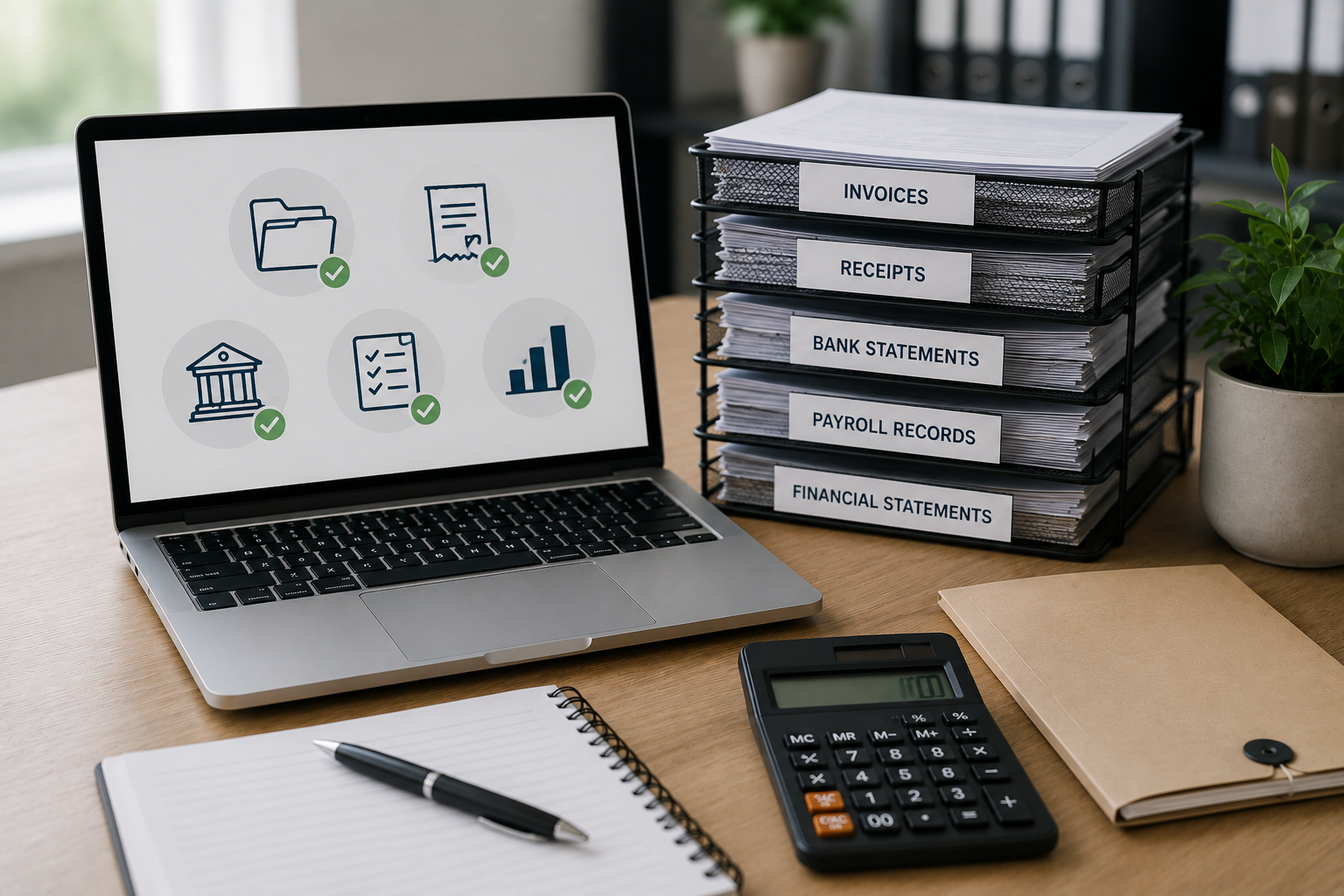
A Complete Checklist of Schedules, Certificates, and Financial Records
Preparing your Annual Income Tax Return (AITR) involves much more than completing the appropriate Bureau of Internal Revenue (BIR) tax form. One of the most overlooked aspects of annual tax compliance is organizing the supporting documents that substantiate the figures reported in your tax return. Even if your income tax has been computed correctly, incomplete or inconsistent documentation may result in delays, disallowed deductions, denied tax credits, or additional questions during a BIR tax audit.
Every business—whether a sole proprietorship, partnership, corporation, freelancer, or professional practice—should maintain complete financial records throughout the year. Proper documentation not only supports tax compliance but also improves bookkeeping, financial reporting, and internal controls.
This guide provides a comprehensive checklist of the supporting documents businesses should prepare before filing their Annual Income Tax Return and explains why each document is important.
Important Note: Documentary requirements vary depending on the taxpayer’s legal structure, tax registration, accounting system, business activities, and applicable BIR regulations. Businesses should always consult the latest BIR issuances and seek professional advice where necessary.
Why Supporting Documents Matter
Supporting documents serve as evidence that the information reported in your tax return is accurate and properly substantiated.
Proper documentation helps businesses:
- Support income and expense claims
- Substantiate tax deductions
- Validate tax credit claims
- Demonstrate compliance during BIR audits
- Improve the accuracy of Financial Statements
- Reduce the risk of deficiency tax assessments
Incomplete documentation is one of the most common reasons expenses and tax credits are questioned during tax examinations.
Documents Related to Business Registration
Before filing your annual tax return, verify that your registration records are complete and updated.
These may include:
- Certificate of Registration
- Taxpayer Identification Number (TIN)
- Business registration certificates
- Registered business address information
- Registration updates, if applicable
- Books of Accounts registration records
- ORUS registration confirmations, where applicable
These documents confirm the taxpayer’s registration status and applicable tax obligations.
Books of Accounts
Your Books of Accounts are among the most important documents supporting your tax return.
Depending on your accounting system, these may include:
- General Journal
- General Ledger
- Cash Receipts Book
- Cash Disbursements Book
- Sales Journal
- Purchase Journal
- Other subsidiary books, where applicable
Books of Accounts should be updated before preparing annual reports.
Financial Statements
Financial Statements summarize your business’s financial performance and financial position.
These generally include:
- Statement of Financial Position
- Statement of Comprehensive Income
- Statement of Changes in Equity
- Statement of Cash Flows
- Notes to the Financial Statements
Where required by law, Financial Statements should also be audited by an independent Certified Public Accountant (CPA).
Financial Statements should reconcile with the Annual Income Tax Return before filing.
Trial Balance and General Ledger
The Trial Balance serves as the foundation for preparing Financial Statements.
Review:
- Account balances
- Adjusting entries
- Closing entries
- Year-end journal entries
The General Ledger should support every balance appearing in the Financial Statements.
Sales Records
Businesses should organize complete sales documentation.
Examples include:
- Sales invoices
- Official receipts, where applicable
- Sales journals
- Sales summaries
- Customer invoices
- Credit memos
- Debit memos
Sales records should reconcile with:
- VAT Returns
- Accounting records
- Financial Statements
- Annual Income Tax Return
Purchase and Expense Records
Business expenses should always be properly documented.
Maintain copies of:
- Purchase invoices
- Official receipts, where applicable
- Supplier invoices
- Contracts
- Service agreements
- Utility bills
- Rental agreements
- Insurance records
- Professional fee invoices
- Proof of payment
Only properly substantiated expenses are generally eligible for deduction, subject to applicable tax laws.
Bank Records
Businesses should maintain complete banking documentation.
This includes:
- Bank statements
- Bank reconciliation reports
- Deposit slips
- Cancelled checks
- Electronic fund transfer confirmations
Bank records help verify recorded cash transactions and support financial statement balances.
Payroll Records
Businesses with employees should organize payroll documentation before year-end.
Prepare:
- Payroll registers
- Employee master records
- Compensation schedules
- Government contribution reports
- Payroll summaries
- Payroll journal entries
Payroll records should reconcile with annual withholding tax reports.
Withholding Tax Certificates
Tax certificates are essential for supporting tax credit claims.
These commonly include:
BIR Form 2307
Certificate of Creditable Tax Withheld at Source.
Used to support claims for Creditable Withholding Tax.
BIR Form 2306
Certificate of Final Tax Withheld at Source.
Serves as proof that Final Withholding Tax has already been withheld and remitted.
BIR Form 2316
Certificate of Compensation Payment and Tax Withheld.
Issued to employees and used for annual compensation tax reporting.
These certificates should be complete, accurate, and properly reconciled with accounting records.
Annual Information Returns
Businesses acting as withholding agents should retain copies of annual information returns.
Examples include:
- BIR Form 1604-C
- BIR Form 1604-E
- BIR Form 1604-F
These returns should reconcile with payroll records, withholding tax returns, and tax certificates.
Inventory Records
Businesses maintaining inventories should prepare:
- Physical inventory count sheets
- Inventory subsidiary ledger
- Inventory valuation schedules
- Warehouse reports
- Stock cards
- Inventory adjustment reports
- Annual Inventory List, where applicable
Inventory records should agree with the Financial Statements and Cost of Goods Sold.
Fixed Asset Records
Maintain documentation supporting business assets.
Examples include:
- Fixed asset register
- Purchase invoices
- Asset acquisition documents
- Depreciation schedules
- Asset disposal records
These records support depreciation expense and year-end asset balances.
Tax Credit Schedules
Before filing your Annual Income Tax Return, organize documentation supporting tax credits.
Examples include:
- Creditable Withholding Tax schedules
- Minimum Corporate Income Tax (MCIT) schedules
- Net Operating Loss Carry-Over (NOLCO) schedules
- Excess Input VAT schedules
- Foreign Tax Credit documentation, where applicable
- Deferred Tax Asset schedules
Each tax credit should be supported by adequate documentation.
Contracts and Legal Documents
Certain transactions require supporting legal documentation.
Maintain copies of:
- Lease agreements
- Loan agreements
- Service contracts
- Purchase agreements
- Franchise agreements
- Licensing agreements
Contracts often support deductible business expenses and significant accounting transactions.
SEC Documents (For Corporations)
Corporations should organize:
- General Information Sheet (GIS)
- Articles of Incorporation
- By-Laws
- Board Resolutions
- Annual Financial Statements submitted to the SEC
- Shareholder records
These documents may be relevant during regulatory reviews.
Common Documentation Mistakes
Many businesses experience tax issues because of incomplete documentation.
Missing Tax Certificates
Failure to obtain BIR Forms 2307 may result in disallowed tax credit claims.
Request tax certificates promptly from withholding agents.
Unorganized Filing System
Searching for invoices during filing season wastes valuable time.
Maintain both physical and electronic filing systems throughout the year.
Incomplete Expense Documentation
Expenses without supporting invoices or proof of payment may not qualify as allowable deductions.
Review documentation before claiming deductions.
Failure to Reconcile Records
Supporting documents should agree with:
- Books of Accounts
- Financial Statements
- Tax Returns
- Payroll records
- Inventory records
Inconsistencies may attract BIR attention.
Waiting Until Filing Season
Businesses often begin organizing documents only when deadlines are approaching.
Instead, maintain documentation continuously throughout the year.
Best Practices for Document Management
Businesses can strengthen tax compliance by following these practices.
Create a Year-Round Filing System
Organize documents by category:
- Sales
- Purchases
- Payroll
- Bank records
- Tax returns
- Financial Statements
- Contracts
- Inventory
This simplifies year-end preparation.
Use Digital Recordkeeping
Maintain secure electronic copies of important records in addition to physical files.
Digital backups reduce the risk of document loss.
Perform Monthly Reviews
Review accounting records and supporting documents every month rather than waiting until year-end.
Reconcile Before Filing
Before filing your Annual Income Tax Return, ensure that supporting documents reconcile with:
- Financial Statements
- Books of Accounts
- Tax Returns
- Payroll records
- Inventory records
Consult a CPA Before Submission
A professional review helps identify missing documents, unsupported deductions, and inconsistencies before filing.
Annual Tax Filing Document Checklist
Before filing your Annual Income Tax Return, confirm that you have prepared:
Business Registration
✔ Certificate of Registration
✔ TIN information
✔ Books of Accounts registration
✔ ORUS confirmations, where applicable
Accounting Records
✔ Books of Accounts
✔ General Ledger
✔ Trial Balance
✔ Journal Entries
Financial Statements
✔ Statement of Financial Position
✔ Statement of Comprehensive Income
✔ Statement of Changes in Equity
✔ Statement of Cash Flows
✔ Notes to Financial Statements
Sales and Expenses
✔ Sales invoices
✔ Official receipts, where applicable
✔ Purchase invoices
✔ Supplier records
✔ Proof of payment
Payroll
✔ Payroll registers
✔ Employee records
✔ BIR Form 2316
✔ Payroll summaries
Tax Certificates
✔ BIR Form 2307
✔ BIR Form 2306
✔ Annual information returns
Inventory
✔ Physical inventory reports
✔ Inventory schedules
✔ Annual Inventory List, where applicable
Tax Credits
✔ MCIT schedules
✔ NOLCO schedules
✔ Input VAT schedules
✔ Other tax credit documentation
Supporting Documents
✔ Contracts
✔ Bank statements
✔ Fixed asset schedules
✔ SEC documents, where applicable
✔ Prior-year tax returns
Final Thoughts
Preparing the correct supporting documents is just as important as preparing the Annual Income Tax Return itself. Accurate and complete documentation allows businesses to substantiate reported income, support deductible expenses, validate tax credit claims, and demonstrate compliance during a BIR examination.
Rather than gathering documents only during filing season, businesses should establish a year-round document management system that includes organized recordkeeping, regular reconciliations, and periodic internal reviews. This proactive approach not only simplifies annual tax filing but also strengthens financial reporting, improves operational efficiency, and minimizes regulatory risks.
By working closely with qualified accounting and tax professionals and maintaining complete supporting records, businesses can approach annual tax filing with confidence and ensure continued compliance with Philippine tax laws.
Leave a Reply